How to Identify Bolt Thread Pitch: A Complete Guide
Learn the essential techniques for accurately measuring and identifying bolt thread pitch using simple tools.
<h1>How to Identify Bolt Thread Pitch: A Complete Guide</h1>
<p>Thread pitch is one of the most critical measurements when working with bolts and fasteners. Getting it wrong can lead to stripped threads, loose connections, or complete project failure. This comprehensive guide will teach you everything you need to know about identifying bolt thread pitch.</p>
<h2>What is Thread Pitch?</h2>
<p>Thread pitch refers to the distance between adjacent threads on a bolt or screw. It's measured differently depending on whether you're working with metric or imperial (standard) fasteners:</p>
<ul>
<li><strong>Metric</strong>: Measured in millimeters between thread peaks</li>
<li><strong>Imperial</strong>: Measured as threads per inch (TPI)</li>
</ul>
<h2>Tools You'll Need</h2>
<h3>Essential Tools</h3>
<ul>
<li><strong>Thread pitch gauge</strong>: The most accurate tool for identification</li>
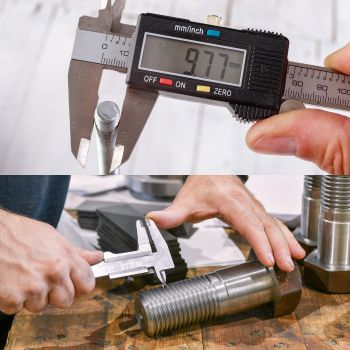
<li><strong>Ruler or caliper</strong>: For measuring thread spacing</li>
<li><strong>Magnifying glass</strong>: For examining fine threads</li>
<li><strong>Good lighting</strong>: Essential for accurate measurement</li>
</ul>
<h3>Professional Tools</h3>
<ul>
<li><strong>Digital calipers</strong>: For precise measurements</li>
<li><strong>Thread ring gauges</strong>: For verification</li>
<li><strong>Optical comparator</strong>: For extremely precise work</li>
</ul>
<h2>Step-by-Step Identification Process</h2>
<h3>Method 1: Using a Thread Pitch Gauge</h3>
<ol>
<li><strong>Clean the bolt</strong>: Remove any dirt, rust, or debris from the threads</li>
<li><strong>Select the gauge</strong>: Start with the most common pitches for your bolt size</li>
<li><strong>Test the fit</strong>: The gauge should fit snugly without forcing</li>
<li><strong>Verify</strong>: Check multiple threads to ensure consistency</li>
<li><strong>Record the measurement</strong>: Note both the size and pitch</li>
</ol>
<h3>Method 2: Manual Measurement</h3>
<ol>
<li><strong>Count the threads</strong>: Count threads over a 1-inch span (imperial) or 10mm span (metric)</li>
<li><strong>Calculate</strong>: For imperial, this gives you TPI directly. For metric, divide 10 by the number of threads</li>
<li><strong>Double-check</strong>: Repeat the measurement at different locations</li>
</ol>
<h2>Common Thread Pitches by Size</h2>
<h3>Metric Standard Pitches</h3>
<ul>
<li>M6: 1.0mm (standard), 0.75mm (fine)</li>
<li>M8: 1.25mm (standard), 1.0mm (fine)</li>
<li>M10: 1.5mm (standard), 1.25mm (fine)</li>
<li>M12: 1.75mm (standard), 1.25mm (fine)</li>
<li>M14: 2.0mm (standard), 1.5mm (fine)</li>
<li>M16: 2.0mm (standard), 1.5mm (fine)</li>
</ul>
<h3>Imperial Standard Pitches</h3>
<ul>
<li>1/4": 20 TPI (standard), 28 TPI (fine)</li>
<li>5/16": 18 TPI (standard), 24 TPI (fine)</li>
<li>3/8": 16 TPI (standard), 24 TPI (fine)</li>
<li>7/16": 14 TPI (standard), 20 TPI (fine)</li>
<li>1/2": 13 TPI (standard), 20 TPI (fine)</li>
</ul>
<h2>Troubleshooting Common Issues</h2>
<h3>Damaged Threads</h3>
<ul>
<li>Use a thread file to clean up minor damage</li>
<li>Consider using a thread chaser for restoration</li>
<li>Replace severely damaged fasteners</li>
</ul>
<h3>Unclear Measurements</h3>
<ul>
<li>Ensure proper lighting and magnification</li>
<li>Clean threads thoroughly before measuring</li>
<li>Use multiple measurement methods for verification</li>
</ul>
<h2>Pro Tips for Accurate Identification</h2>
<ol>
<li><strong>Start with common sizes</strong>: Most applications use standard pitches</li>
<li><strong>Check manufacturer specs</strong>: Consult vehicle or equipment manuals when available</li>
<li><strong>Keep a reference chart</strong>: Maintain a quick-reference guide for common applications</li>
<li><strong>Practice regularly</strong>: Familiarity improves speed and accuracy</li>
<li><strong>Invest in quality tools</strong>: Good thread gauges are worth the investment</li>
</ol>
<h2>When to Use Fine vs. Coarse Threads</h2>
<h3>Coarse Threads (Standard)</h3>
<ul>
<li><strong>Advantages</strong>: Faster assembly, better for soft materials, more resistant to damage</li>
<li><strong>Applications</strong>: General construction, automotive body panels, wood applications</li>
</ul>
<h3>Fine Threads</h3>
<ul>
<li><strong>Advantages</strong>: Higher strength, better for thin materials, more precise adjustment</li>
<li><strong>Applications</strong>: Engine components, precision machinery, <a href="/vehicles/ford/f-150/2022/">2022 Ford F-150</a> applications</li>
</ul>
<h2>Safety Considerations</h2>
<ul>
<li>Always wear safety glasses when working with fasteners</li>
<li>Use proper lighting to avoid eye strain</li>
<li>Keep fingers clear of sharp thread edges</li>
<li>Store thread gauges properly to maintain accuracy</li>
</ul>
<h2>Conclusion</h2>
<p>Accurate thread pitch identification is a fundamental skill for anyone working with fasteners. With the right tools and techniques, you can quickly and accurately identify thread pitch, ensuring proper fit and optimal performance in your projects.</p>
<p>Remember: when in doubt, it's always better to double-check your measurements than to risk damaging threads or compromising safety.</p>