Metric vs Standard Bolts: Key Differences Explained
Learn the differences between metric and SAE (standard) bolts — thread pitch, head sizes, identification tips, and which system your vehicle uses.
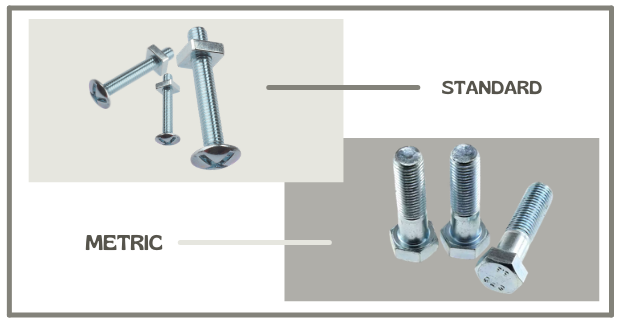
<p>Metric and standard (SAE) bolts look almost identical on the shelf, but they are <strong>not interchangeable</strong>. They use different units, different thread systems, and different head sizes — and forcing one into the other strips threads in seconds. Knowing which system you're dealing with saves you a ruined hole, a rounded bolt head, and a trip back to the parts counter. This guide covers the differences, how to identify each system in the driveway, and which one your vehicle almost certainly uses.</p>
<h2 class="text-2xl font-bold text-slate-900 mb-2">What Is the Difference Between Metric and Standard?</h2>
<p>Standard (SAE) bolts are measured in <strong>fractions of an inch</strong> — for example 3/8"-16, meaning a 3/8-inch diameter with 16 threads per inch. Metric bolts are measured in <strong>millimeters</strong> — for example M10x1.5, meaning a 10 mm diameter with 1.5 mm between threads. The thread system is the key divider: SAE counts <strong>threads per inch (TPI)</strong>, while metric measures the <strong>pitch</strong>, the actual distance from one thread to the next. Because the threads are cut differently, a metric bolt and an SAE nut will cross-thread and gall almost immediately.</p>
<div class="overflow-x-auto rounded-xl border border-slate-200 mb-6">
<table class="w-full text-sm">
<thead><tr style="background-color:#01696F;color:#fff"><th class="text-left px-4 py-3 font-semibold">Feature</th><th class="text-left px-4 py-3 font-semibold">Metric</th><th class="text-left px-4 py-3 font-semibold">Standard (SAE)</th></tr></thead>
<tbody>
<tr class="bg-white"><td class="px-4 py-3 font-semibold text-slate-800">Diameter label</td><td class="px-4 py-3 text-slate-700">M + millimeters (M8, M12)</td><td class="px-4 py-3 text-slate-700">Fraction of an inch (5/16", 1/2")</td></tr>
<tr class="bg-slate-50"><td class="px-4 py-3 font-semibold text-slate-800">Thread spec</td><td class="px-4 py-3 text-slate-700">Pitch in mm (1.25, 1.5)</td><td class="px-4 py-3 text-slate-700">Threads per inch (16, 18 TPI)</td></tr>
<tr class="bg-white"><td class="px-4 py-3 font-semibold text-slate-800">Wrench / head size</td><td class="px-4 py-3 text-slate-700">Millimeters (10, 13, 17 mm)</td><td class="px-4 py-3 text-slate-700">Fractions (3/8", 9/16")</td></tr>
<tr class="bg-slate-50"><td class="px-4 py-3 font-semibold text-slate-800">Grade marking</td><td class="px-4 py-3 text-slate-700">Stamped numbers (8.8, 10.9)</td><td class="px-4 py-3 text-slate-700">Radial lines (3 lines = Grade 5)</td></tr>
<tr class="bg-white"><td class="px-4 py-3 font-semibold text-slate-800">Typical origin</td><td class="px-4 py-3 text-slate-700">Imports & modern vehicles</td><td class="px-4 py-3 text-slate-700">Older US cars, farm & shop hardware</td></tr>
</tbody>
</table>
</div>
<h2 class="text-2xl font-bold text-slate-900 mb-2">How to Identify Which System You Have</h2>
<p>The fastest checks need no special tools. Look at the <strong>head marking</strong> first: radial lines mean SAE, a stamped decimal number (like 8.8) means metric. Next, try a wrench — if a <strong>1/2" wrench fits perfectly</strong>, it's likely SAE; if that same wrench feels slightly loose, a <strong>13 mm</strong> will usually seat correctly, telling you it's metric. For threads, a pitch gauge or a caliper removes all doubt: measure the diameter, then count threads over a known length.</p>
<div class="flex gap-3 bg-blue-50 border border-blue-200 rounded-xl p-4 text-sm mb-6">
<svg xmlns="http://www.w3.org/2000/svg" viewBox="0 0 24 24" fill="none" stroke="currentColor" stroke-width="2" stroke-linecap="round" stroke-linejoin="round" class="h-5 w-5 text-blue-600 shrink-0 mt-0.5"><circle cx="12" cy="12" r="10"></circle><path d="M12 16v-4"></path><path d="M12 8h.01"></path></svg>
<div><span class="font-bold text-blue-800">Close is not the same.</span><span class="text-blue-700"> Many sizes nearly overlap — 13 mm ≈ 1/2", 19 mm ≈ 3/4", 10 mm ≈ 13/32". The slightly-wrong tool rounds the head or strips the thread. When a socket goes on with any wobble, switch systems before you apply force.</span></div>
</div>
<div class="rounded-lg border my-6 bg-secondary/20 border-border/50 overflow-hidden shadow-sm">
<div class="p-5 sm:p-6">
<div class="flex items-start gap-3 mb-3">
<svg xmlns="http://www.w3.org/2000/svg" viewBox="0 0 24 24" fill="none" stroke="currentColor" stroke-width="2" stroke-linecap="round" stroke-linejoin="round" class="h-5 w-5 flex-shrink-0 mt-0.5" style="color:#01696F"><path d="M14.7 6.3a1 1 0 0 0 0 1.4l1.6 1.6a1 1 0 0 0 1.4 0l3.77-3.77a6 6 0 0 1-7.94 7.94l-6.91 6.91a2.12 2.12 0 0 1-3-3l6.91-6.91a6 6 0 0 1 7.94-7.94l-3.76 3.76z"></path></svg>
<div class="flex-1">
<div class="text-xs font-semibold uppercase tracking-wide text-slate-500 mb-1">Recommended Tool <span class="ml-1.5 normal-case font-normal">· metric + SAE</span></div>
<h3 class="font-bold text-base sm:text-lg leading-snug text-slate-900">Combination Thread Pitch Gauge (Metric & SAE)</h3>
</div>
</div>
<p class="text-sm text-slate-600 mb-4 pl-8">A dual metric/SAE pitch gauge ends the guesswork in seconds — lay the leaves against the threads until one matches, and you instantly know the system and pitch before you buy a replacement.</p>
<div class="pl-8">
<a href="https://www.amazon.com/s?k=thread+pitch+gauge+metric+and+sae&tag=whatsizebol0a-20" target="_blank" rel="nofollow sponsored noopener" class="inline-flex items-center justify-center rounded-md text-sm font-medium h-10 px-4 py-2" style="background-color:#01696F;color:#fff">Shop on Amazon</a>
<p class="text-xs text-slate-400 mt-2">As an Amazon Associate, WhatSizeBolt earns from qualifying purchases.</p>
</div>
</div>
</div>
<h2 class="text-2xl font-bold text-slate-900 mb-2">Which System Does My Vehicle Use?</h2>
<p class="text-slate-600 text-sm mb-4">Almost every car built in the last few decades is metric — but it pays to confirm.</p>
<div class="overflow-x-auto rounded-xl border border-slate-200 mb-6">
<table class="w-full text-sm">
<thead><tr style="background-color:#01696F;color:#fff"><th class="text-left px-4 py-3 font-semibold">Vehicle Type / Origin</th><th class="text-left px-4 py-3 font-semibold">Primary System</th></tr></thead>
<tbody>
<tr class="bg-white"><td class="px-4 py-3 text-slate-700">Japanese (e.g. <a href="/vehicles/toyota/corolla/2020/" class="font-medium hover:underline" style="color:#01696F">2020 Toyota Corolla</a>)</td><td class="px-4 py-3 font-semibold" style="color:#01696F">Metric</td></tr>
<tr class="bg-slate-50"><td class="px-4 py-3 text-slate-700">European (VW, BMW, Mercedes)</td><td class="px-4 py-3 font-semibold" style="color:#01696F">Metric</td></tr>
<tr class="bg-white"><td class="px-4 py-3 text-slate-700">Korean (Hyundai, Kia)</td><td class="px-4 py-3 font-semibold" style="color:#01696F">Metric</td></tr>
<tr class="bg-slate-50"><td class="px-4 py-3 text-slate-700">Modern US, ~1990s+ (e.g. <a href="/vehicles/ford/f-150/2022/" class="font-medium hover:underline" style="color:#01696F">2022 Ford F-150</a>)</td><td class="px-4 py-3 font-semibold" style="color:#01696F">Metric (mostly)</td></tr>
<tr class="bg-white"><td class="px-4 py-3 text-slate-700">Classic US (pre-1980s)</td><td class="px-4 py-3 font-semibold text-slate-800">Standard (SAE)</td></tr>
<tr class="bg-slate-50"><td class="px-4 py-3 text-slate-700">Older farm & shop equipment</td><td class="px-4 py-3 font-semibold text-slate-800">Standard (SAE)</td></tr>
</tbody>
</table>
</div>
<p>Even on a "metric" vehicle you'll occasionally find an SAE fastener in accessories or aftermarket parts, so check each bolt rather than assuming. To see the exact OEM size, pitch, and torque for your year and model, use our free <a href="/vehicles" class="font-medium hover:underline" style="color:#01696F">Vehicle Fastener Specs</a> tool.</p>
<h2 class="text-2xl font-bold text-slate-900 mb-2">Can You Mix Metric and Standard?</h2>
<div class="flex gap-3 bg-amber-50 border border-amber-200 rounded-xl p-4 text-sm mb-6">
<svg xmlns="http://www.w3.org/2000/svg" viewBox="0 0 24 24" fill="none" stroke="currentColor" stroke-width="2" stroke-linecap="round" stroke-linejoin="round" class="h-5 w-5 text-amber-600 shrink-0 mt-0.5"><path d="m21.73 18-8-14a2 2 0 0 0-3.48 0l-8 14A2 2 0 0 0 4 21h16a2 2 0 0 0 1.73-3Z"></path><path d="M12 9v4"></path><path d="M12 17h.01"></path></svg>
<div><span class="font-bold text-amber-800">No — they are not compatible.</span><span class="text-amber-700"> A metric bolt threaded into an SAE nut (or vice versa) will start by hand for a turn or two, then bind and shear the threads. If a fastener resists after a couple of clean turns, stop and confirm the system — never wrench through the resistance.</span></div>
</div>
<p>The diameters and pitches are simply too different to share a thread. The only safe approach is to replace a fastener with the same system, diameter, pitch, and grade as the original.</p>
<h2 class="text-2xl font-bold text-slate-900 mb-2">Frequently Asked Questions</h2>
<div class="space-y-5 mb-6">
<div><h3 class="font-bold text-slate-800 mb-1">Is M12 the same as 1/2 inch?</h3><p class="text-slate-600 text-sm">No. M12 is 12 mm in diameter (about 0.472"), close to but not the same as 1/2" (0.500"). The threads are cut differently too, so they will not interchange.</p></div>
<div><h3 class="font-bold text-slate-800 mb-1">Why does my SAE socket almost fit a metric bolt?</h3><p class="text-slate-600 text-sm">Several sizes are within a fraction of a millimeter (13 mm vs 1/2"). The near-fit lets the socket slip under load and round the corners of the head. Always use the matching system.</p></div>
<div><h3 class="font-bold text-slate-800 mb-1">How do I measure thread pitch without a gauge?</h3><p class="text-slate-600 text-sm">Lay a ruler along the threads and count how many threads span 1 inch (SAE/TPI) or measure the distance across several threads in millimeters and divide (metric pitch). A pitch gauge is faster and far more reliable.</p></div>
<div><h3 class="font-bold text-slate-800 mb-1">Do I need two full sets of tools?</h3><p class="text-slate-600 text-sm">For modern vehicles a metric set covers almost everything. Keep a small SAE set on hand for older domestic vehicles, trailers, and shop hardware.</p></div>
</div>
<p>Once you know the system, confirm the exact pitch in our <a href="/thread-pitch" class="font-medium hover:underline" style="color:#01696F">Thread Pitch Guide</a>, check strength ratings in the <a href="/knowledge-hub/bolt-grades" class="font-medium hover:underline" style="color:#01696F">Bolt Grade Guide</a>, or look up your exact sizes on the <a href="/bolt-size-chart" class="font-medium hover:underline" style="color:#01696F">Bolt Size Chart</a>.</p>