Blue vs Red Threadlocker: Complete Guide (Colors, Brands & Codes)
By WhatSizeBoltEdited 6 min read
Threadlocker color codes plus the exact product numbers for Loctite, Permatex, Vibra-Tite and 3M — when to use blue, red, purple or green, how to apply it, and how to remove red.
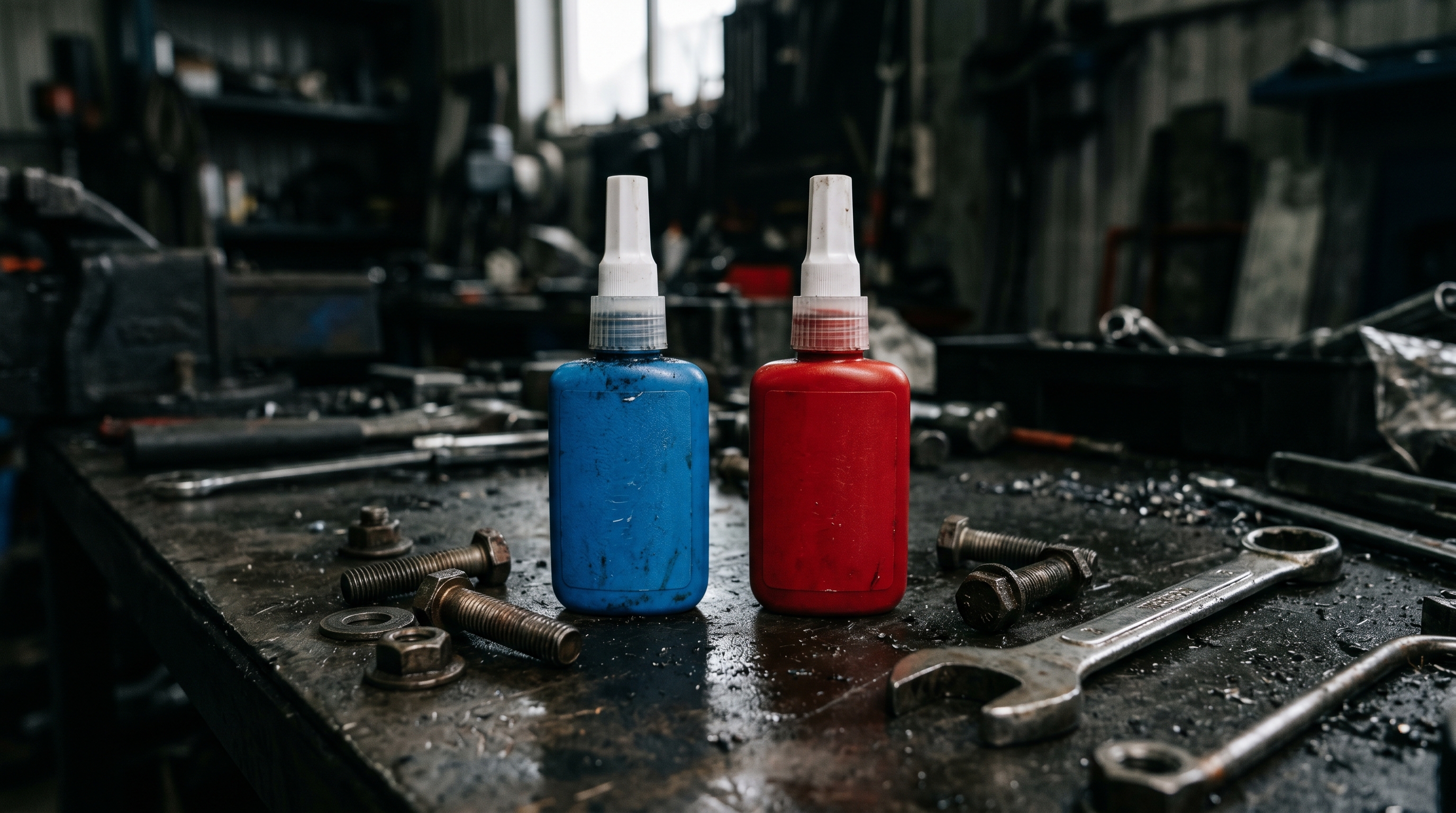
Threadlocker is a single-component anaerobic adhesive: liquid in the bottle, but it cures solid once it’s trapped between metal threads away from air. Cured, it fills the gaps between male and female threads — stopping the fastener vibrating loose and sealing the threads against moisture. Pick the wrong strength and you’ll either strip the bolt removing it, or watch it rattle out on the road.
The threadlocker colour code
Colour is the fast read on strength — but confirm the grade on the label, as brands vary.

| Colour | Strength | Best for | Removal |
|---|---|---|---|
| Purple | Low | Small screws under 1/4": set screws, adjusters, electronics | Hand tools |
| Blue | Medium | Most 1/4–3/4" service fasteners: caliper bolts, valve covers, sensors, brackets | Hand tools |
| Red | High | Near-permanent: studs, frame bolts, axle & suspension hardware | Heat (~500°F / 260°C), then hand tools |
| Green | Wicking | Fasteners that are already assembled — capillary action draws it in | Hand tools or heat (by grade) |
Blue vs red: which one do you actually need?
The decision that trips up most DIYers — and the one that snaps bolts when you get it wrong.
| Question | Blue (medium) | Red (high) |
|---|---|---|
| Will you service this part? | Yes — calipers, valve covers, sensors, brackets | No — studs, frame/subframe bolts, bellhousing |
| Vibration / load | Normal | Severe or structural |
| How you’ll remove it | Hand tools | Heat to ~500°F first, then hand tools |
Green (wicking) — the one most people miss
Thin enough to lock a bolt you already torqued, without tearing the assembly apart.
Wicking grade (Loctite 290, Permatex 29000) is built to be applied after assembly — capillary action draws it down into the engaged threads. It’s perfect for locking a set screw, electrical terminal or pre-set adjustment you found loose, without disturbing the setting.
Loctite codes (the original lineup)
Loctite (Henkel) is the most widely specified brand; the base 3–4 digit number is the grade.
| Grade / colour | Product | Notes & temperature |
|---|---|---|
| Purple — Low | 222 | Small screws under 1/4"; −65 to 300°F |
| Blue — Medium | 242 | The classic removable grade for 1/4–3/4" bolts; to 300°F |
| Blue — Medium | 243 | 242 upgrade — oil-tolerant & primerless; to 360°F |
| Blue — Medium (stick) | 248 | Semisolid stick — no drip, great overhead |
| Red — High | 271 | High-strength workhorse for permanent assembly |
| Red — High | 263 | Oil-tolerant & primerless; to 360°F |
| Red — High (large bolts) | 277 | For bolts roughly 1" and larger |
| Green — Wicking | 290 | Penetrates pre-assembled fasteners; medium-to-high hold |
Permatex codes (auto-parts-store shelf)
Same colour logic as Loctite, usually easier to find locally.
| Grade / colour | Part numbers | Use |
|---|---|---|
| Purple — Low | 24024 | Small fasteners under 1/4" |
| Blue — Medium | 24200 (liquid), 24010 (gel), 24240 | The everyday removable pick |
| Red — High | 27100, 27110, 27140 | Permanent assembly |
| Red — High (high-temp) | 27200, 27240 | Heat-resistant permanent |
| Green — Wicking | 29000, 29040 | Penetrating, applied after assembly |
Other brands follow the same colours — Vibra-Tite 111/121/131 (purple/blue/red) and 150 (green wicking); 3M Scotch-Weld TL22/TL42/TL62 (low/medium/high).
How to apply threadlocker the right way
It only works on clean, dry threads — and it changes how the fastener torques.
| Step | What to do |
|---|---|
| 1. Clean | Degrease the bolt and hole with brake cleaner; remove old cured threadlocker, oil and debris. |
| 2. Dry | Let the threads dry fully. For oily or blind holes use an oil-tolerant grade (243 / 263) or a primer. |
| 3. Apply | A few drops on the engaged threads is plenty; in a blind hole add a little down the hole. Wicking goes on after assembly. |
| 4. Torque | Tighten to spec — wet threadlocker lubricates, so use the wet torque value if your manual lists one. |
| 5. Cure | Hand-tight strength in ~10–20 min; full cure in about 24 hours. Don’t load it hard until cured. |
How to remove red (high-strength)
Don’t crank harder — you’ll snap it. Red comes out with heat.
Apply localised heat with a heat gun or torch until the fastener reaches roughly 500°F (260°C); the adhesive softens and the bolt backs out while it’s still warm. Work safe: heat-resistant gloves, eye protection, and keep flame well away from fuel lines, plastics and rubber.
Common mistakes
Five ways threadlocker turns on you.
| Mistake | Why it bites you |
|---|---|
| Red where blue belongs | Turns a 5-minute job into a torch-and-pray removal — or a snapped bolt |
| Dirty or oily threads | The bond won’t form; clean and dry first, or use an oil-tolerant grade |
| Using it on plastic | Anaerobics can craze and crack many plastics — use a plastic-safe product |
| Ignoring the torque change | Wet threadlocker lubricates; use wet-torque values or you’ll over-tighten |
| Locking TTY / pre-coated bolts blindly | Some torque-to-yield or pre-coated bolts are designed dry — check the manual |
Which threadlocker to keep on the shelf
Three grades cover almost every job around the garage — grab what you’re missing.
Some links below are Amazon affiliate links — as an Amazon Associate we may earn a small commission at no extra cost to you.
Loctite 243 (blue, medium)
The one you’ll reach for most — calipers, brackets, sensors and valve covers. Oil-tolerant, and still removable with hand tools.
Loctite 271 (red, high)
High-strength hold for studs, frame and suspension bolts. Plan on localised heat to remove it later.
Loctite 290 (green, wicking)
Thin enough to wick into assembled threads — the fix for a fastener you found loose without stripping the assembly down.
Frequently asked questions
Is blue threadlocker permanent?
No — medium-strength blue is removable with ordinary hand tools. That’s the whole point. Use red when a fastener should never come loose.
Can I reuse threadlocker?
Scrape and clean the old cured product off and apply fresh — don’t rely on the old bond. The exception is repositionable products like Vibra-Tite VC-3.
Does threadlocker expire?
Yes. Anaerobics have a shelf life (around two years unopened, less once opened); old product cures poorly and won’t hold.
Threadlocker or a lock washer?
Threadlocker also seals the joint and works where washers can’t; mechanical locks can be reused instantly. Plenty of critical joints use both.
Keep going
Bottom line: blue for anything you’ll service, red for joints that must never move (and need ~500°F to remove), purple for tiny screws, and green to lock what’s already assembled. Apply to clean, dry threads, use the wet-torque value, and let it cure — the right grade is the difference between a joint that holds and a snapped bolt.

Video plays from YouTube when clicked. Always confirm torque values against your service manual.