The Complete Guide to Bolt Grades, Heat Treatment, and Hydrogen Embrittlement
By WhatSizeBolt TeamEdited 18 min read
Hardening, quenching, tempering, carbon content, alloying elements, SAE vs metric grading — and the hidden failure mode that can make a perfect-looking Grade 8 bolt snap weeks after you cleaned it in the wrong acid.
Schematic illustration, not a grade identification, dimensioned drawing or application-specific procedure. Follow the exact product and vehicle instructions.
Every bolt in the world exists on a spectrum — from soft, cheap, low-strength fasteners holding together a garden fence, to ultra-high-strength alloy steel bolts keeping a suspension bridge from collapsing. What separates them isn’t just shape or material — it’s a precise combination of carbon content, alloying elements, and heat treatment that determines how strong, how tough, and how durable a bolt will be.
This guide breaks down the metallurgy behind bolt grades in plain language. Whether you’re an engineer specifying fasteners, a mechanic who wants to understand what they’re torquing, or a fabricator who needs to know why you should never acid-clean a Grade 8 bolt — this is your complete reference. If you just need the numbers, jump to the summary cheat sheet at the end.
What is hardening?
Turning soft steel into a hard, brittle material — the first of three required steps.
Hardening is a heat treatment process that increases the strength and hardness of steel by transforming its internal crystal structure into a harder configuration.
Steel at room temperature has a body-centered cubic (BCC) crystal structure called ferrite. When heated to roughly 800–900°C (depending on the alloy), the structure transforms to face-centered cubic (FCC) — a phase called austenite. In this state, carbon atoms dissolve into the iron lattice uniformly.
The magic happens during cooling. Cooled slowly, carbon diffuses back out and forms a soft, layered structure called pearlite. Cooled rapidly enough, the carbon has no time to escape — it gets trapped inside the lattice, distorting it into a stressed, body-centered tetragonal (BCT) structure called martensite, the hardest phase achievable in steel.
What is quenching?
The rapid-cooling step that turns austenite into martensite. Without it, there is no hardening.
| Quenching medium | Cooling rate | Typical application |
|---|---|---|
| Brine (salt water) | Very fast | Low-hardenability steels, simple shapes |
| Water | Fast | Plain carbon steel bolts (Grade 2, some Grade 5) |
| Oil | Moderate | Alloy steel bolts (Grade 8, Class 10.9, 12.9) |
| Air / forced air | Slow | High-alloy steels with excellent hardenability |
Quenching is a constant battle between two competing failures. Too slow, and carbon escapes the lattice before martensite can form — the bolt never reaches its target hardness. Too fast, and severe thermal gradients between the surface and core create enormous internal stresses that cause quench cracking — the bolt cracks apart during manufacturing, before it ever reaches a shelf.
This dilemma is the fundamental reason alloying elements exist in bolt steel. Alloys increase hardenability, letting martensite form even with a slower, gentler quench — oil instead of water — which dramatically reduces cracking risk while still hardening the full cross-section.
What is tempering?
The follow-up step that trades a little hardness for a lot of usability.
Tempering reduces brittleness while retaining most of the hardness and strength gained during quenching. The hardened steel is reheated to a moderate temperature — typically 150°C to 650°C, well below the austenitizing temperature — and held there for minutes to hours depending on section size. The supersaturated carbon in martensite precipitates out as tiny carbide particles, internal quenching stresses relieve, and the brittle untempered martensite becomes tougher tempered martensite.
| Tempering temperature | Result |
|---|---|
| Low (~150–200°C) | Maximum hardness retained, still somewhat brittle — used for Class 12.9 |
| Medium (~400–500°C) | Good strength-toughness balance — Grade 8, Class 10.9 |
| High (~500–600°C) | Maximum toughness, lower strength — Grade 5, Class 8.8 |
Higher tempering temperature means greater toughness and ductility, but lower hardness and tensile strength. Approximate ranges by grade: Grade 5 / Class 8.8 ~450–550°C, Grade 8 / Class 10.9 ~400–500°C, Class 12.9 ~300–400°C — the most brittle of the heat-treated grades.
Carbon content: the foundation of everything
No carbon, no hardening — full stop.
Carbon is the single most important element in steel. Pure iron stays soft no matter how fast you quench it. Carbon atoms are small enough to fit in the interstitial spaces between iron atoms; when steel is quenched, these trapped atoms distort the lattice into the BCT martensite structure. More carbon means more lattice distortion, and harder martensite.
| Carbon range | Classification | Typical bolt grades |
|---|---|---|
| 0.05–0.15% | Low carbon (mild steel) | Some Grade 2, Class 4.6 |
| 0.15–0.30% | Mild-medium carbon | Some Grade 2, Class 4.8 / 5.8 |
| 0.30–0.50% | Medium carbon | Grade 5, Class 8.8 |
| 0.30–0.55% + alloys | Medium carbon alloy | Grade 8, Class 10.9 |
| 0.30–0.50% + alloys | Higher alloy steel | Class 12.9 |
More carbon means harder martensite and higher tensile strength — but also more brittleness, less ductility, and more risk of quench cracking. Less carbon means tougher and more ductile, but a lower ceiling on achievable strength. A practical maximum of about 0.5% carbon is typical for bolts; beyond that the steel gets too brittle to serve as a useful fastener even after tempering, and weldability drops sharply.
SAE vs. metric bolt grading systems
Same idea, two completely different numbering conventions.
Both systems classify bolts by mechanical properties — mainly tensile and yield strength — but with different numbering, marking conventions, and test standards.
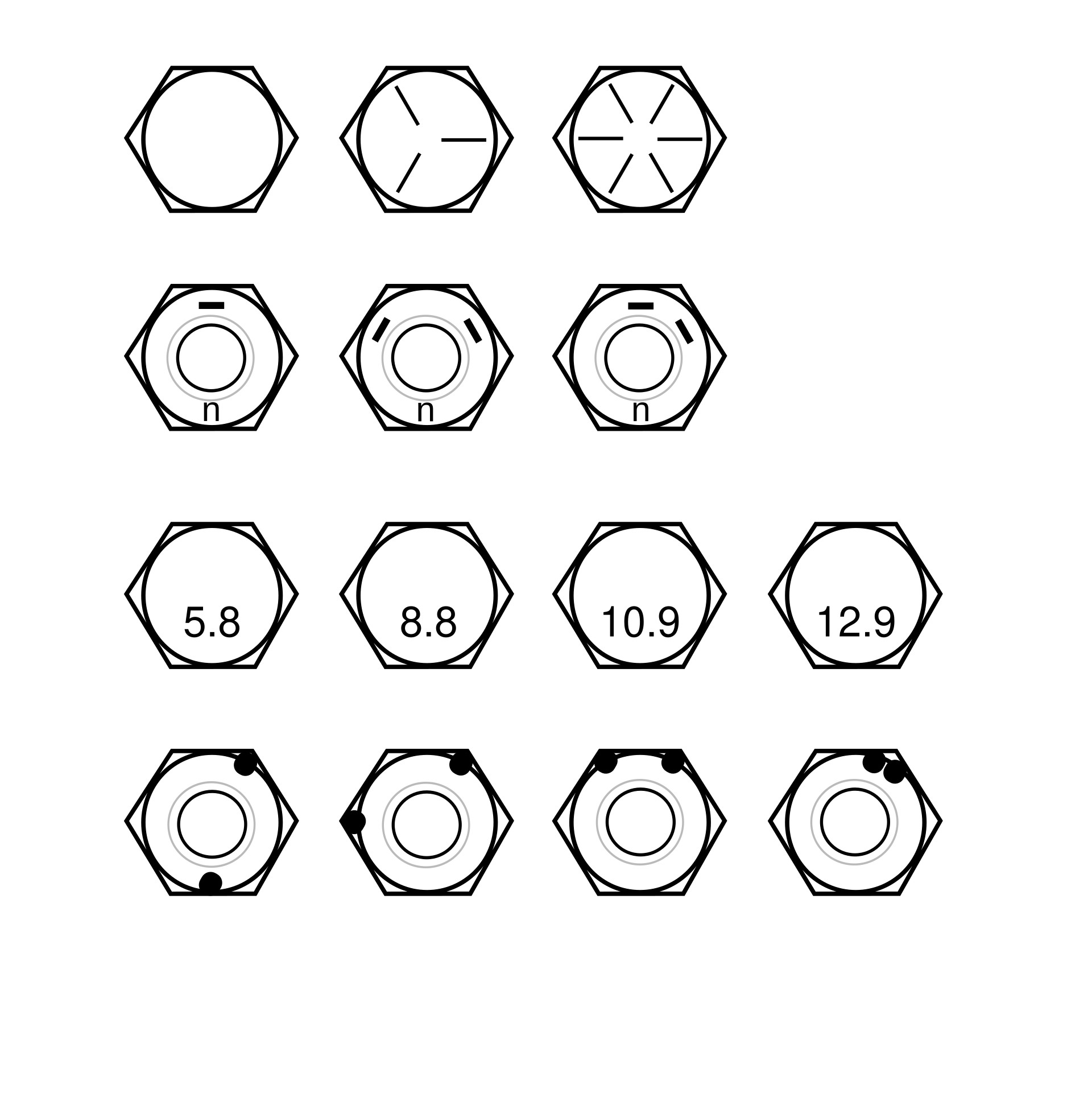
SAE radial-line markings (top) and metric property-class stamps (middle rows). This is the exact chart to check before choosing any cleaning method — see the hydrogen embrittlement section below.
SAE (imperial) system
Grade numbers 1, 2, 5, 8. Strength is indicated by radial lines on the bolt head — the number of lines equals the grade number minus 2 (Grade 5 = 3 lines, Grade 8 = 6 lines; Grade 2 is unmarked). Properties are defined in psi and governed by SAE J429.
| Grade | Marking | Material | Min. tensile strength | Heat treatment |
|---|---|---|---|---|
| Grade 2 | No marks | Low/medium carbon steel | ~60,000–74,000 psi | None (or light temper) |
| Grade 5 | 3 radial lines | Medium carbon steel, Q&T | ~105,000–120,000 psi | Quenched & tempered |
| Grade 8 | 6 radial lines | Medium carbon alloy steel, Q&T | ~150,000 psi | Quenched & tempered |
Metric (ISO) system
Property classes 4.6, 4.8, 5.6, 5.8, 8.8, 10.9, 12.9 — stamped directly on the head. Properties are defined in MPa and governed by ISO 898-1.
| SAE grade | Approximate ISO class | Notes |
|---|---|---|
| Grade 2 | 4.6 / 4.8 | Low strength, mild steel |
| Grade 5 | 8.8 | Medium-high strength, Q&T |
| Grade 8 | 10.9 | High strength, alloy steel Q&T |
| — | 12.9 | Very high strength, no direct SAE equivalent |
These are rough equivalents, not true interchangeables — different thread profiles (UNC/UNF vs. metric coarse/fine), different test standards, and slightly different strength definitions. If the metric-vs-imperial split itself is what trips you up, our metric vs standard fasteners guide breaks down the two systems side by side.
Alloying elements and their purposes
Plain carbon steel can’t do everything — here’s what each addition actually buys you.
Carbon (C) — 0.05–0.55%
The hardness engine. Forms martensite during quenching. More carbon means harder martensite, but also more brittleness. No carbon, no hardening possible.
Manganese (Mn) — 0.60–1.50%
The cost-effective hardenability booster. Allows deeper hardening of larger cross-sections and permits oil quenching instead of water, reducing crack risk. Also deoxidizes molten steel (preventing porosity) and provides solid-solution strengthening. Present in nearly all medium-carbon bolt steels — cheap and effective.
Chromium (Cr) — 0.20–1.20%
The strength-retention specialist. Increases hardenability more powerfully than manganese. Forms extremely stable chromium carbides that resist coarsening during tempering, so the bolt retains strength at higher service temperatures. Also improves corrosion resistance (at higher percentages this leads toward stainless steel) and raises the allowable tempering temperature without excessive hardness loss. Common in Class 10.9 and 12.9 steels.
Molybdenum (Mo) — 0.15–0.40%
The embrittlement preventer. Its standout role: suppressing temper embrittlement, where certain steels (especially Cr-Ni alloys) go brittle when tempered in the 350–575°C range. Molybdenum is also a powerful hardenability enhancer even in small amounts, forms carbides resistant to high-temperature coarsening, allows higher tempering temperatures for better toughness without sacrificing strength, and improves creep resistance. Commonly paired with chromium in Cr-Mo steels (e.g., AISI 4140/4142) for high-strength bolts.
Nickel (Ni) — 0.30–2.00%
The toughness champion. Unmatched for improving toughness, especially at low temperatures. Increases hardenability moderately (less than Cr or Mo) and strengthens the lattice without significantly reducing ductility — unusual among alloying elements. Improves fatigue resistance. Doesn’t form carbides; stays dissolved in the iron lattice. Expensive, so used judiciously — most valuable where impact loading or low-temperature service is expected.
Vanadium (V) — 0.05–0.15%
The grain refiner. Forms tiny vanadium carbonitride particles that pin grain boundaries during heat treatment, preventing grain growth — finer grains improve strength and toughness at once, rare since most strengthening mechanisms sacrifice one for the other. Also exhibits secondary hardening: at ~550–600°C tempering, vanadium carbides precipitate and cause a secondary hardness increase, allowing high-temperature tempering with retained or even increased strength.
Silicon (Si) — 0.15–0.35%
The deoxidizer. Removes dissolved oxygen from molten steel (producing “killed steel”), preventing gas porosity. Provides moderate solid-solution strengthening, raises the elastic limit, and improves tempering resistance. Present in virtually all steel as a residual from steelmaking; some spring-steel bolts use higher silicon (up to 2%) for elasticity.
Boron (B) — 0.0005–0.003%
The micro-booster. Weight for weight, the most powerful hardenability enhancer known for steel — effective in microscopic quantities (as little as 0.001%). Works by segregating to prior-austenite grain boundaries and retarding the transformation to ferrite/pearlite, promoting martensite even with slower cooling. A cost-effective alternative to Cr or Mo. Many commercial Grade 5 bolts use boron-treated steel (e.g., AISI 15B41 or 10B21).
Titanium (Ti) — 0.02–0.10%
The nitrogen scavenger. Forms titanium nitride, protecting boron’s hardenability effect in boron-treated steels. Also refines grain by pinning boundaries, similar to vanadium. Rarely a primary addition, but plays an important supporting role.
Aluminum (Al) — 0.02–0.08%
The grain controller. A strong deoxidizer used to produce fully deoxidized “killed” steel. Forms fine aluminum nitride particles that pin austenite grain boundaries during heating, preventing grain growth. Mostly a steelmaking processing element, but contributes positively to the finished bolt’s grain structure.
Copper (Cu) — 0.10–0.50%
The corrosion fighter. Its primary role is atmospheric corrosion resistance (the basis of “weathering steels”), with minor solid-solution strengthening as a side benefit. More relevant to atmospheric-exposure bolts than high-strength structural ones — often a residual element rather than an intentional addition.
Summary: every alloying element at a glance
| Element | Typical % | Primary purpose | Critical for |
|---|---|---|---|
| Carbon (C) | 0.05–0.55 | Forms hard martensite | All heat-treated grades |
| Manganese (Mn) | 0.60–1.50 | Hardenability, deoxidation | Grade 5+, Class 8.8+ |
| Chromium (Cr) | 0.20–1.20 | Stable carbides, hardenability | Class 10.9, 12.9 |
| Molybdenum (Mo) | 0.15–0.40 | Prevents temper embrittlement | Class 10.9, 12.9 |
| Nickel (Ni) | 0.30–2.00 | Toughness, low-temp impact | Specialty / impact-rated |
| Vanadium (V) | 0.05–0.15 | Grain refinement, secondary hardening | High-performance alloys |
| Silicon (Si) | 0.15–0.35 | Deoxidation, tempering resistance | All grades (processing) |
| Boron (B) | 0.0005–0.003 | Massive hardenability boost | Grade 5 (economical route) |
| Titanium (Ti) | 0.02–0.10 | Nitrogen scavenging for boron | Boron-treated steels |
| Aluminum (Al) | 0.02–0.08 | Deoxidation, grain refinement | All grades (processing) |
| Copper (Cu) | 0.10–0.50 | Corrosion resistance | Weathering/exposed bolts |
Hardenability vs. hardness
Two terms that sound alike and mean very different things.
Hardness is how hard a specific point of the steel is, measured after heat treatment — a measure of the result. Hardenability is how deep below the surface the steel can be hardened — a measure of capability.
Plain carbon steel has relatively poor hardenability — only thin sections harden all the way through. As bolt diameter increases, the core of a plain carbon steel bolt won’t fully transform to martensite during quenching, leaving a soft, weak core beneath a hard shell.
Alloying elements (Cr, Mo, Mn, Ni) increase hardenability by slowing the rate at which austenite transforms back to softer phases during cooling — so martensite can form even with a slower quench. That enables full hardening through thick cross-sections, gentler quench media (oil instead of water, less cracking risk), and more uniform properties from surface to core. This is exactly why high-strength bolts (Grade 8, Class 10.9/12.9) use alloy steel: larger diameters need deeper hardening, and alloys are what make that possible.
Hydrogen embrittlement: the hidden killer of hardened bolts
A bolt that was manufactured perfectly, tested perfectly, and installed correctly — failing anyway, without warning.
Hydrogen embrittlement (HE) is one of the most dangerous and insidious failure modes in high-strength fasteners. It causes bolts that passed every check to spontaneously fail — sometimes hours, days, or weeks after installation — with no visible warning.
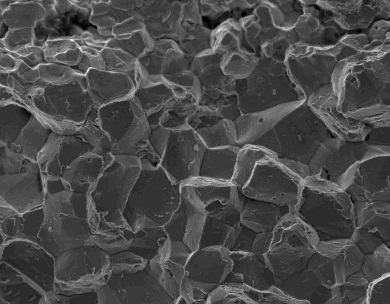
Real SEM micrograph of hydrogen-embrittlement intergranular cracking. Note how the cracks follow the grain boundaries rather than cutting through the grains — the microscopic signature of this failure mode.
Atomic hydrogen — individual hydrogen atoms, not H₂ gas molecules — penetrates the steel lattice of a hardened bolt. Once inside, it:
- Diffuses through the crystal lattice — hydrogen atoms are the smallest atoms in existence, so they move freely through iron at room temperature.
- Collects at areas of high stress — grain boundaries, dislocations, and regions under tensile stress like the root of a bolt’s threads.
- Weakens the atomic bonds between iron atoms at those locations.
- Reduces ductility and toughness dramatically, while having little to no effect on hardness or apparent strength.
- Causes sudden brittle fracture — failure far below rated capacity, often with a cleavage-type fracture and little to no plastic deformation.
Why only hardened bolts are affected
HE overwhelmingly affects high-hardness, high-strength bolts — typically above ~32 HRC (Rockwell C). That corresponds roughly to Grade 8 and above (SAE) or Class 10.9 and 12.9 (metric). Lower-grade bolts (Grade 2, Grade 5, Class 8.8 and below) are generally not susceptible — their softer, more ductile microstructure absorbs hydrogen atoms without catastrophic cracking. The harder the steel, the more susceptible it is; Class 12.9 is the most vulnerable of all standard bolt grades.
Failure characteristics
- Delayed failure — the bolt fails later under sustained load, not immediately upon hydrogen absorption. The delay ranges from minutes to months.
- Brittle fracture surface — little to no necking or plastic deformation; the surface often looks granular or crystalline.
- Intergranular cracking — under a microscope, cracks follow grain boundaries rather than crossing through grains.
- Failure below rated load — the bolt breaks at a fraction of its specified tensile or proof load.
- No obvious external damage — the bolt looks perfectly normal right up until it snaps.
How hydrogen actually gets in
- Electroplating — the most common industrial source. Zinc plating and similar processes generate atomic hydrogen at the bolt surface as an electrolysis byproduct, which can be absorbed directly into the steel.
- Acid cleaning / pickling / acid derusting — covered in detail below.
- Corrosion in service — the electrochemical corrosion reaction itself can generate hydrogen at the metal surface.
- Hydrogen gas environments — relevant in chemical processing, oil and gas, and hydrogen-energy applications.
- Welding — moisture in consumables or atmospheric humidity can dissociate during welding, introducing hydrogen into the heat-affected zone.
Why acid derusting causes hydrogen embrittlement
The single most practical lesson in this whole guide.
Immerse a rusty steel bolt in an acid bath — hydrochloric acid, muriatic acid, sulfuric acid, phosphoric acid, or even household vinegar — and the acid reacts directly with the iron in the steel: Fe + 2HCl → FeCl₂ + H₂↑. That reaction dissolves the rust and the base metal, producing iron chloride and hydrogen gas.
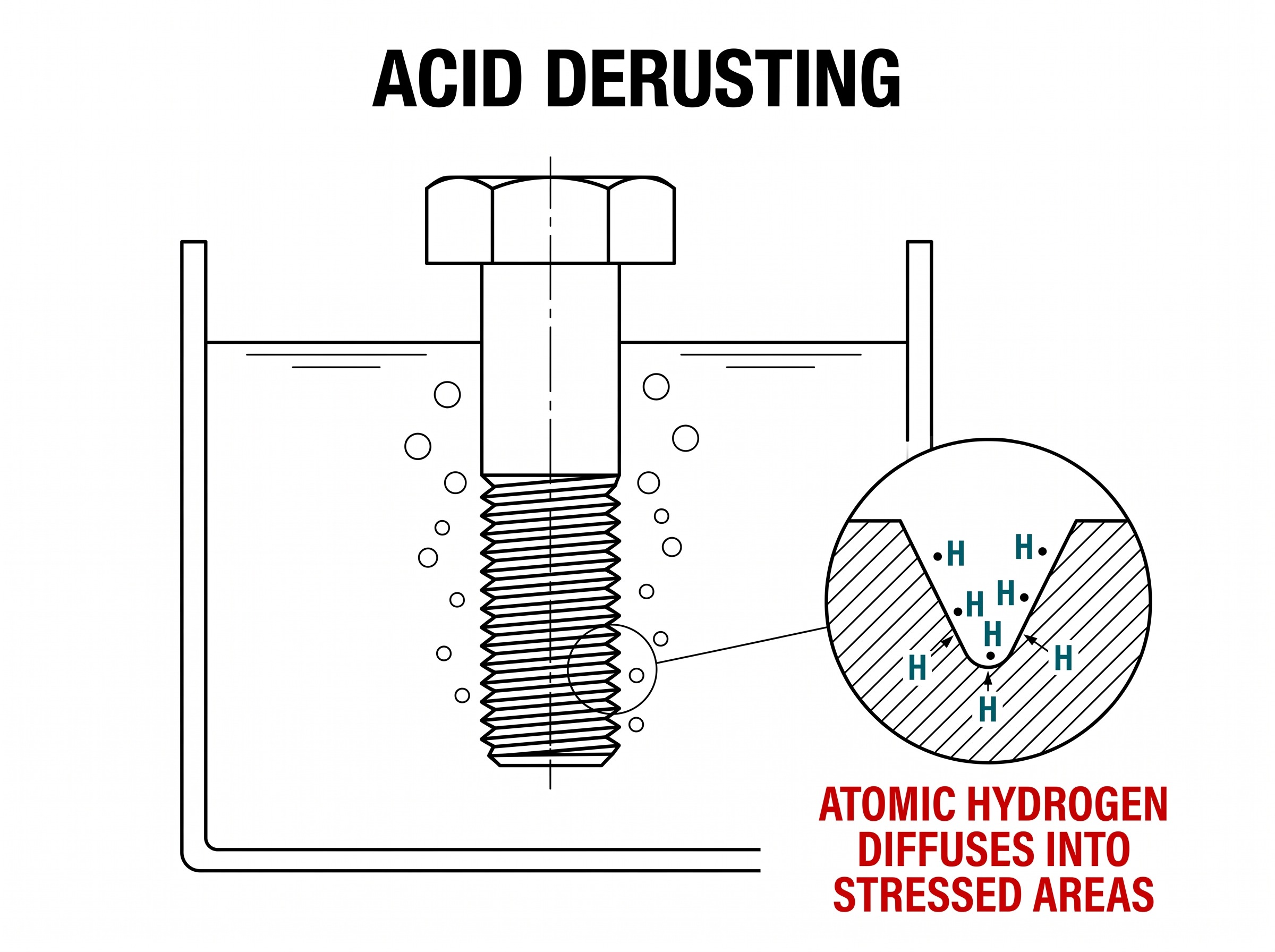
Where it actually happens: the thread root and under-head fillet are the highest-stress points on a bolt — exactly where migrating hydrogen atoms do the most damage.
Before hydrogen atoms pair up into H₂ gas bubbles, they exist briefly as individual atoms at the metal surface — the smallest atoms in existence, small enough to diffuse directly into the steel lattice before they ever combine into gas and bubble away.
In a hardened, high-strength martensitic bolt, the lattice is already distorted and strained from the trapped carbon — like a tightly wound spring. Hydrogen atoms migrate to grain boundaries and stress concentrations (thread roots, under-head fillets), weaken the iron-iron bonds there, and under the sustained tensile load of being torqued in place, the weakened boundaries begin to crack. The bolt may look perfect immediately after cleaning and could even pass a hardness test — the hydrogen is already inside, migrating and accumulating, and the bolt can fail hours, days, or weeks later under load.
Why softer bolts survive acid cleaning
Grade 2 and Grade 5 bolts (Class 4.6–8.8) have softer, more ductile microstructures. Lower carbon content and less aggressive heat treatment mean the lattice is less strained and more accommodating of hydrogen atoms — the steel can deform locally around hydrogen-rich areas without cracking, and hydrogen can even diffuse back out given time (the basis of “baking,” below). This is why mechanics have soaked rusty Grade 2 and Grade 5 hardware in vinegar for decades without incident. The same treatment on a Grade 8 bolt can create a delayed-action failure.
The baking solution
When hardened bolts undergo electroplating or any hydrogen-introducing process, they must be baked (“hydrogen embrittlement relief baking”): heated to 190–220°C (375–430°F) for 4–24 hours, immediately after the process and ideally within 1 hour, before the bolt is ever placed under load. ASTM B850 and ISO 2081 specify the required times and temperatures by hardness.
| Bolt hardness | Baking temperature | Minimum time |
|---|---|---|
| ≤ 320 HV (~32 HRC) | 190–220°C | Not required (low susceptibility) |
| > 320–390 HV (~32–39 HRC) | 190–220°C | 8 hours |
| > 390 HV (~39+ HRC, e.g. Class 12.9) | 190–220°C | 24 hours |
Practical rules to live by
| Situation | Recommendation |
|---|---|
| Acid-derusting a Grade 2 bolt | Generally OK — low risk, soft ductile microstructure |
| Acid-derusting a Grade 5 bolt | Caution — acceptable risk, not ideal |
| Acid-derusting a Grade 8 bolt | DO NOT — high risk of delayed brittle failure |
| Acid-derusting a Class 12.9 bolt | ABSOLUTELY NOT — extreme risk |
| Cleaning rust from a hardened bolt | Mechanical methods (wire brush, sandblast, glass bead) — or a chelation-based cleaner like Evapo-Rust, safe on any grade |
| Electroplating hardened bolts | Must be baked per ASTM B850 — no exceptions |
| Alternative corrosion protection | Mechanical galvanizing, dip-spin zinc flake, or phosphate + oil — none involve electrolytic hydrogen generation |
Chelation-based rust remover (e.g. Evapo-Rust)
The one derusting method that skips the acid-vs-grade calculation entirely — safe to use on Grade 2 through Class 12.9 without checking the head marking first.
Some links above are Amazon affiliate links — as an Amazon Associate we may earn a small commission at no extra cost to you.
The full manufacturing process of a high-strength bolt
Putting it all together — a Grade 8 / Class 10.9 bolt from raw material to finished product.
Summary cheat sheet
The three heat-treatment steps
| Step | What it does | Result |
|---|---|---|
| Austenitizing (~850°C) | Dissolves carbon into the FCC lattice | Uniform solid solution, ready for transformation |
| Quenching (rapid cool) | Traps carbon, forms martensite | Extremely hard, extremely brittle |
| Tempering (150–650°C) | Precipitates carbides, relieves stress | Usable balance of strength and toughness |
Bolt grade quick reference
| Grade / class | Material | Tensile strength | Heat treated? | HE susceptible? |
|---|---|---|---|---|
| Grade 2 / 4.6–4.8 | Low carbon | ~60–74 ksi / 400 MPa | No | No |
| Grade 5 / 8.8 | Medium carbon | ~105–120 ksi / 800 MPa | Yes (Q&T) | Low risk |
| Grade 8 / 10.9 | Carbon alloy | ~150 ksi / 1,000 MPa | Yes (Q&T) | Yes — high risk |
| — / 12.9 | Alloy steel | — / 1,200 MPa | Yes (Q&T) | Yes — extreme risk |
The golden rules
- Never acid-clean hardened bolts (Grade 8, Class 10.9, 12.9). Mechanical methods, or a chelation-based cleaner, only.
- Hardening makes steel hard but brittle. Tempering makes it usable. Both are required.
- More carbon means harder but more brittle. Always a tradeoff.
- Alloys enable deep hardening with a gentle quench. That's their primary job.
- Molybdenum prevents temper embrittlement. Essential for high-grade bolts.
- Bake after electroplating hardened bolts. No exceptions.
- Hydrogen embrittlement is delayed and invisible. The bolt looks fine until it suddenly isn't.
Frequently asked questions
Is it safe to soak a Grade 8 bolt in vinegar overnight?
No. Vinegar is a weak acid, but it still reacts with the base iron and can introduce atomic hydrogen into a hardened bolt's lattice. The risk is lower than with a mineral acid, but not zero — and the failure it can cause is delayed and invisible. Use mechanical cleaning or a chelation-based remover instead.
Is Evapo-Rust safe on Grade 8 or Class 10.9 bolts?
Yes. Evapo-Rust and similar chelation-based rust removers contain no acid or alkali and don't react with the base metal — only with the iron already in rust. No metal-acid reaction means no hydrogen byproduct, so it's safe on any bolt grade, hardened or not.
Can a hydrogen-embrittled bolt pass a hardness test?
Yes. Hydrogen embrittlement reduces ductility and toughness, but has little to no effect on hardness. A bolt can pass a hardness check and still be carrying a hydrogen load that causes it to fail under tension days or weeks later.
Why does Class 12.9 need more baking time than Grade 8 / Class 10.9?
Baking time scales with hardness. Class 12.9 exceeds roughly 39 HRC, the highest-susceptibility band, so ASTM B850 calls for 24 hours at 190–220°C versus 8 hours for the 32–39 HRC band that covers most Grade 8 / Class 10.9 hardware.
What's the difference between SAE Grade 8 and metric Class 10.9?
They're close but not interchangeable. Grade 8 is roughly equivalent to Class 10.9 in tensile strength (~150 ksi vs. 1,000 MPa / ~145 ksi), but the two use different thread standards (UNC/UNF vs. metric coarse/fine) and different test methods, so don't swap them into the same joint without checking the thread pitch too.
Image credits
SEM micrograph of hydrogen-embrittlement intergranular cracking — KassJuanebe, via Wikimedia Commons, CC BY-SA 4.0.
SAE/Metric bolt and nut marking chart — Duk & Wizard191, via Wikimedia Commons, CC BY-SA 3.0.
Acid-derusting and hydrogen-diffusion diagram — original technical illustration, WhatSizeBolt.
Always consult the applicable standards — SAE J429, ISO 898-1, ASTM B850, ASTM F1940 — for exact requirements in your application. As an Amazon Associate we earn from qualifying purchases; some links on this page are affiliate links (rel="nofollow sponsored").