Coarse vs Fine Thread: Which Is Stronger? (And When to Use Each)
By WhatSizeBolt TeamEdited 6 min read
Same bolt diameter, two different thread pitches — and the choice matters more than most people realize. This guide covers what coarse and fine threads are, when to use each, a full comparison table, and how to identify which thread you have in seconds.
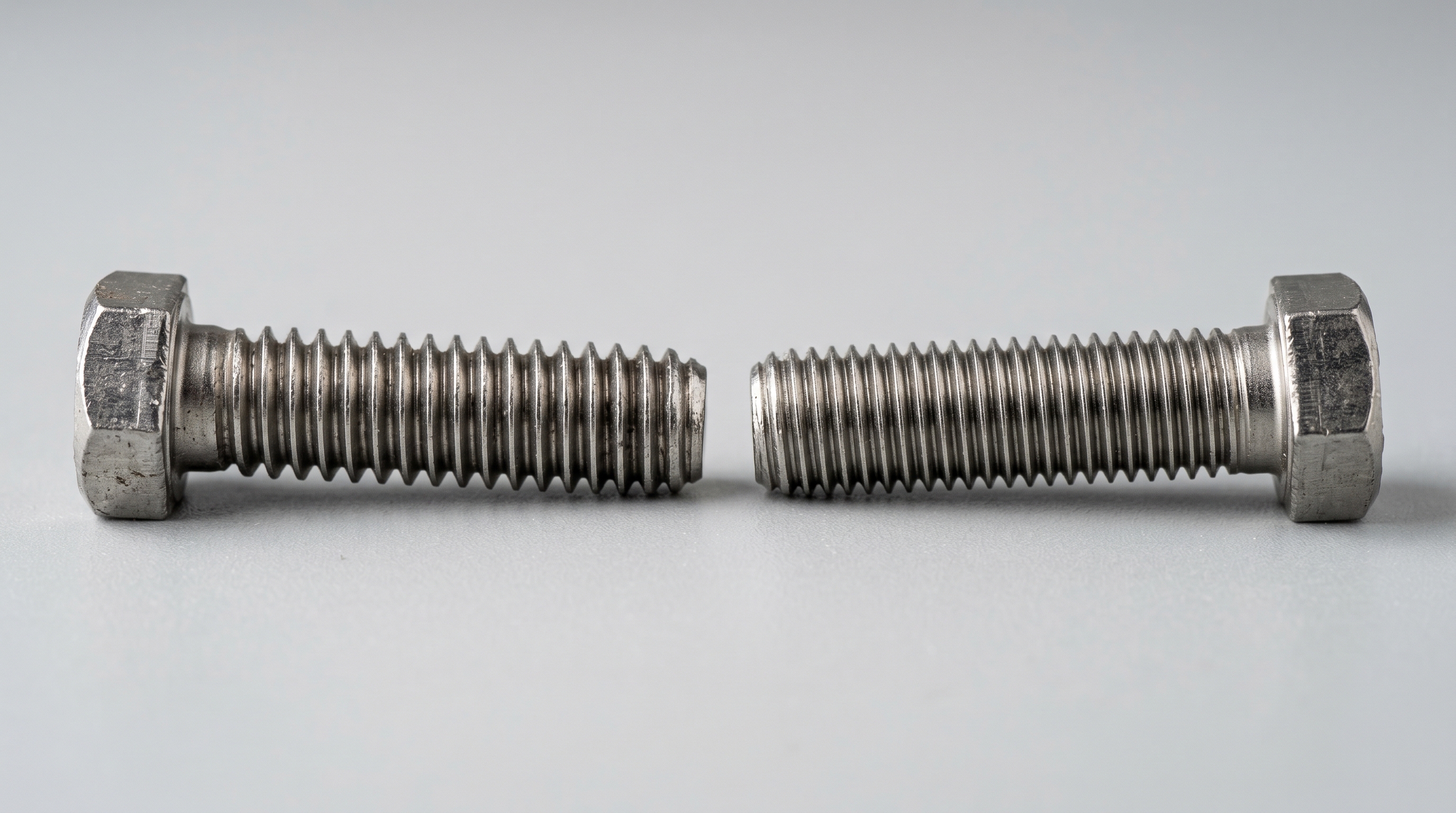
Pull a bolt from any bin and it will have one of two thread standards: coarse or fine. Same nominal diameter, same hex head — but a different number of threads per inch (TPI) or per millimeter depending on the standard. The difference sounds small, but it changes how the bolt handles vibration, how fast it installs, and how well it grips different materials. Knowing which you have — and which you need — takes about two seconds with the right tool, and it's worth understanding before you reach for the wrench.
Coarse Thread (UNC / Metric Coarse)
The default in most hardware bins for good reason.
Coarse threads have fewer threads per inch (or a larger pitch in metric). In the Unified National system, a 3/8-inch coarse bolt (3/8-16) has 16 threads per inch; the fine version (3/8-24) has 24. That wider spacing between flanks means each thread is deeper and beefier, which gives coarse-thread fasteners several practical advantages:
- Tolerant of contamination. Rust, grit, or minor dings to the thread flanks rarely prevent a coarse bolt from starting cleanly.
- Faster installation. Fewer turns from finger-tight to full torque — useful in production and on tight, repetitive service jobs.
- Forgiving in soft materials. In aluminum, cast iron, or plastic, the deep thread profile distributes load across fewer, wider flanks, making it harder to strip on assembly.
- Standard everywhere. Walk into any hardware store or dealer parts counter and the default is coarse unless marked otherwise.
The tradeoff is slightly lower thread engagement per inch of grip length, and a marginally lower theoretical tensile strength compared to fine at the same diameter — though in practice, bolt grade (material strength) matters far more than TPI for pull-out resistance.
Fine Thread (UNF / Metric Fine)
More threads per inch, and a different set of tradeoffs.
Fine threads are specified where the application genuinely benefits from closer pitch:
- Higher clamping force for the same torque. More thread engagement per unit length means a steeper mechanical advantage — the same wrench torque stretches the bolt slightly more, generating higher preload. This matters in precision joints where maximum clamping is critical.
- Better in thin or hard materials. Where wall thickness limits grip length, packing more threads into that thickness increases pull-out resistance.
- Lower self-loosening tendency in some static applications. The shallower helix angle means the thread is less inclined to "unscrew" under purely axial load. However, this advantage disappears under transverse vibration (see below).
Fine threads carry their own gotchas. The shallower, narrower flanks are easier to cross-thread — even a few degrees off-axis can engage the wrong flank and gall the thread before you notice. They're also more sensitive to corrosion and contamination, and they simply don't exist in all the hardware you'll find on a typical shelf.
Coarse vs Fine Thread — Side-by-Side Comparison
| Property | Coarse (UNC / Metric Coarse) | Fine (UNF / Metric Fine) |
|---|---|---|
| Thread pitch | Fewer TPI / larger mm pitch | More TPI / smaller mm pitch |
| Clamping force (same torque) | Good | Slightly higher |
| Tensile strength (same grade) | Marginally lower | Marginally higher (minor in practice) |
| In soft metals (aluminum, etc.) | Better — deeper flank | More likely to strip |
| In thin/hard material | Fewer threads in grip length | Better — more threads engaged |
| Cross-thread risk | Lower | Higher |
| Vibration resistance | Similar (see note above) | Similar (see note above) |
| Typical use | General hardware, automotive, structural | Precision joints, thin walls, some OEM spec |
Which Does Your Vehicle Use?
Most passenger-car fasteners are metric coarse, but wheel hardware is a common exception: the wheel studs on a typical Honda are M12×1.5, which is a fine pitch (M12 coarse is 1.75 mm), and BMW lug bolts run M14×1.25, also fine (M14 coarse is 2.0 mm). Suspension and brake hardware often mixes both depending on the OEM's requirements for clamping force, material, or serviceability. The safest policy: always identify the thread before installing any fastener, especially on safety-critical joints.
A thread pitch gauge (a fan of metal leaves, each stamped with a pitch) identifies your thread in seconds — just find the leaf that drops cleanly into the flank without rocking. For a digital shortcut, use the free Vehicle Fastener Specs lookup at WhatSizeBolt to see the exact thread pitch, torque spec, and grade for any fastener on your specific year, make, and model.
How to Tell Which Thread You Have
1. Thread pitch gauge
The most reliable method. Fan out the leaves against the bolt thread and find the leaf that seats flush without gaps or rocking. The leaf is stamped with the pitch (e.g., "1.25" for M12×1.25, or "16" for 3/8-16 UNC).
2. Count threads per inch
Lay a ruler along 1 inch of the shank and count the crests. 16 crests on a 3/8 bolt = coarse (3/8-16); 24 crests = fine (3/8-24). Works for inch fasteners; metric pitch is measured differently (distance between crests in mm).
3. Thread gauge app or caliper measurement
Measure the pitch with digital calipers across several threads and divide by the count. Useful for confirming a gauge reading on unusual pitches.
4. Look it up
The bolt size chart and the thread pitch guide list standard UNC, UNF, and metric pitches by diameter.
Thread Pitch Gauge Set (SAE & Metric)
A dual-standard pitch gauge fan covers both inch (UNC/UNF) and metric coarse/fine threads. The leaf that drops cleanly into the flank without rocking tells you the pitch instantly — no math, no guessing.
As an Amazon Associate, WhatSizeBolt earns from qualifying purchases.
Frequently Asked Questions
Is coarse or fine thread stronger?
For the same material and diameter, fine thread has a very slightly larger stress area (the effective cross-section under load), so tensile proof load is marginally higher. In practice the difference is small enough that bolt grade — the material's strength — is what matters far more. Use whichever pitch the joint design calls for; don't choose fine "for strength."
Can I use a fine-thread bolt in a coarse-thread hole?
No. A fine-thread bolt in a coarse-thread hole will cross-thread immediately. The pitches must match the tapped hole or nut exactly. If you're re-threading a stripped hole, you can re-tap to the same size or go up one size, but never swap coarse for fine in an existing hole.
Why do some wheel bolts use fine thread?
Several European OEMs (BMW, Mercedes-Benz, Volkswagen Group) specify fine-thread lug bolts because the thinner pitch generates higher clamping force at the manufacturer's specified torque, which suits the harder steel of their wheel hubs. Always use the pitch the manufacturer specifies — substituting coarse-thread lug hardware is a safety hazard.
Do fine threads strip more easily?
In soft materials like aluminum, yes. The shallower, narrower flank of a fine thread has less material per thread to resist pull-out in a soft parent metal. Coarse thread's deeper profile distributes load across a wider flank, making it harder to strip during assembly and in service. Fine thread performs better in steel, hard alloys, and thin-wall applications.
How do I find the right thread pitch for my vehicle?
Use the free Vehicle Fastener Specs lookup — enter your year, make, and model to see the thread pitch, size, grade, and torque for every major fastener. The printable torque chart gives you those values in a shop-ready format.
The bottom line: coarse thread is the right default for most work — it's tough, forgiving, and available everywhere. Fine thread earns its place in precision joints, thin materials, and wherever the OEM specifies it. When in doubt, measure first with a pitch gauge, then confirm torque specs with the free Vehicle Fastener Specs tool, and cross-reference the bolt size chart or thread pitch guide for the full picture.

Video plays from YouTube when clicked. Always confirm torque values against your service manual.