How to Identify Bolt Thread Pitch: A Complete Guide
Learn the essential techniques for accurately measuring and identifying bolt thread pitch using simple tools.
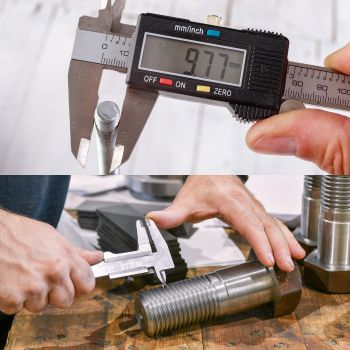
Thread pitch is one of the most critical measurements when working with bolts and fasteners — and one of the easiest to get wrong. Misjudge it and you cross-thread the hole, strip the threads, or end up with a fastener that feels tight but isn't. This guide shows you exactly how to identify bolt thread pitch: with a gauge, with calipers, or with nothing but a ruler.
What is thread pitch?
The one measurement that decides whether a bolt threads home smoothly or binds up halfway.
Thread pitch is the spacing of the threads along a bolt or screw. It’s quoted two different ways depending on the standard you’re working in:
- Metric — the distance in millimetres between two adjacent thread crests (e.g. 1.25 mm).
- Imperial / SAE — the number of threads that fit in one inch, written as TPI.

How to identify thread pitch
Two reliable methods: a thread pitch gauge (fastest and most accurate), or careful measurement when you don’t have one.
Method 1 — Use a thread pitch gauge
- Clean the threads — wipe off any dirt, rust or debris so the leaf can seat fully.
- Pick a likely leaf — start with the common pitches for that diameter.
- Press it on — the leaf should drop into the threads with no rocking and no force.
- Check for daylight — hold it to the light; a perfect match shows no gaps under the teeth.
- Read and record — note the stamped pitch (and whether it’s the metric or SAE side).

If the leaf rocks or you can see light beneath it, you’re close but wrong — try the next one. That “almost fits” feeling is exactly how cross-threading starts.
Some links below are Amazon affiliate links — as an Amazon Associate we may earn a small commission at no extra cost to you.
Thread pitch gauge set (metric + SAE)
A fan of stamped leaves you press against the threads until one nests perfectly. Buy a set that covers both metric and SAE so you can identify any fastener in seconds — the single best few dollars you can spend on fastener work.
Method 2 — Measure it by hand
- Count the crests over a known span — one inch for imperial, 10 mm for metric.
- Do the math — crests per inch is the TPI; for metric, divide 10 mm by the number of crests in that span.
- Repeat at another spot on the bolt to confirm you counted right.

Digital calipers
Read crest-to-crest spacing and the major diameter to a hundredth of a millimetre. The go-to when a gauge is borderline or you also need the bolt’s diameter and length.
Common thread pitches by size
The standard (coarse) and fine pitches you’ll meet most often. Use this as a starting point, then confirm with a gauge.
Metric (coarse & fine)
| Size | Standard (coarse) | Fine |
|---|---|---|
| M6 | 1.0 mm | 0.75 mm |
| M8 | 1.25 mm | 1.0 mm |
| M10 | 1.5 mm | 1.25 mm |
| M12 | 1.75 mm | 1.25 mm |
| M14 | 2.0 mm | 1.5 mm |
| M16 | 2.0 mm | 1.5 mm |
Imperial / SAE (threads per inch)
| Size | UNC (standard) | UNF (fine) |
|---|---|---|
| 1/4" | 20 TPI | 28 TPI |
| 5/16" | 18 TPI | 24 TPI |
| 3/8" | 16 TPI | 24 TPI |
| 7/16" | 14 TPI | 20 TPI |
| 1/2" | 13 TPI | 20 TPI |
Coarse vs fine: which is which?
Same diameter, different pitch — and each has jobs it does better.

| Coarse (standard) | Fine | |
|---|---|---|
| Thread form | Fewer, deeper threads | More, shallower threads |
| Strength | More resistant to nicks & stripping | Higher tensile and shear strength |
| Assembly | Faster, more forgiving | Finer adjustment, holds torque well |
| Best for | General construction, soft materials, body panels | Engine components, precision machinery, thin-walled parts |
Fine threads turn up most on engine and driveline parts where strength and precise clamp load matter — for real-world sizes and torque figures, see our 2022 Ford F-150 fastener specs.
Fixing damaged threads
Caught early, a buggered thread is usually recoverable — no need to bin the part.
- Run a thread file over nicked crests to clean them up.
- Chase a damaged thread back to spec with a rethreading die or chaser (match the pitch you just identified).
- If the threads are torn out, replace the fastener — or fit a thread insert in the part.
Thread restorer file & rethreading kit
A thread file cleans up crushed crests, and a rethreading set re-cuts both external and internal threads back to a known pitch. Identify the pitch first, then chase to match.
Frequently asked questions
What’s the most common bolt thread pitch?
For metric, the coarse standard for each size — M6 × 1.0, M8 × 1.25, M10 × 1.5. For imperial, UNC coarse such as 1/4"-20 and 3/8"-16. Fine pitches exist for the same diameters and show up on engine and precision parts.
How do I tell metric from imperial thread pitch?
Metric pitch is a distance (millimetres between crests); imperial is a count (threads per inch). A pitch gauge has separate metric and SAE leaves — whichever side seats flush tells you the system. If a metric leaf and an SAE leaf both almost fit, you’ve found a close-but-wrong match, which is how cross-threading starts.
Can I measure thread pitch without a gauge?
Yes — lay the bolt against a ruler and count the crests across a known length. The number of crests in one inch is the TPI; for metric, divide 10 mm by the crests in that span to get the pitch in millimetres. Count across as many threads as you can for accuracy.
What’s the difference between coarse and fine thread?
Same diameter, different pitch. Coarse threads are fewer and deeper — faster to run and more damage-resistant. Fine threads are more numerous and shallower — higher strength and better for thin walls and precise adjustment, which is why they’re common on engines.
Is thread pitch the same as TPI?
They describe the same thing from opposite directions. Pitch (metric) is the distance between threads; TPI (imperial) is how many threads fit in an inch. A finer thread has a smaller pitch but a higher TPI.
Keep going
Bottom line: thread pitch is simply the crest-to-crest spacing — read it in millimetres for metric or threads-per-inch for imperial. Confirm it with a gauge before you fit anything, keep metric and SAE strictly separate, and you’ll never cross-thread a fastener again.