The Hidden Math in Your Bolt Bin
By WhatSizeBoltEdited 13 min read8 source links
Four number patterns hiding in a bolt bin: torque scales with diameter cubed, five lug nuts make exactly one star, bolt diameters climb Renard's ×1.26 ladder — which is why M7 barely exists — and both grade-mark codes are just arithmetic.

Dump a bolt bin on the bench and sort it by size, and you are looking at four number patterns. Three of them were put there on purpose. The fourth is physics you cannot avoid — and it is the reason your torque chart curves instead of climbing in a straight line.
Torque specs that jump in a curve. A lug pattern that traces a five-pointed star. A run of thread sizes that skips from M6 straight to M8 with no M7 in between. None of it is random. Two of these four patterns are catalogued in the On-Line Encyclopedia of Integer Sequences — the reference library of number patterns founded by Neil Sloane. One belongs to a French balloon engineer instead. Here is the whole bin, one pattern at a time.
1. Torque specs are cube numbers
The physics is three steps. Clamp force scales with the bolt’s cross-section, and cross-section scales with diameter squared (d²). Torque is force times lever arm, and the lever arm scales with diameter (d). Multiply them and spec torque scales with diameter cubed. Double the diameter and you are not looking at double the torque — you are looking at roughly eight times the torque.

You can see it in any generic class-8.8 dry torque chart. The last column is not typed in — it is (d/6)³ calculated, sitting next to the ratio the chart actually gives:
| Size | Torque, dry (ft-lb / Nm) | Ratio to M6 | Cube prediction (d/6)³ |
|---|---|---|---|
| M6 | 7 (10) | 1.0× | 1.0× |
| M8 | 18 (25) | 2.5× | 2.4× |
| M10 | 36 (49) | 4.9× | 4.6× |
| M12 | 63 (85) | 8.5× | 8.0× |
| M16 | 155 (210) | 21× | 19× |
| M20 | 302 (410) | 41× | 37× |
The measured ratios and the cube prediction track each other the whole way up. They do not match perfectly, and that gap is honest: thread pitch and stress area do not scale in exact proportion, and friction under the head and in the threads — the K-factor — adds real scatter. That is why every chart is labelled “approximate,” and why most of the torque you apply never becomes clamp force at all. We work that through in A Bolt Is a Spring, and the lubrication half of it in oil vs anti-seize.
The cube law is also why a lug spec on M14 studs sits so far above an M12 spec. It is not a small step: (14/12)³ = 1.59. A stud 17% bigger needs about 59% more torque to load it properly. Cube math, not gut feel, is why “just torque it like the last one” is a bad habit the moment the diameter changes.
2. Your lug pattern is a pentagram
Look at a 5-lug wheel and tighten in the usual star sequence: 1-3-5-2-4. You just drew a pentagram. That is not a styling choice — it is the only star you can draw on five points, and there is a number that says so.
A star polygon, written {n/k}, connects n points by stepping k at a time until you get back to the start. For it to be one continuous star rather than a smaller shape retraced, n and k have to share no common factor (gcd(n,k) = 1), with 2 ≤ k < n/2. The number of true stars on n points works out to φ(n)/2 − 1, where φ is Euler’s totient function — OEIS A000010, one of the oldest and most useful sequences there is.

Run the common lug counts through it:
- 5 lugs: φ(5) = 4, so exactly 1 star — the pentagram, {5/2}, tightened 1-3-5-2-4.
- 8 lugs: φ(8) = 4, also exactly 1 star: {8/3}.
- 7 lugs: φ(7) = 6, so there are 2 different stars to pick from.
- 6 lugs: φ(6) = 2, and the count comes out to zero. {6/2} is not a star at all — it collapses into two separate triangles. That is exactly why a 6-lug wheel gets tightened in opposite pairs rather than a star pattern: the star math simply is not there for six points.
The pattern is not decoration either. Tightening in star order pulls the wheel flat against the hub instead of cocking it to one side, which is what happens when you go around in a circle. Snug in star order, then make a final pass to spec with a torque wrench — and re-check the torque at the interval your owner’s manual or wheel maker gives, whatever the lug count. Exact numbers by vehicle are in the lug nut torque guide.
3. Why there is (almost) no M7 bolt
This is the odd item in the bin — the one pattern here that OEIS does not own, because it is not an integer sequence at all. It is a geometric one, and it has a name: Charles Renard’s numbers.

Charles Renard (1847–1905) was a French military engineer who joined the army’s aeronautical service after the Franco-Prussian War. His problem was not bolts — it was balloon cable. The army was stocking 425 different rope sizes to moor its observation balloons. Renard worked out that the parameter that actually mattered was mass per unit length, and built a geometric series in which every fifth step multiplied it by ten. In 1877 that cut 425 sizes to 17, and the scheme was published in the army’s 1886 instruction for captive-balloon troops. He was not a desk engineer either: in August 1884 he flew the airship La France with Arthur Krebs on a 23-minute circular flight — the first time a flying machine returned to its own take-off point. The numbering outlived the balloons: it was adopted as international standard ISO 3 in 1952, and it is why your bolt drawer skips from M6 to M8.

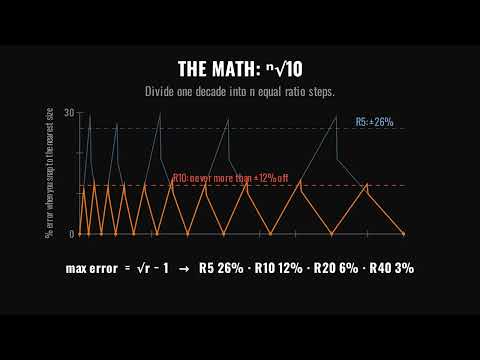
The math: split a decade (1 to 10, or 10 to 100) into n even ratio steps, so the step ratio is r = 101/n. Renard defined a few standard densities:
- R5: r ≈ 1.585 — 1, 1.6, 2.5, 4, 6.3, 10
- R10: r ≈ 1.259 — 1, 1.25, 1.6, 2, 2.5, 3.15, 4, 5, 6.3, 8, 10
- R20: r ≈ 1.122
- R40: r ≈ 1.059
Round any real value to the nearest series number and your worst-case error is √r − 1: 26% for R5, 12% for R10, 6% for R20, 3% for R40. R10 is the series metric bolt diameters are built on:

| R10 value | Became | Bigger than the last rung |
|---|---|---|
| 4 | M4 | — |
| 5 | M5 | +25% |
| 6.3 | M6 | +26% |
| 8 | M8 | +27% |
| 10 | M10 | +25% |
| 12.5 | M12 | +25% |
| 16 | M16 | +28% |
| 20 | M20 | +25% |
| 25 | M24 | +25% |
| 31.5 | M30 | +26% |
Above M30 the standard drifts off the pure series into round even steps — 36, 42, 48 — but everything below it is Renard’s logic straight through.
And here is the elegant part. 1.259² = 1.585. One R10 step in diameter is one R5 step in cross-section, and cross-section is roughly strength. So every size up is about 26% thicker and about 60% stronger — which is exactly why you never need the size in between. M7 would land between two rungs that already do the job; you just take the next rung up from whatever your load requires.
You will meet the same idea outside the bolt bin. Resistor kits use the E12 series, built on the twelfth root of 10 (IEC 60063) — same logic, finer steps. The old 1-2-5 series on money and multimeter dials is a coarser cousin. Bearings, shafts and drill sizes all lean on some version of it. The same standards-consolidation instinct is why 10 mm and 3/8” dominate automotive fasteners.
4. The grade-mark code
Two separate coding systems, and both of them are counting.

Inch bolts (SAE J429): count the radial lines stamped on the head.
| Grade | Lines on head | The rule |
|---|---|---|
| Grade 2 | 0 | grade − 2 = 0 |
| Grade 5 | 3 | grade − 2 = 3 |
| Grade 8 | 6 | grade − 2 = 6 |
Lines = grade minus 2. That is the whole rule.
Metric bolts (ISO 898-1): the head marking is two numbers, and both are literal.
| Marking | Tensile, min | Yield, min | What the marking literally says |
|---|---|---|---|
| 8.8 | 800 MPa | 640 MPa | 8 × 100 = 800 tensile; × 0.8 = 640 yield |
| 10.9 | 1,040 MPa | 940 MPa | 10 × 100 = 1,000 tensile; × 0.9 = 900 yield |
| 12.9 | 1,220 MPa | 1,100 MPa | 12 × 100 = 1,200 tensile; × 0.9 = 1,080 yield |
So “8.8” is not a grade name, it is a formula: 8 × 100 = 800 MPa tensile, and 8 × 0.8 = 6.4, × 100 = 640 MPa yield. The two left-hand columns are the standard’s published minima, which sit at or a little above what the marking nominally promises — that headroom is deliberate, not a discrepancy. There is more on reading a head in bolt grades and material markings.
Try it in your garage
Three five-minute checks. No shop required.
- Calipers on your bolt bin. Measure the shank diameter of an M6, M8, M10 and M12 bolt. Divide each reading by the one before it. You will land near 1.26 twice, and closer to 1.2 or 1.33 on the sizes that got rounded — that is Renard’s ratio showing up in your own hardware.
- The torque-chart cube check. Grab any torque chart — yours, ours, it does not matter. Divide the M12 spec by the M6 spec. Expect something near 8. That is the cube law in one division.
- Draw your lug pattern. Mark dots for your lug count, then connect them in star order. Five lugs draws a clean pentagram. Try it with six and watch it fail — you get two triangles, not a star, exactly as the totient math predicts.
Some links below are Amazon affiliate links — as an Amazon Associate we may earn a small commission at no extra cost to you.
Digital calipers (0.01 mm resolution)
You need two decimal places to see a 1.26 ratio in real hardware. A cheap digital caliper also settles every “is this M8 or 5/16”” argument in the drawer for good.
EPAuto 1/2” drive click torque wrench
The cube law is why a 1/2” wrench exists at all: lug and suspension specs live in the band where a 3/8” tool runs out. A 1/2” clicker covers roughly 50–250 ft-lb.
Thread checker & bolt gauge
Screw the unknown bolt into the board until it runs clean, and you have its size and pitch. Pairs nicely with the grade marks on the head — between the two you can identify almost anything in the bin.
Frequently asked questions
Why is there no M7 bolt?
There is — M7 is a real size, but the ISO metric series files it under third choice, the “only when necessary” tier, so general retailers do not stock it. The reason it lands there is Renard’s R10 series: bolt diameters climb in fixed ×1.26 steps, and each step is already about 60% stronger than the last, so a rung between M6 and M8 would not earn its part number. You will still meet M7 on some flywheel bolts and older European engine hardware.
Why does torque go up so fast with bolt size?
Because it scales with diameter cubed. Clamp force follows cross-section (d²) and the lever arm follows diameter (d), so torque follows d³. An M12 spec is roughly 8× an M6 spec, not 2×.
Why do you tighten lug nuts in a star pattern?
It seats the wheel flat against the hub instead of cocking it to one side. On five lugs the star order 1-3-5-2-4 traces a pentagram — mathematically the only star that exists on five points.
What about 6-lug wheels — is there a star pattern?
No, and that is not an oversight. Six points cannot make a star polygon at all (φ(6)/2 − 1 = 0); stepping by two just draws two separate triangles. Six-lug wheels are tightened in opposite pairs instead.
What do the lines on a bolt head mean?
On inch bolts they are the SAE J429 grade: lines = grade − 2. No lines is Grade 2, three lines is Grade 5, six lines is Grade 8. Metric bolts skip the lines and stamp the class as a number instead, like 8.8 or 10.9.
Is a 12.9 bolt stiffer than an 8.8?
No. Stronger, not stiffer. Both are steel with essentially the same Young’s modulus (≈30 Mpsi), so under the same light load they stretch the same amount. The 12.9 simply takes far more load before that stretch becomes permanent.
Keep going
Bottom line: none of this is trivia for its own sake. It is why your torque wrench clicks where it clicks, why your lug pattern looks the way it does, and why the bolt bin skips sizes instead of running one by one. When you want the number rather than the maths, the wrench & socket finder and our vehicle database answer in one search.
Sources
- OEIS A000578 — the cubes.
- OEIS A000010 — Euler’s totient function.
- Preferred numbers and Charles Renard — the R-series, ISO 3 (1952), and the 1884 La France flight.
- Sizes.com: preferred numbers and the Oughtred Society’s history of Renard’s numbers — the 1877 balloon-cable reduction, 425 sizes down to 17, and the 1886 captive-balloon instruction.
- ISO 261 / ISO 262 — the first / second / third choice ranking that puts M7 and M9 in third choice.
- Star polygon — the {n/k} notation and the gcd condition.
- ISO 898-1 (metric property classes) and SAE J429 (inch grades) — the strength and head-marking values in section 4.
- Nord-Lock: torque, preload and friction — why the K-factor makes every chart approximate.
Video plays from YouTube when clicked. Always confirm torque values against your service manual.