Why 10mm and 3/8" Dominate Automotive Fasteners: The Engineering History
By WhatSizeBolt TeamEdited 12 min read
How ISO metric M10 and SAE 3/8" became the most common automotive bolt sizes — and why the "10mm socket" everyone loses is actually a different size entirely.
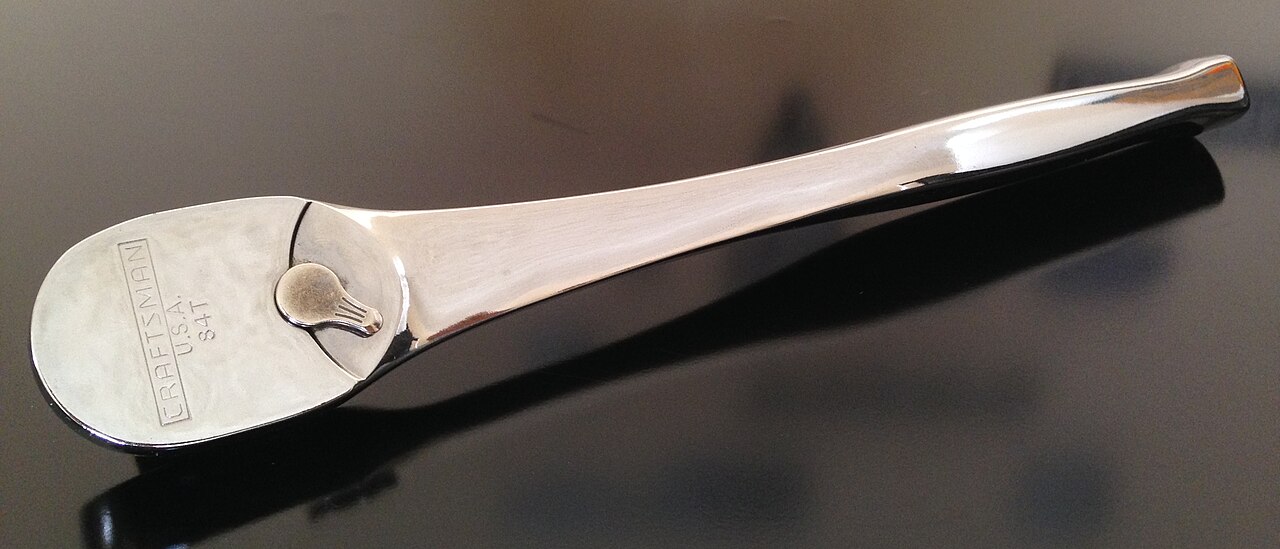
Open any mechanic’s toolbox and two things are guaranteed: a 10mm socket (usually the one that’s gone missing) and a 3/8" drive ratchet to spin it. Look under the hood and the pattern repeats in the metal itself — a huge share of the fasteners are M10 (metric) or its imperial cousin 3/8". These sizes aren’t an accident. They’re the result of a century of engineering decisions, two world wars’ worth of standardization fights, and manufacturing economics that locked them in for good. This is the story of how the industry converged on these numbers — and, first, how to stop confusing the two completely different things people call “10mm.”
First, untangle the two “10mm”s
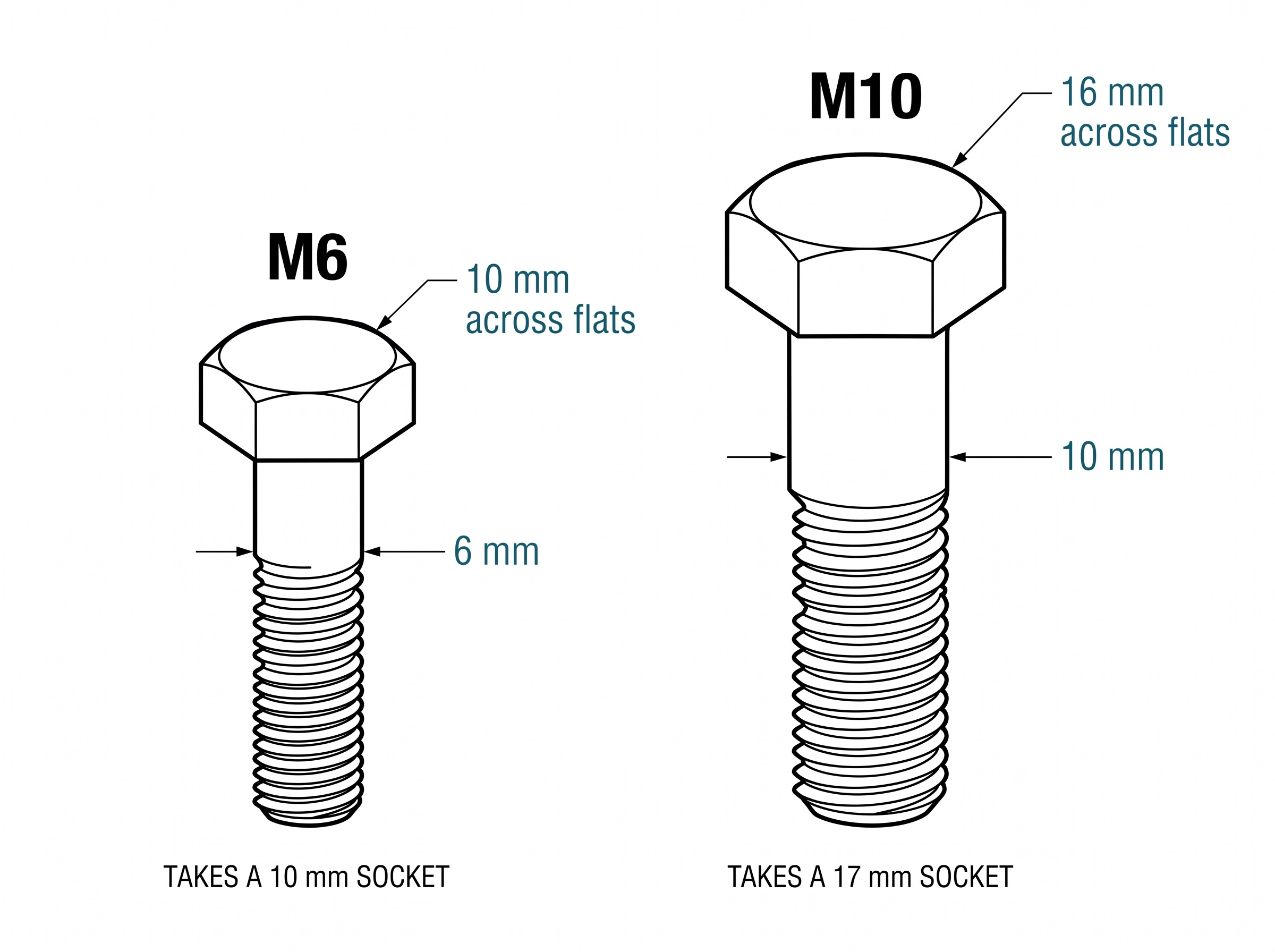
Most fastener confusion online comes from mixing up a socket size with a bolt size. They are not the same number.
- The 10mm socket — the one everyone loses — measures 10mm across the flats of its opening. It fits the head of an M6 bolt (a 6mm-diameter bolt, whose hex head is 10mm across). M6 is the workhorse of brackets, covers, sensors, splash shields, and interior trim, which is exactly why this socket leaves your hand more than any other.
- The M10 bolt — a 10mm-diameter bolt — is a structural fastener (engine, suspension, subframe). Its hex head is typically 16mm or 17mm across the flats, so you drive it with a 16/17mm socket, not a 10mm one.
So “10mm” is famous twice over: as the most-used socket opening (M6 heads) and as one of the most common load-bearing bolt diameters (M10). This article is about the second one — why M10 and 3/8" became the default bolt sizes — with the toolbox staples explained along the way. If the metric-versus-imperial split itself is what trips you up, our metric vs standard fasteners guide breaks down the two systems side by side.
The Goldilocks principle: why this diameter won
Neither M10 nor 3/8" was chosen at random. Both sit in an engineering sweet spot for the loads a vehicle actually sees.
- Too small (M5–M8 / 1/4"): threads can’t carry heavy engine, suspension, or structural loads without over-stressing — joints loosen or fail.
- Too large (M12+ / 1/2"+): you waste material, weight, and money. Going from M10 to M12 adds roughly 45% more steel per bolt; multiply by thousands of fasteners per vehicle and that’s real weight and cost.
- Just right (M10 / 3/8"): carries the loads in the engine bay, suspension, and driveline with the least material. An M10 bolt has a ~58 mm² tensile stress area versus ~84 mm² for M12 — about 90% of the practical job for ~70% of the material.
The metric story: how M10 went global (1800–1980)
From a single lathe to a worldwide preferred-size series.
Interchangeable screw threads only became practical around 1800, when Henry Maudslay’s screw-cutting lathe turned identical V-threads into a manufacturable commodity. But for the next century there was no shared standard. Britain used Whitworth (a 55° thread angle, from 1841). America used the Sellers/USS system (60°, from 1864). Continental Europe was developing its own metric variants. That incompatibility became a genuine problem in both world wars.
In 1947 the International Organization for Standardization (ISO) was founded, and unifying screw threads was an early priority. The ISO metric thread that emerged kept the proven 60° profile from Sellers’ 1864 design, but specified everything in millimeters and published a “preferred size series” — the diameters manufacturers should stock: M3, M5, M6, M8, M10, M12, and so on.
M10 landed squarely in the automotive Goldilocks zone — M8 was short on load capacity for engine-bay hardware, M12 was overkill for most joints. Paired with M10×1.5 (coarse, general use) and M10×1.25 (fine, for vibration-prone joints), it became the industry’s default. That coarse-versus-fine choice is a whole decision of its own — see our coarse vs fine thread guide for when each wins.
U.S. automakers resisted at first — they had billions sunk in imperial tooling — but global expansion changed the math. General Motors announced its move to metric in 1973, writing to all 47,000 of its suppliers, and by the end of the decade Ford, GM, and Chrysler had all committed to metric fasteners for new platforms. Toyota, Nissan, and Honda were metric-native already. The switch was gradual — GM metricated parts only as tooling came up for replacement — so some cars left the factory with a mix of metric and SAE fasteners well into the 1980s. Within a decade, though, ISO metric (with M10 doing the heavy lifting) was the de facto global standard.
The SAE story: how 3/8" became America’s default (1864–1948)
America solved its own standardization crisis earlier — and on the same 60° profile.
America had solved its own standardization crisis earlier. In 1864, William Sellers proposed a 60° symmetrical V-thread with consistent geometry — the basis of the United States Standard (USS). One reason this form eventually won out over Whitworth: its flat roots and crests were easier to manufacture than Whitworth’s rounded profile. The Society of Automotive Engineers (founded in 1905) later standardized a finer-pitch thread series for automotive use — the direct ancestor of today’s UNF “fine” threads.
The 3/8" size — designated 3/8"-16 UNC (3/8" diameter, 16 threads per inch) — became the imperial workhorse for the same Goldilocks reason: at 9.525mm it carries essentially the same loads as M10, while tooling for quarter- and half-inch increments was already everywhere. A fine-pitch 3/8"-24 UNF covered vibration-critical joints.
In November 1948, the United States, United Kingdom, and Canada agreed on the Unified Thread Standard (UTS) — formalizing UNC (coarse) and UNF (fine) on the shared 60° profile, and codified in the U.S. as ANSI/ASME B1.1-1949. In practical terms, 3/8" UNC became the North American equivalent of M10×1.5.
M10 ≈ 3/8" — but never interchangeable
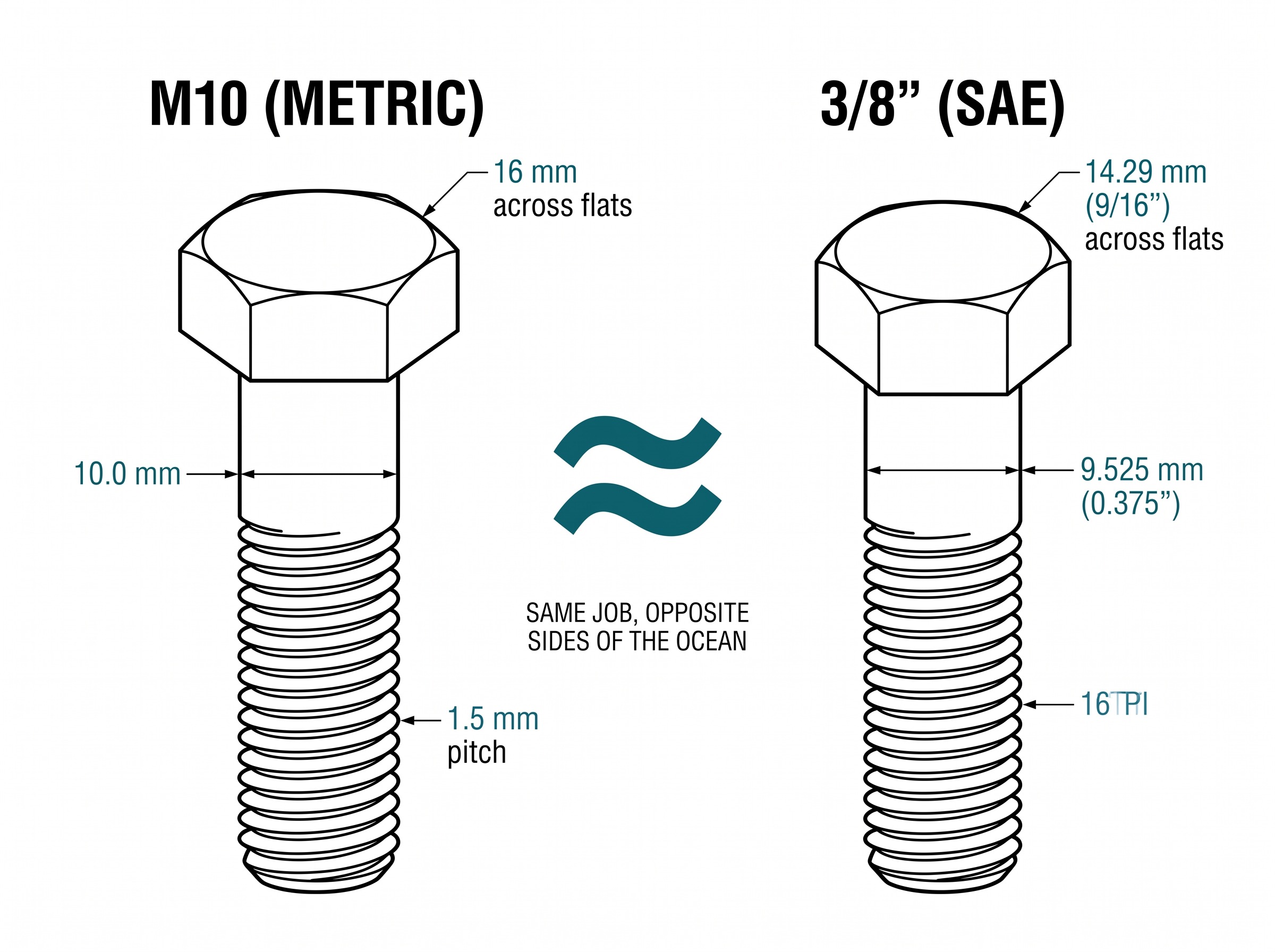
Close by diameter, incompatible by thread. Mixing them cross-threads and ruins both.
By diameter the two are close: M10 is 10mm, 3/8" is 9.525mm. That’s why they fill the same role on either side of the metric line. But they do not interchange. The thread pitches and systems differ, so threading an M10 bolt into a 3/8" hole (or vice versa) cross-threads and ruins both. Their hex heads differ too — M10 takes 16/17mm, 3/8" takes 9/16" — so even your sockets aren’t shared.
| Spec | M10 (metric) | 3/8" (SAE) |
|---|---|---|
| Shank diameter | 10.0 mm | 9.525 mm |
| Common coarse pitch | 1.5 mm | 16 TPI (UNC) |
| Common fine pitch | 1.25 mm | 24 TPI (UNF) |
| Hex head / socket | 16–17 mm | 9/16" |
| Thread angle | 60° | 60° |
How a bolt is actually made
Cold-headed, then thread-rolled — the process that makes the high-volume sizes both cheap and strong.
A bolt isn’t machined from bar stock — that would be slow and waste steel. It’s cold-headed: a cut length of wire is fed into a die and punched into shape — head and shank — at room temperature, in a fraction of a second, by machines that turn out hundreds of blanks a minute. The threads are then rolled, not cut: the blank is pressed between hardened dies that displace the metal into thread form.
That isn’t just cheaper — it’s stronger. Rolling cold-works the surface (raising its hardness) and leaves the steel’s internal grain flowing around the thread rather than cut straight through it, which gives a rolled thread markedly better fatigue strength than a cut one. It’s exactly why the highest-volume sizes, like M10, are virtually always thread-rolled — the size, the process, and the economics all reinforce each other.
What the WhatSizeBolt data shows
A century of standardization, compressed into a parts database.
Across our catalog of more than 330,000 vehicle fasteners, the standardization story shows up clearly:
- 10mm is the single most common socket size — about 41,600 fasteners — because M6 hardware is everywhere. It really is the one you’ll reach for (and lose) most.
- 21mm is the most common lug-nut socket (~15,000 entries), sitting on top of the two dominant wheel-stud threads, M12×1.5 and M14×1.5. (Lug nuts are their own world — that 21mm socket does not fit an M10 or 3/8" bolt.)
- The 13mm, 14mm, and 17mm sockets dominate the structural fasteners across the broader catalog — the heads of the M8, M10, and M12 bolts that hold the car together.
None of that is random. It’s a century of engineering and manufacturing standardization, compressed into a parts database.
Some links below are Amazon affiliate links — as an Amazon Associate we may earn a small commission at no extra cost to you.
3/8"-drive metric socket set
A 3/8"-drive ratchet with a metric socket set is the tool this whole story points to: the 10mm for M6 heads, the 13/14/17mm for the M8/M10/M12 structural bolts, and the 16mm for M10 heads. One set spins nearly every fastener under the hood — and gives you a spare 10mm for the one you’ll inevitably lose.
By the numbers
The exact catalog counts as of today — 330,500 fasteners across every vehicle we track.
Where the 10mm socket lives
Nearly half of every 10mm turn happens in the engine bay — the M6 hex-head cap screws holding stamped-steel and aluminum together. Body panels and transmission pans follow.
| Category | 10mm rows | Share |
|---|---|---|
| Engine | 19,289 | 44.3% |
| Body | 9,531 | 21.9% |
| Transmission | 7,231 | 16.6% |
| Brakes | 2,089 | 4.8% |
| Electrical | 1,568 | 3.6% |
The single most common 10mm fastener across every car in the catalog? The valve cover bolt — 2,043 rows, 2.7× more than the next component. Timing cover, oil pan, water pump, transmission pan, and small-perimeter cylinder-head bolts follow, each about 738 rows apiece. Every one of these is an M6 hex-head cap screw with a 10mm head.
Where the 3/8" socket lives
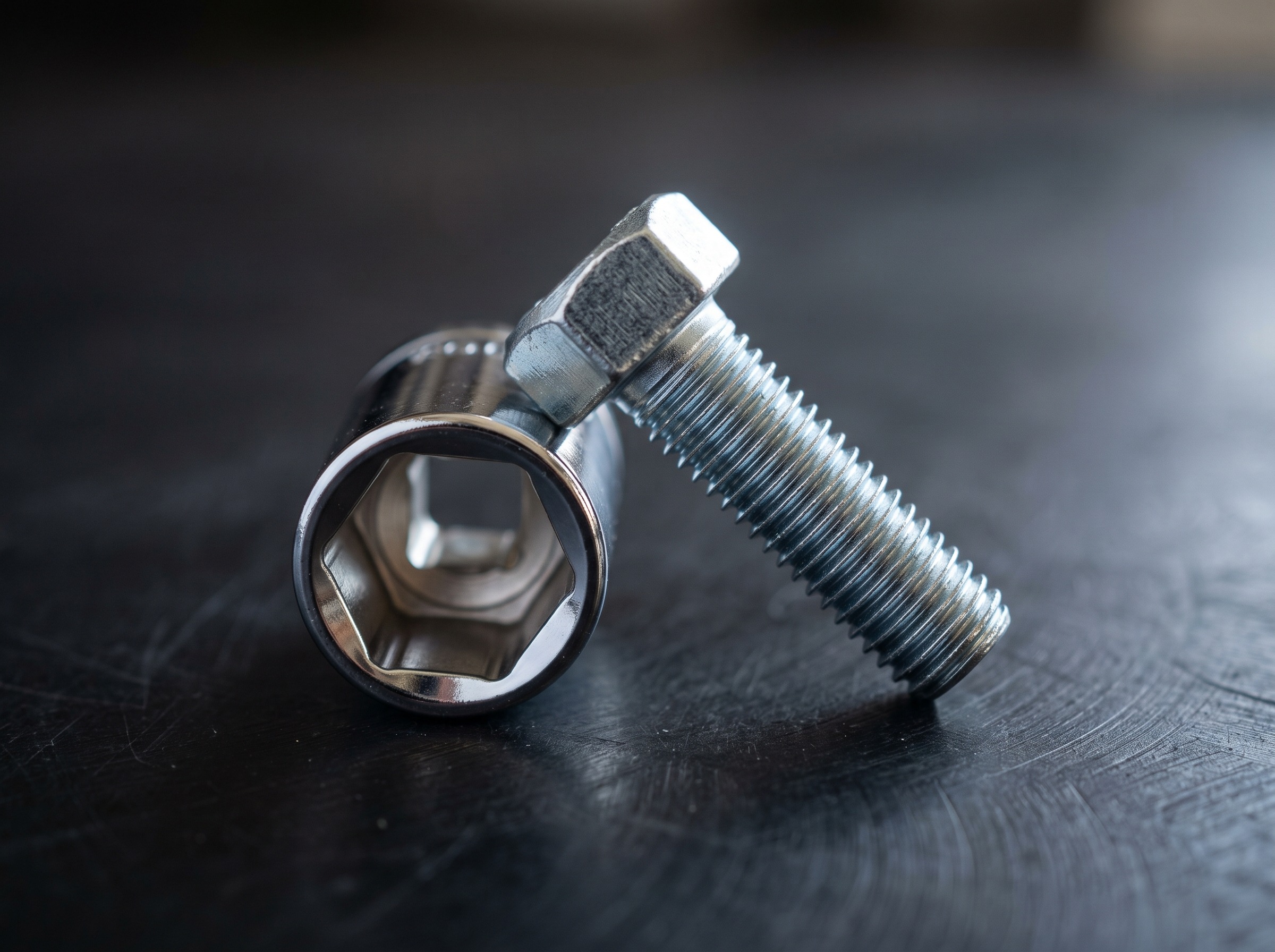
Here is the twist: 92% of every 3/8" fastener in the catalog is in the drivetrain. Not the engine bay. Not the chassis. The drivetrain.
| Component | Rows |
|---|---|
| Differential Drain / Fill Plug | 1,179 |
| Front Axle Hub Nut (4WD) | 307 |
| Transfer Case Drain / Fill Plug | 150 |
| Differential Fill Plug (separate row) | 81 |
| Differential Drain Plug (separate row) | 81 |
| Rear Differential Cover Bolts | 63 |
| Rear Axle Pinion Nut | 25 |
Genuine 3/8"-across-flats hex heads do show up — mostly on pre-1980s US-domestic hardware: starter motor bolts, motor mounts, exhaust manifold bolts, battery terminal bolts on older imperial-only vehicles. Together those account for fewer than 100 rows in the entire modern catalog.
Why engineers still reach for these sizes
When engineers spec fasteners for a brand-new platform, they still default to M10×1.5, M10×1.25, and M12×1.5 — not out of dogma, but economics.
- The standard is proven — billions of these bolts in service since the 1970s.
- Supply is guaranteed — every fastener manufacturer stocks M10; lead times are days, not months.
- Cost is minimized — the highest-volume sizes carry the lowest per-unit price.
- Tools are universal — every shop already owns the sockets.
Once a size becomes standard, manufacturing inertia keeps it there: tooling is dedicated to it, supply chains are built around it, and a car from 1985 still needs the same bolts as one built today.
Frequently asked questions
Why is it always the 10mm socket that goes missing?
Because it’s the one you use most. A 10mm socket fits the head of an M6 bolt, and M6 is the workhorse for brackets, covers, sensors, splash shields, and trim — so that socket leaves your hand more than any other and has more chances to disappear.
Is a 10mm socket the same as a 10mm (M10) bolt?
No. A 10mm socket is 10mm across the flats and fits an M6 bolt head. An M10 bolt is 10mm in diameter and its head takes a 16 or 17mm socket. They’re two different measurements that happen to share the number 10.
Can I use an M10 bolt in place of a 3/8" one, or the reverse?
No. M10 is 10mm and 3/8" is 9.525mm, and their thread pitches and systems are different, so they cross-thread and ruin both parts. Their heads differ too — 16/17mm for M10 versus 9/16" for 3/8" — so even the sockets aren’t interchangeable.
Why not just use bigger, stronger bolts everywhere?
Because size costs weight and money. Going from M10 to M12 adds roughly 45% more steel per bolt, and an M10 already carries about 90% of the practical job for about 70% of the material. Across thousands of fasteners per vehicle, M10 and 3/8" are the efficient choice.
Keep going
Bottom line: “10mm” means two things — the socket (10mm across the flats, for M6 heads) and the M10 bolt (10mm diameter, 16/17mm head). M10 and 3/8" (9.525mm) became the automotive defaults because they hit the load-vs-material sweet spot, got locked in by ISO’s 1947 preferred series and the 1948 Unified Thread Standard, and stayed there on manufacturing inertia. They’re close in diameter but never interchangeable — different pitches, different heads, so measure before you mix them.