LS Head Bolt Torque & Tightening Sequence (Gen III & Gen IV)
By WhatSizeBoltEdited 9 min read
GM LS V8 head-bolt torque: seat the ten 11 mm bolts to 22 ft-lb, then +90 degrees and a final +90/+50 (Gen III) or +70 (Gen IV). Torque-to-yield single-use bolts, plus ARP head stud/bolt specs.

The GM LS V8 uses torque-to-yield (TTY) head bolts torqued with a torque angle (degrees), not a single ft-lb figure — and the spec changed between Gen III and Gen IV. Get the method wrong (or reuse the old bolts) and you risk a blown head gasket, coolant in the oil, or a cracked head. Here are the exact FSM-verified specs and the tightening sequence for the 4.8, 5.3, 6.0 and 6.2 L LS engines.
Which engines this covers
The Gen III/IV small-block (LS) family — trucks, SUVs and performance cars.
| Generation | Engines (RPO) | Where you’ll find them |
|---|---|---|
| Gen III (1997–2007) | LR4 4.8 · LM7/L59 5.3 · LQ4/LQ9 6.0 · LS1/LS6 5.7 | Silverado/Sierra, Tahoe/Suburban, Camaro/Firebird, Corvette C5, GTO |
| Gen IV (2005–2015+) | LY6/LC9/LMG 5.3 · LS2/L76 6.0 · LS3/L92/L94 6.2 · LS7 7.0 · LSA/LS9 6.2 SC | Silverado/Sierra, Tahoe/Escalade, Camaro SS/ZL1, Corvette C6/C7, CTS-V, G8 |
LS head bolt torque specs
Torque-to-yield: a seating torque, then one or two angle turns. Confirm against your service manual.
| Bolt group | Step 1 | Step 2 | Step 3 (final) |
|---|---|---|---|
| Gen III — 11 mm long, inner (#1–8) | 22 ft-lb | +90° | +90° |
| Gen III — 11 mm short, outer (#9–10) | 22 ft-lb | +90° | +50° |
| Gen IV — 11 mm, all ten (#1–10) | 22 ft-lb | +90° | +70° |
| 8 mm perimeter bolts (#11–15) | 22 ft-lb | single pass | — |
Why the tightening sequence matters
The head gasket seals combustion, coolant and oil at once — clamp load has to land evenly.
An LS head gasket (MLS — multi-layer steel) seals high-pressure combustion gas in each cylinder and the coolant and oil passages between head and block. Fully torque one bolt before the rest and you pull that corner down while the others lift — warping the deck and loading the MLS layers unevenly. Because the final clamp is set by an angle, every bolt has to start from the same 22 ft-lb seat and be turned in the right order, or the finished clamp loads are all over the map.
LS head bolt tightening sequence
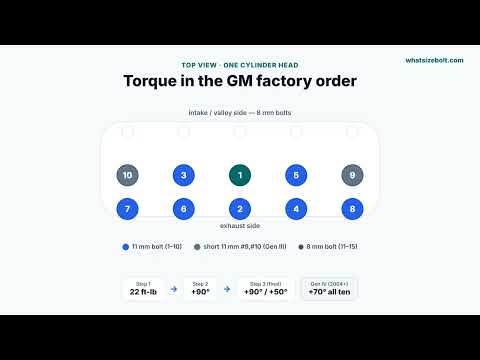
Ten 11 mm bolts first, center-out; five 8 mm perimeter bolts last.

Run the ten 11 mm bolts through all their passes first, starting from the center pair and working outward, alternating side to side — the two short outer bolts (#9–10 on Gen III) end up last. Then torque the five 8 mm perimeter bolts to 22 ft-lb in one pass, center-out. Do the whole thing per head.
How to torque LS head bolts, step by step
Clean, new bolts, light oil, then seat-and-angle.
- Fit NEW torque-to-yield head bolts — factory LS head bolts are single-use; reusing stretched bolts gives a false, low clamp load.
- Clean and dry the deck and bolt holes — chase the threads with a thread chaser if needed; a dirty or oiled blind hole gives a false reading.
- Lightly oil the bolt threads and under the heads with clean engine oil (GM spec) — not anti-seize, which changes the torque.
- Seat all ten 11 mm bolts to 22 ft-lb in the numbered sequence (1–10).
- Turn every 11 mm bolt +90° in sequence (use a torque-angle gauge, not eyeballing).
- Final pass on the 11 mm bolts — Gen III: +90° on the long inner bolts, +50° on the two short bolts (#9,#10); Gen IV: +70° on all ten.
- Torque the five 8 mm bolts (11–15) to 22 ft-lb in a single pass.
- Use a calibrated torque wrench and angle gauge — never an impact gun.
ARP head bolts & studs (the reusable alternative)
ARP hardware is not torque-to-yield: straight torque, no angle, and reusable — the go-to for rebuilds and boost.
ARP fasteners are torqued to a flat ft-lb value (no angle) using ARP Ultra-Torque assembly lube, and they can be reused. The exact number depends on the kit and the washer that ships with it — always follow the printed instruction sheet in your box and use ARP’s lube; the values below are from ARP’s official instructions.
| ARP kit | 11 mm bolts/studs | 8 mm bolts |
|---|---|---|
| Head STUD kit #234-4317 | 25 → 50 → 70 ft-lb (flat washer) or 80 ft-lb (stamped washer) | 28 ft-lb |
| Head BOLT kit #134-3610 | 25 → 50 → 80 ft-lb | 25 ft-lb |
What size socket do LS head bolts take?
The “11 mm” and “8 mm” in the specs are thread sizes — the driver that fits the head is different, and it changes with OEM vs ARP hardware.
| Hardware | Head / drive | Tool |
|---|---|---|
| OEM factory bolts — ten 11 mm (#1–10) | external hex | 15 mm socket |
| OEM factory bolts — five 8 mm (#11–15) | external hex | a smaller socket — measure the head before you buy |
| ARP head bolts (#134-3610) | hex head | hex socket — confirm the size on ARP’s instruction sheet |
| ARP head studs (#234-4317) | reduced 12-point nuts | a 12-point socket (a 6-point won’t seat on the reduced nut) |
Tools and parts for the job
A head job is a bad place to improvise — order anything you’re missing before you start.
Some links below are Amazon affiliate links — as an Amazon Associate we may earn a small commission at no extra cost to you.
1/2" torque wrench
You need an accurate 22 ft-lb seat before the angle passes. A calibrated 1/2" drive wrench covers the LS range.
Torque angle gauge
LS head bolts are set by angle, not ft-lb. A torque-angle gauge (or an angle-reading wrench) is the only way to hit +90° and +50°/+70° repeatably.
ARP LS head bolt kit
Non-TTY and reusable, unlike the factory stretch bolts — the standard upgrade for a rebuild or repeated teardowns. Match the kit to your engine and check the drive type and torque on the instruction sheet in the box. Studs (#234-4317) hold more but need the head completely off, so bolts are the practical pick for an in-car job.
LS MLS head gasket set
Fresh multi-layer-steel gaskets are non-negotiable on reassembly — match the set to your bore and gen.
Common mistakes
Five ways an LS head job turns into a comeback.
- Reusing factory head bolts — LS factory bolts are torque-to-yield and single-use; reused bolts under-clamp the gasket.
- Torquing to “65 ft-lb straight” — that’s the old pre-TTY method for older small-blocks; it is wrong for LS, which uses 22 ft-lb + angle.
- Using the wrong final angle — applying Gen III’s +50° short-bolt step to a Gen IV engine (uniform +70°), or a +90° to a short Gen III bolt.
- The wrong 8/2 vs 5/5 split — on Gen III the +50° is the two short inner-row bolts (#9–10), not “bolts 6–10” as some sites claim.
- Skipping the angle gauge — eyeballing 90° or 50° wrecks the clamp load on a TTY joint.
Frequently asked questions
What is the head bolt torque on an LS engine?
Factory LS head bolts are torque-to-yield: seat the ten 11 mm bolts to 22 ft-lb, turn +90°, then a final pass. On Gen III (1997–2007) the final pass is +90° on the eight long inner bolts and +50° on the two short bolts; on Gen IV (2004+) it’s a uniform +70° on all ten. The five 8 mm bolts get 22 ft-lb in one pass. Always use new bolts.
Can I reuse LS head bolts?
No. Factory LS head bolts (both Gen III and Gen IV) are torque-to-yield — they stretch permanently during the angle passes and must be replaced whenever the heads come off. If you want reusable hardware, use ARP bolts or studs, which are not torque-to-yield.
What’s the difference between Gen III and Gen IV LS head bolt torque?
Step 1 (22 ft-lb) and step 2 (+90°) are the same. The final pass differs: Gen III splits it by bolt length (+90° on the eight long bolts, +50° on the two short bolts), while Gen IV uses one 155.5 mm bolt length throughout and turns all ten a uniform +70°.
What is the ARP torque spec for LS head studs?
For the ARP head stud kit #234-4317 with ARP Ultra-Torque lube: 25, then 50, then 70 ft-lb (flat washer) or 80 ft-lb (stamped washer) on the 11 mm nuts, and 28 ft-lb on the 8 mm bolts. ARP head bolt kit #134-3610 runs 25/50/80 ft-lb on the 11 mm and 25 ft-lb on the 8 mm. Always follow the sheet in your kit and use ARP’s lube.
Keep going
Bottom line: LS head bolts are torque-to-yield — seat all ten 11 mm bolts (1–10) to 22 ft-lb, turn +90°, then a final +90°/+50° (Gen III) or +70° (Gen IV), then the five 8 mm bolts (11–15) at 22 ft-lb. Fit new bolts every time (or switch to ARP), use a torque-angle gauge, and follow the GM factory numbered sequence for a flat, even MLS seal.
Video plays from YouTube when clicked. Always confirm torque values against your service manual.