100 Years of Socket Drives: Why the 3/8" Drive Won the Garage
By WhatSizeBoltEdited 5 min read
The square on your ratchet is the survivor of a hundred-year argument. Which drive to use for which job, practical torque ranges, adapter safety - and how the 3/8" quietly won.
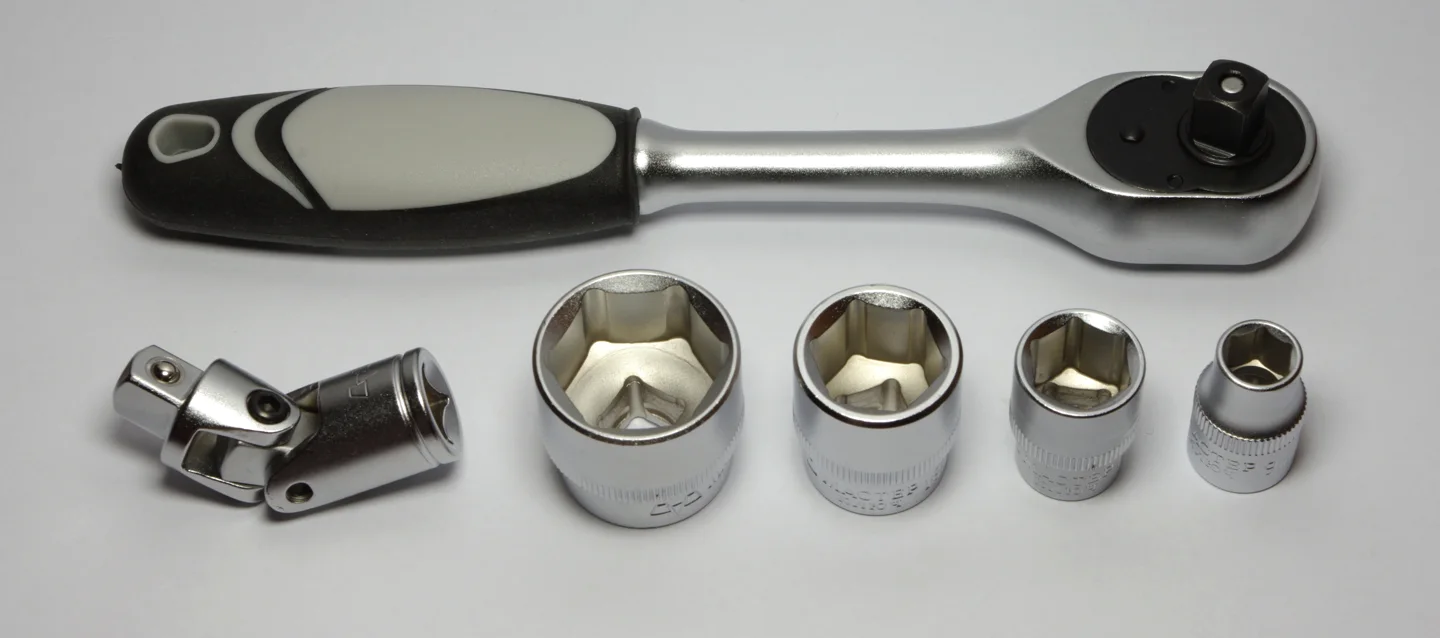
An ordinary ratchet and sockets, not a torque wrench.
Photo: Kae · CC BY-SA 3.0 · Resized without cropping for the article hero.
Pick up any ratchet and the square on its head is one of three sizes: 1/4”, 3/8” or 1/2”. That little square is the survivor of a hundred-year argument about how much wrench a mechanic actually needs — an argument the 3/8” drive quietly won. Here’s the history in two minutes, and the practical rules for which drive to grab for which job.

The three squares in your toolbox
Same idea at three scales: a bigger square carries more torque but costs you access, weight and feel.
| Drive | Working range* | Typical sockets | What it’s really for |
|---|---|---|---|
| 1/4” | ≈20–180 in-lb | 4–14 mm | Interior trim, sensors, valve-cover and small-engine work, electronics — and aviation, where specs run in inch-pounds |
| 3/8” | ≈10–75 ft-lb | 8–19 mm | The default: spark plugs, drain plugs, brackets, most engine-bay and brake hardware |
| 1/2” | ≈50–250 ft-lb | 13–32 mm | Lug nuts, axle and suspension bolts, crank pulleys — anything you torque with two hands |
| 3/4” & 1” | 250 ft-lb and way up | 1–3”+ | Trucks, agriculture, industrial plant — drives sized for breaker bars and multipliers |
*Working ranges are practical guidance for choosing a drive, not a per-fastener spec. Always torque to the number your vehicle’s manual (or our database) gives for the exact fastener.
How we got here: 1863 to today

The ratchet is older than the car: the first US ratchet-wrench patent was granted in 1863 (J. J. Richardson) — so the wrench-vs-ratchet argument predates the automobile it would eventually serve.
When interchangeable socket sets took over professional garages around 1920, the 1/2” drive ruled. Cars of that era carried big, coarse hardware, and one stout drive square handled all of it. By 1928 toolmakers were shipping 3/8” drive lines for the growing share of smaller fasteners — and per tool-industry records (Snap-on and Blackhawk catalog history preserved by Alloy Artifacts), the 3/8” share basically never stopped climbing.
Postwar cars sealed it: tighter engine bays, smaller metric-trending hardware, torque specs mostly in the 10–75 ft-lb band. Today 3/8” runs the auto bay, aviation lives on 1/4” (inch-pound territory, where over-torque is a wreck report), and heavy industry swings 3/4” and up.
Why 3/8” won
- It sits on the fat of the curve. Line up every torque spec on a modern car and the bulk lands between 10 and 75 ft-lb — exactly the 3/8” sweet spot. The 1/2” is overkill there; the 1/4” taps out.
- Access beats capacity. A 3/8” head and socket are dramatically slimmer than 1/2” equivalents — and in a modern engine bay, fitting the tool on the fastener is half the job.
- Feel. Light hardware strips before a 1/2” breaker even loads up. The smaller drive gives your hand a chance to feel a cross-thread or a bottomed bolt before it becomes a repair.
- One drive, most jobs. A single 3/8” set with 8–19 mm sockets covers the large majority of routine car maintenance — which is why it’s the drive that lives on the bench.
Matching the drive to the torque wrench
Torque wrenches follow the same logic: accuracy lives in the middle of the range, so buy the wrench whose drive and range center on your specs. An in-lb 1/4” or 3/8” wrench for small stuff, a 3/8” ft-lb wrench for engine work, a 1/2” for wheels and suspension. A single 10–170 ft-lb 1/2” clicker used at 15 ft-lb is guessing.
Some links below are Amazon affiliate links — as an Amazon Associate we may earn a small commission at no extra cost to you.
CRAFTSMAN 3/8” Drive Torque Wrench (CMMT99433)
A mid-range 3/8” clicker covers the band where most of a car’s specs live — spark plugs, drain plugs, brackets, brake hardware. Pair it with a 1/2” wrench for lug nuts and you’re covered end to end.

Frequently asked questions
Which socket drive size should I buy first?
3/8”. With 8–19 mm sockets it covers most routine car maintenance. Add 1/2” when wheels or suspension enter the picture, and 1/4” when you find yourself on trim and sensors.
What drive do I need for lug nuts?
1/2”. Passenger-car lug nuts run roughly 80–150 ft-lb — above the comfortable 3/8” band. Look your exact spec up by year, make and model in our database.
Is it safe to use a 3/8”-to-1/2” adapter?
For snugging light hardware, yes. For breaking loose or final-torquing high-spec fasteners, no — the 3/8” square becomes the fuse, and adapters add joint slop that throws torque accuracy off.
Why does aviation use 1/4” drive?
Aircraft hardware is small, light and torque-critical — specs are written in inch-pounds, and over-torque is treated as damage. The 1/4” drive (and in-lb torque wrenches) match that scale.
When was the ratchet invented?
The first US ratchet-wrench patent dates to 1863 — decades before the automobile. Interchangeable socket sets as we know them took over garages in the early 1920s.
Keep going
Bottom line: the square sizes on your ratchets are a century of garage consensus. Default to 3/8”, keep 1/2” for the big stuff, 1/4” for the delicate stuff — and when you need the exact socket for an exact bolt, the wrench & socket finder answers in one search.

Video plays from YouTube when clicked. Always confirm torque values against your service manual.