When to Replace vs. Reuse Bolts: A Mechanic's Decision Guide
By WhatSizeBoltEdited 8 min read
Every time you remove a bolt, you face a decision: reuse it or replace it? It seems like a simple choice, but the wrong decision can lead to broken bolts, stripped threads, or catastrophic part failures. This guide gives you the definitive framework for making the right call every time.
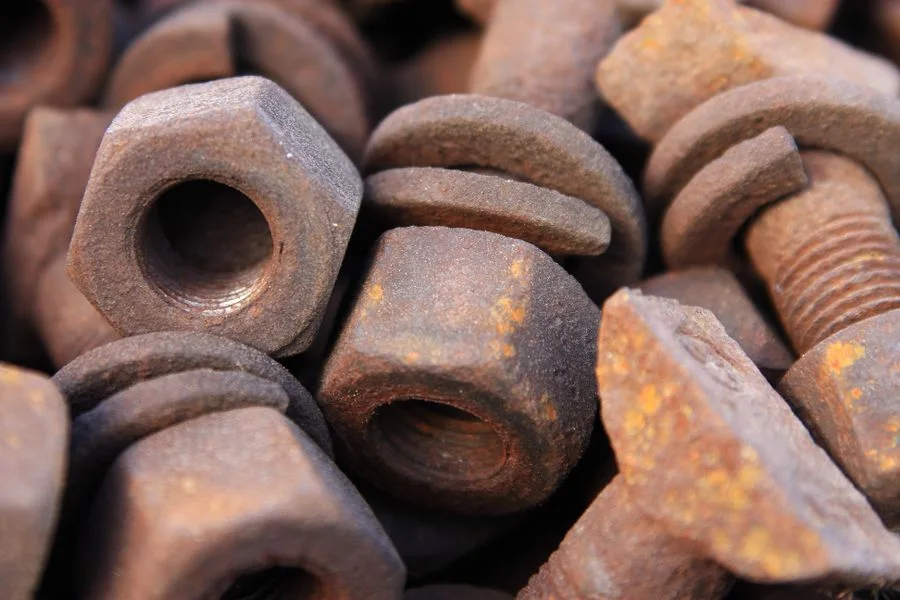
Visible corrosion for inspection context, not a reuse verdict or an extraction procedure.
Photo: gervee · Pexels License · Resized without cropping for the article hero.
Overview
Every time you remove a bolt, you face a decision: reuse it or replace it? It seems like a simple choice, but the wrong decision can lead to broken bolts, stripped threads, or catastrophic part failures. This guide gives you the definitive framework for making the right call every time.The Short Answer
Replace a bolt when in doubt. Fasteners are the cheapest component in any repair. A new bolt costs pennies to dollars. A failed bolt can cost hundreds or thousands in repairs — or put lives at risk.Why Bolts Shouldn't Always Be Reused
What Happens to a Bolt When You Torque It
The Definitive Reuse Decision Matrix
✅ SAFE TO REUSE
| Condition | Why It's Okay | ||| | Grade 2 bolts (low-stress) | Never stressed near yield, plenty of life remaining | | Non-critical cosmetic fasteners | Interior trim, covers, guards — failure isn't dangerous | | Bolts removed during normal maintenance | Oil drain plugs, inspection covers — if they weren't over-torqued | | Threads are clean with no visible damage | No galling, cross-threading, or deformation | | Low-heat, low-vibration environment | Bolts in non-stressed locations | | Removed and reinstalled only 1-2 times | Minimal fatigue cycles | | Hardware store / general-purpose bolts | Cheap to replace, low consequence of failure |⚠️ CONDITIONAL — INSPECT BEFORE REUSING
| Condition | What to Check | ||| | Grade 5 bolts in non-critical applications | Look for thread wear, measure length (elongation = stress) | | Suspension bolts | Thread condition, corrosion, torquing history | | Exhaust bolts | Extreme heat exposure — check for discoloration, scaling | | Bolts in aluminum threads | Thread deformation is more likely — inspect carefully | | Bolts exposed to moisture/salt | Corrosion pitting in threads |❌ NEVER REUSE — ALWAYS REPLACE
| Condition | Why It's Dangerous | ||| | Torque-to-yield (TTY) bolts | Designed to stretch permanently — second torque is unreliable | | Head bolts (most modern engines) | Engine manuals almost always specify new bolts | | Main bearing cap bolts | Extreme loads — reused bolts can cause bearing failure | | Connecting rod bolts | Catastrophic engine failure if reused and fatigued | | Brake caliper bolts | Failure = loss of braking — never worth the risk | | Suspension-to-frame bolts | Structural failure risk | | Any bolt showing thread damage | Stripped, cross-threaded, or galled threads won't hold proper torque | | Any bolt that has been stretched | Visible necking, elongated length, or permanent set | | Any bolt exposed to extreme heat | Heat changes metallurgy — bolt may be embrittled | | Corroded or rusted bolts | Internal thread damage invisible from outside | | Bolts from a failed joint | The failure indicates the bolt was compromised |Understanding TTY (Torque-to-Yield) Bolts
What Makes TTY Bolts Special
TTY bolts are engineered to stretch permanently during installation. This creates a very precise and consistent clamping force. The problem: once stretched, they can't stretch the same way again.Where You'll Find TTY Bolts
The Risk of Reusing TTY Bolts
How to Inspect a Bolt for Reuse
Visual Inspection Checklist
Thread Measurement Test
Magnetic Particle Inspection (Advanced)
Application-Specific Guidelines
Automotive Engine Bolts
| Bolt Type | Always Replace? | Notes | |||| | Cylinder head bolts | ✅ Yes | TTY on most modern engines | | Main cap bolts | ✅ Yes | High-load, fatigue-critical | | Rod bolts | ✅ Yes | If in doubt, replace | | Rocker arm bolts | ❌ Usually safe | Low stress if torque spec is normal | | Oil pan bolts | ❌ Usually safe | Replace if threads are damaged | | Exhaust manifold bolts | ⚠️ Inspect | Extreme heat exposure — check carefully | | Valve cover bolts | ❌ Usually safe | Low torque, low stress |Automotive Chassis & Suspension
| Bolt Type | Always Replace? | Notes | |||| | Ball joint nuts | ❌ Usually safe | Unless visibly damaged | | Control arm bolts | ⚠️ Inspect | High-load area | | Sway bar link bolts | ❌ Usually safe | Low torque application | | Strut tower bolts | ⚠️ Inspect | Structural — be cautious | | Brake caliper bolts | ✅ Yes | Safety-critical | | Lug nuts / wheel bolts | ⚠️ Inspect | Replace if threads, seat or shank are damaged; follow the OEM manual |General/Industrial Fasteners
| Application | Reuse? | Notes | |||| | Structural bolts (A325/A490) | ❌ No | Building/frame connections | | Machinery bolts | ⚠️ Inspect | Depends on load and environment | | Electrical conduit bolts | ✅ Usually safe | Low stress | | Plumbing bolts | ⚠️ Inspect | Corrosion-prone environments |The Economics of Bolt Replacement
Cost Comparison
| Scenario | Cost of New Bolt | Cost of Failure | |||| | Oil drain plug | $1-$3 | $200-$1,000 (stripped oil pan) | | Head bolt | $2-$10 | $1,000-$3,000 (head gasket failure) | | Lug nut/bolt | $0.50-$2 | ∞ (wheel loss = catastrophic) | | Caliper bolt | $1-$5 | $500-$2,000 (brake failure) | | Exhaust manifold bolt | $1-$3 | $200-$800 (manifold damage) |The Rule of Thumb
> If the component costs more than $50 to repair, and the bolt costs less than $5 to replace, always replace the bolt.Best Practices for Bolt Storage and Inventory
Keeping New Bolts Organized
When Buying Replacement Bolts
Frequently Asked Questions
Q: What if I already reused a torque-to-yield bolt?
A: Monitor closely. Check for leaks, unusual noises, or loosening. Have a mechanic inspect the joint if possible. Don't rely on the same TTY bolt twice.Q: Can I reuse bolts if I apply more torque than before?
A: No. Over-torquing a reused bolt is dangerous — it may already be fatigued and could snap under excessive force. The proper approach is to replace, not over-torque.Q: How many times can I reuse a non-TTY Grade 5 bolt?
A: It depends on the application. In non-critical, low-vibration environments, 2-3 reuses with proper inspection is generally acceptable. In any safety-critical application, replace every time.Q: My bolt came out easily — does that mean it's fine to reuse?
A: Not necessarily. Easy removal usually means the bolt wasn't torqued to spec, or corrosion didn't bond it. The bolt could still be fatigued from previous use.Q: Are stainless steel bolts stronger and can they be reused more?
A: Stainless is not inherently stronger than carbon steel — it's just more corrosion resistant. Reuse guidelines for stainless are similar to carbon steel of the same grade.Related Articles
Tools for doing it right the second time
Reusing a bolt is only safe if you can torque it accurately — and torque-to-yield hardware needs an angle, not a number.
Some links below are Amazon affiliate links — as an Amazon Associate we may earn a small commission at no extra cost to you.
1/2" click torque wrench (10–150 ft-lb)
The whole reuse-or-replace decision assumes the replacement gets torqued correctly. A click wrench in the 10–150 ft-lb band covers most suspension, driveline and cylinder-head work.
Torque angle gauge
Any bolt this guide tells you to replace rather than reuse is usually torque-to-yield, which means a seating torque followed by a measured turn. Eyeballing 90° is not close enough on a head or rod bolt.