Bolt Grade Guide: SAE & Metric Strength Ratings
Count the radial lines on an SAE bolt head or read the metric class number to gauge a fastener's strength at a glance—and never fit one too weak for the job.
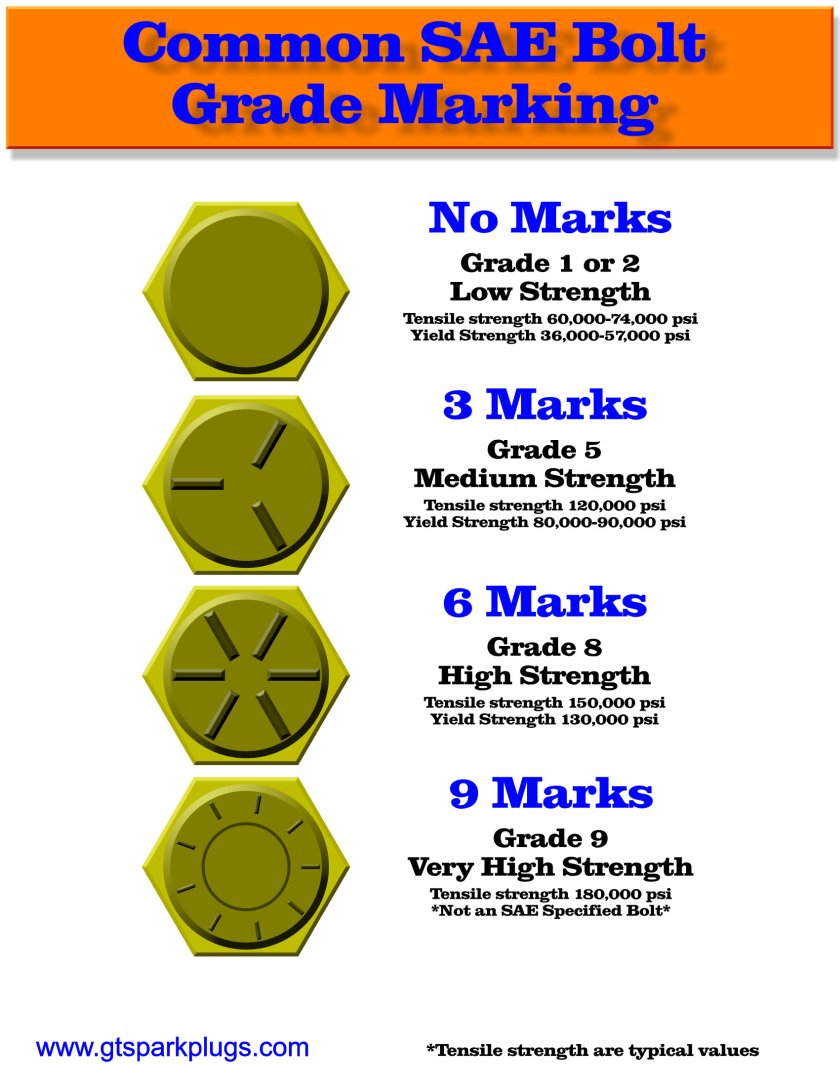
A bolt's grade (SAE) or class (metric) tells you how strong it is — its ultimate tensile strength, its yield point, and how much clamping force it can safely hold. Using the wrong grade is one of the most common and most dangerous fastener mistakes a DIYer can make: a bolt that looks identical can be less than half as strong, and a grade that's too low in a suspension, brake, or engine joint can shear under load. This guide explains every common marking so you can read a bolt head at a glance and match the manufacturer's spec with confidence.
What Do Bolt Grade Markings Mean?
SAE and metric fasteners use two different marking systems stamped right on the bolt head.
SAE bolts use raised radial lines on the head to indicate strength: no lines means Grade 2, three lines means Grade 5, and six lines means Grade 8 — count the lines and add two. Metric bolts instead carry a stamped two-number class such as 8.8, 10.9, or 12.9. There are no lines to count; you read the printed number directly. Both systems are widely used, and many vehicles mix them, so it pays to recognize both.
SAE Bolt Grades Explained
| Grade | Head Markings | Material | Tensile Strength | Typical Use |
|---|---|---|---|---|
| Grade 2 | None | Low/medium carbon steel | 74,000 psi | Non-critical hardware, brackets, trim |
| Grade 5 | 3 radial lines | Medium carbon, quenched & tempered | 120,000 psi | General automotive — e.g. the 2020 Toyota Camry |
| Grade 8 | 6 radial lines | Medium carbon alloy, quenched & tempered | 150,000 psi | High-stress: suspension, axles, the 2022 Ford F-150 |
Grade 5 is the workhorse of most automotive applications, while Grade 8 is reserved for high-stress, safety-critical areas like suspension links, axle hardware, and engine mounts. Grade 2 is fine for light brackets and interior trim but should never appear in a load-bearing joint. Stainless fasteners (marked 18-8, A2, or A4) resist corrosion well but are generally weaker than Grade 5 — do not assume "stainless" means "stronger."
Metric Bolt Classes Explained
| Class | Tensile (MPa) | Yield (MPa) | SAE Equivalent | Common Use |
|---|---|---|---|---|
| 4.6 | 400 | 240 | ~Grade 2 | Low-strength general hardware |
| 8.8 | 800 | 640 | ~Grade 5 | General automotive |
| 10.9 | 1000 | 900 | ~Grade 8 | High-strength: suspension, brakes |
| 12.9 | 1200 | 1080 | > Grade 8 | Extreme stress: engine internals |
1/2" Drive Click Torque Wrench
A bolt's grade sets how hard you can pull it — guessing by feel either under-clamps a joint or snaps the head. A calibrated click wrench lets you hit the exact spec for the grade you're installing.
As an Amazon Associate, WhatSizeBolt earns from qualifying purchases.
Choosing the Right Grade for Your Job
Always match the manufacturer's specification, especially in safety-critical locations. When you replace a bolt, check its head marking and buy the same grade — or higher only if the service manual allows it. Never substitute a lower grade (such as an 8.8) where a 10.9 or 12.9 is required. To find the exact OEM fastener and torque for your vehicle, use our free Vehicle Fastener Specs tool.
Frequently Asked Questions
Can I use a Grade 8 bolt where Grade 5 is specified?
Usually yes for strength, but not always. A higher-grade bolt is harder and less ductile, and some joints are designed to flex slightly or to have the bolt yield before a more expensive part. Follow the service manual rather than assuming stronger is better.
What does "10.9" actually mean?
The first number times 100 is the approximate ultimate tensile strength in MPa (10 × 100 = 1,000 MPa), and the two numbers multiplied by 10 give the yield strength (10 × 9 × 10 = 900 MPa).
Are stainless steel bolts stronger than graded steel?
No. Common 18-8 (A2) stainless is corrosion-resistant but typically weaker than a Grade 5 / class 8.8 bolt. Use stainless for rust resistance, not for high clamp load.
My bolt has no markings — what grade is it?
No radial lines on an SAE bolt means Grade 2 (low strength). Treat unmarked hardware as non-structural and replace it with a marked, known grade in any load-bearing location.
Next, learn how to confirm the right diameter and pitch in our Thread Pitch Guide, see the differences between systems in our Metric vs Standard Bolts guide, or browse the full Bolt Size Chart.