Whitworth Spanner & Socket Size Chart: BSW & BSF Across-Flats to Metric
By WhatSizeBolt TeamEdited 5 min read
The full Whitworth and BSF spanner/socket chart: across-flats size in inches and mm for every bolt, the BSF size each spanner also fits, and the closest metric socket.
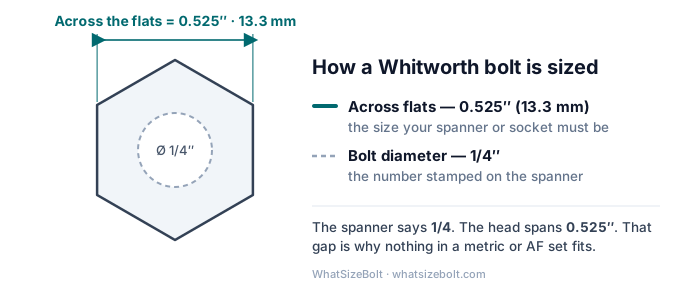
If you have ever held a spanner stamped 1/4 W against a metric or AF socket set and found that nothing matched, you have hit the single most confusing thing about British tools: Whitworth and BSF spanners are numbered by the diameter of the bolt they fit, not by the distance across the flats of the hexagon. Every other system — metric, AF/SAE — names the tool by the hex itself. Whitworth names it by the thread. That one difference is why your wrenches “do not fit,” and it is why this chart exists.
This is the quick-reference companion to our guide on British thread standards, which covers Whitworth, BSF, BA, BSP and BSC. That guide explains the thread; this one gets you the right tool.

Whitworth & BSF spanner size chart
Across-flats (A/F) is the real hex dimension — the size that matters when you reach for a socket. Each Whitworth spanner also fits one BSF size, because a BSF head is made one size smaller than the Whitworth head of the same diameter, so the BSF bolt one size up shares the same hexagon. The metric column is the closest commercial socket; read the fit note below before you trust it on a tight bolt.
| Bolt size (Whitworth) | Also fits (BSF) | Across flats (in) | Across flats (mm) | Closest metric socket |
|---|---|---|---|---|
| 1/8 W | 3/16 BSF | 0.338" | 8.6 mm | 9 mm |
| 3/16 W | 1/4 BSF | 0.445" | 11.3 mm | 11 mm |
| 1/4 W | 5/16 BSF | 0.525" | 13.3 mm | 13 mm |
| 5/16 W | 3/8 BSF | 0.600" | 15.2 mm | 15 mm |
| 3/8 W | 7/16 BSF | 0.710" | 18.0 mm | 18 mm |
| 7/16 W | 1/2 BSF | 0.820" | 20.8 mm | 21 mm |
| 1/2 W | 9/16 BSF | 0.920" | 23.4 mm | 24 mm |
| 9/16 W | 5/8 BSF | 1.010" | 25.7 mm | 26 mm |
| 5/8 W | 11/16 BSF | 1.100" | 27.9 mm | 28 mm |
| 3/4 W | 13/16 BSF | 1.300" | 33.0 mm | 33 mm |
| 7/8 W | — | 1.480" | 37.6 mm | 38 mm |
| 1 W | — | 1.670" | 42.4 mm | 42 mm |
A/F values are the reduced (post-1920s British Standard) hexagon sizes that modern Whitworth spanners are cut to. Pre-1920s bolts used a larger hex — see the wartime note below.
Why the number on the spanner is not the size of the jaws
On a metric spanner, “13 mm” means the jaws are 13 mm apart. On a Whitworth spanner, “1/4 W” means it fits a 1/4-inch-diameter bolt — whose hexagon happens to measure 0.525 in across the flats. The stamped fraction describes the thread, not the tool. Once you know that, the confusion disappears: to find your spanner, measure the bolt shank (or read it off the head), not the gap you need to span.
BSF (British Standard Fine) uses the very same 55° thread form and the very same hexagons as Whitworth — it just pairs them with finer pitches and slightly smaller heads. The practical result is the dual marking you see on British spanners: “1/4 W — 5/16 BSF” on one end means that single opening fits both a 1/4-inch Whitworth bolt and a 5/16-inch BSF bolt. The rule holds all the way up: the Whitworth size is always 1/16 inch smaller than the BSF size that shares the spanner.
The wartime size change (why two “1/4 W” spanners can differ)
During the Second World War, Britain reduced Whitworth and BSF hexagon sizes to save steel. A pre-war 1/4 W spanner will actually fit a wartime-or-later 5/16 W bolt — the head shrank by one size. Nearly every spanner you will buy today is cut to the reduced post-war standard in the chart above, which is why an old family toolkit sometimes has two “1/4 W” spanners that are visibly different. If a spanner is a hair loose on a very old bolt, that is why; reach for the next size down.
Will a metric or AF socket fit a Whitworth bolt?
Sometimes — but check the numbers first, because Whitworth hex sizes fall between metric sizes. A socket has to be equal to or a touch larger than the across-flats dimension to seat; a socket even a few tenths of a millimetre too small will not go on, and one too large rounds the corners of the head. Using the chart:
- 1/4 W (13.3 mm): a 13 mm is the closest and usually works; a 1/2-inch AF socket (12.7 mm) is too small.
- 1/2 W (23.4 mm): use a 24 mm, not 23 mm — 23 mm is under the hex and will not seat.
- 3/8 W (18.0 mm): an 18 mm is almost exact and the one genuinely clean swap on the chart.
Two rules keep you out of trouble: prefer a 6-point socket (a 12-point is far more likely to round a slightly-mismatched head), and never use an approximate substitute on a seized or high-torque fastener — that is exactly when a proper Whitworth socket earns its place.
Need the actual tools?
Whitworth and BSF sizes are not in a standard metric or AF set — you need spanners and sockets cut to these hexagons. A combination Whitworth/BSF set covers the common 1/4 W to 5/8 W range you will meet on most British classics.
Shop Whitworth & BSF spanner and socket sets on Amazon →As an Amazon Associate, WhatSizeBolt earns from qualifying purchases — at no extra cost to you.
Quick answers
What size wrench do I need for a 1/4 Whitworth bolt?
A spanner marked 1/4 W (also stamped 5/16 BSF). Across the flats it is 0.525 in, or 13.3 mm — so a 13 mm socket is the closest metric substitute.
Is Whitworth the same as BSF?
The thread form (55°) and hex sizes are shared, so one spanner fits both, but the pitches differ — BSF is the fine-thread series. A 1/4 W spanner also fits a 5/16 BSF bolt.
How do I convert Whitworth to metric?
There is no exact conversion — Whitworth sizes sit between metric sizes. Use the across-flats millimetre value in the chart and pick the nearest socket that is equal or slightly larger, ideally 6-point.
Working on a British classic and not sure which thread you are even looking at? Start with how to identify BSW, BSF, BA, BSP and Cycle threads, then come back here for the tool.

Video plays from YouTube when clicked. Always confirm torque values against your service manual.