Bolt Pattern (PCD) Explained: How to Read & Measure It
By WhatSizeBolt TeamEdited 4 min read
A bolt pattern (PCD) is two numbers: lug count × bolt-circle diameter in millimeters. Learn what 5×114.3 means, how to measure 4, 5, and 6-lug wheels correctly, and why even a few millimeters off means the wheel won't fit.

You found the perfect set of wheels. Great offset, staggered widths, a deal too good to scroll past. They show up, you grab the lug wrench, line them up to the hub and… the holes don't match. Womp. You just met bolt pattern — the single most-ignored number in wheel fitment, and the one most likely to torpedo your Saturday. Good news: it takes about 30 seconds to read and measure once you know the trick. Let's decode it.
What "5×114.3" Actually Means
A bolt pattern (a.k.a. PCD — Pitch Circle Diameter) is just two numbers describing the ring of lug holes:
- First number = how many lugs. 4, 5, 6, 8… count the holes.
- Second number = the diameter of the imaginary circle those holes sit on, in millimeters. So 5×114.3 = five lugs on a 114.3 mm circle.
How to Measure It (the part everyone gets wrong)
Even-lug patterns are easy. Five-lug is the gremlin. Here's every common layout in one shot:
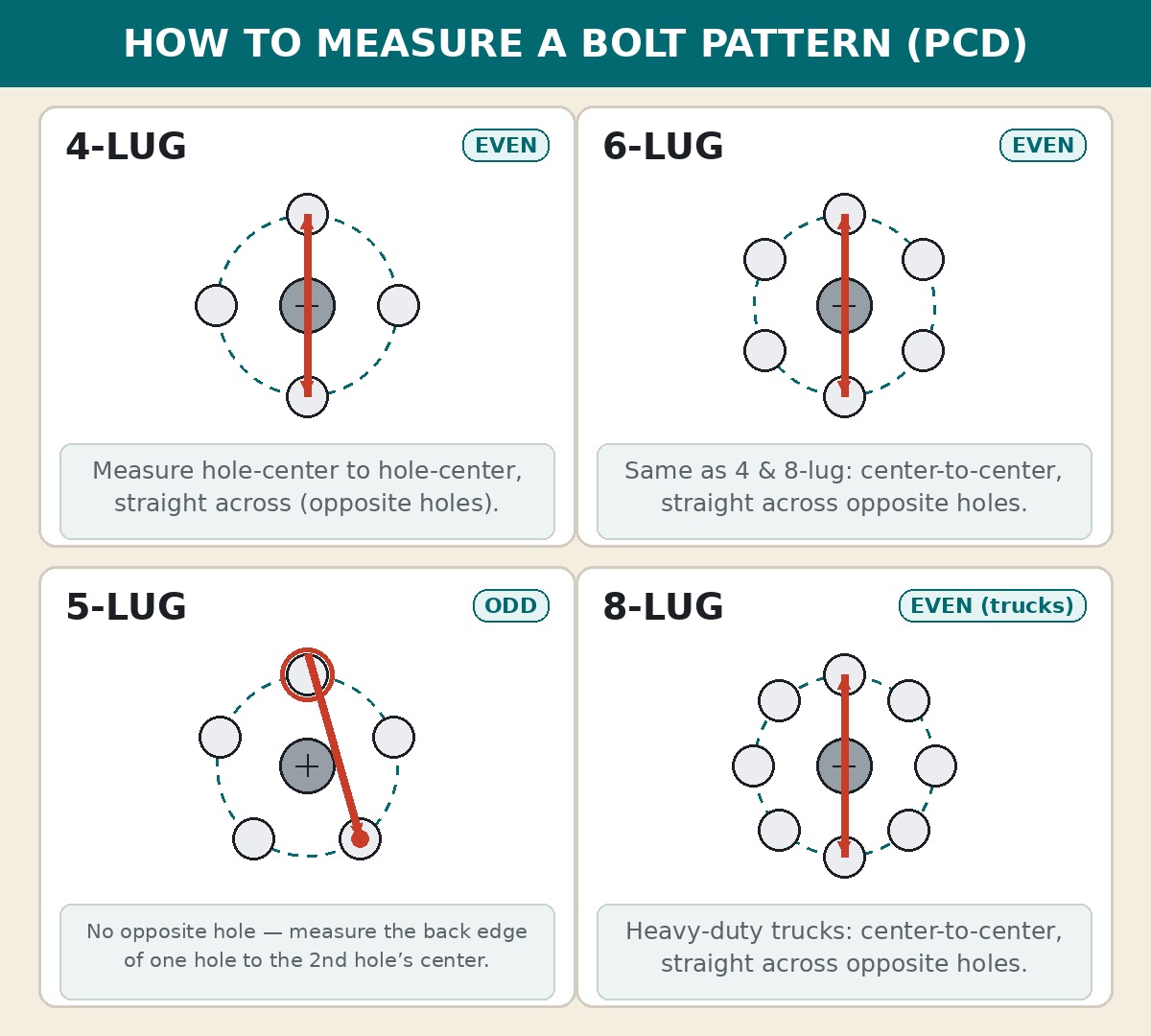
Even lug counts — 4, 6, 8 (the easy ones)
Every hole has a buddy directly across from it, so you just measure straight across from the center of one hole to the center of the hole opposite it. That distance is your PCD. A tape works in a pinch, but calipers are your friend — these numbers live or die by the millimeter.
5-lug — the odd one out
Five holes means no hole sits directly opposite another, so "straight across" doesn't work. Use the mechanic's trick: measure from the back (outer) edge of one hole to the center of the second hole over. That back-edge-to-center cheat lands you right on the true PCD. Prefer math? Measure center-to-center between two adjacent holes and multiply by 1.701 — same answer.
The oddballs — 3-lug and 10-lug
Yes, they exist. 3-lug shows up on kei cars and some Smart/older Euro city cars — it's odd, so use the back-edge-to-center method (or center-to-center × 2 for three holes). 8-lug and 10-lug live on heavy-duty and dually trucks — both even, so measure straight across. Same two rules cover everything: even = across the middle, odd = back-edge to the second hole.
Common Bolt Patterns & Who Runs Them
| Pattern | Inch | Typically found on |
|---|---|---|
| 4×100 | 4×3.94" | Compact cars — older Civic, Mini, Miata, base economy |
| 5×100 | 5×3.94" | Subaru (many), older Toyota, VW Golf, some Audi |
| 5×114.3 | 5×4.5" | The big one — Honda, Toyota, Nissan, Ford, Hyundai/Kia, Mazda |
| 5×112 | 5×4.41" | VW/Audi, Mercedes, modern Euro |
| 5×120 | 5×4.72" | BMW (most), some GM |
| 6×139.7 | 6×5.5" | Trucks/SUVs — Tacoma, 4Runner, Silverado, many full-size |
| 8×165.1 | 8×6.5" | Heavy-duty trucks — GM 2500/3500, Ram HD |
Families, not gospel — always confirm your exact year/make/model. Look yours up free on the Vehicle Fastener Specs tool.
Bolt Pattern Isn't the Whole Story
Nail the pattern and you've cleared the first gate — but three more can still bite you:
- Hub bore — the center hole. Too small and the wheel won't seat; too big and you'll want hub-centric rings so it runs true.
- Offset (ET) — how far the mounting face sits from center. Wrong offset = rubbing fenders or sucked-in stance.
- Lug seat — acorn (cone), ball (radius), or flat. The wheel's seat must match your lug nuts/bolts or they won't clamp right.
Bolt Pattern / PCD Gauge
A slide-style bolt-pattern gauge reads 4-, 5-, 6- and 8-lug patterns in seconds — no math, no guessing at the parts counter.
As an Amazon Associate, WhatSizeBolt earns from qualifying purchases.
Frequently Asked Questions
Is 5×4.5 the same as 5×114.3?
Yep — identical. One's inches, one's millimeters (4.5″ × 25.4 = 114.3 mm).
Can I put a 5×114.3 wheel on a 5×120 car?
Not directly — a 6 mm difference won't bolt up safely. Bolt-pattern adapters exist, but only use quality hub-centric ones and understand the trade-offs. When in doubt, match the factory pattern.
Two cars share my bolt pattern — will those wheels fit?
Maybe. Same pattern is step one; you still need compatible hub bore, offset, and lug seat. Check all four before you buy.
What does PCD stand for?
Pitch Circle Diameter — the diameter of the circle that passes through the center of every lug hole. It's just a fancy name for the second number in your bolt pattern.
Bottom line: count the lugs, measure the circle (even = straight across, odd = back-edge to the second hole), and confirm hub bore + offset before you buy. Get your vehicle's exact bolt pattern and lug specs free on the Vehicle Fastener Specs tool, brush up on torque in the Bolt Size Chart, or browse more in the Knowledge Hub.

Video plays from YouTube when clicked. Always confirm torque values against your service manual.