Differential Cover Bolt Torque: Dana 30, 35, 44 & 60
By WhatSizeBolt TeamEdited 11 min read
There is no single torque for a Dana differential cover. Mag-Hytec lists 12–16 ft-lb for its Dana 44 cover; ARB lists 25.4 ft-lb (Dana 30/35/44) and 45.4 ft-lb (Dana 60) for its kit screws. Here is each figure with the hardware it belongs to, plus a careful install checklist. Factory cover torque is not sourced.
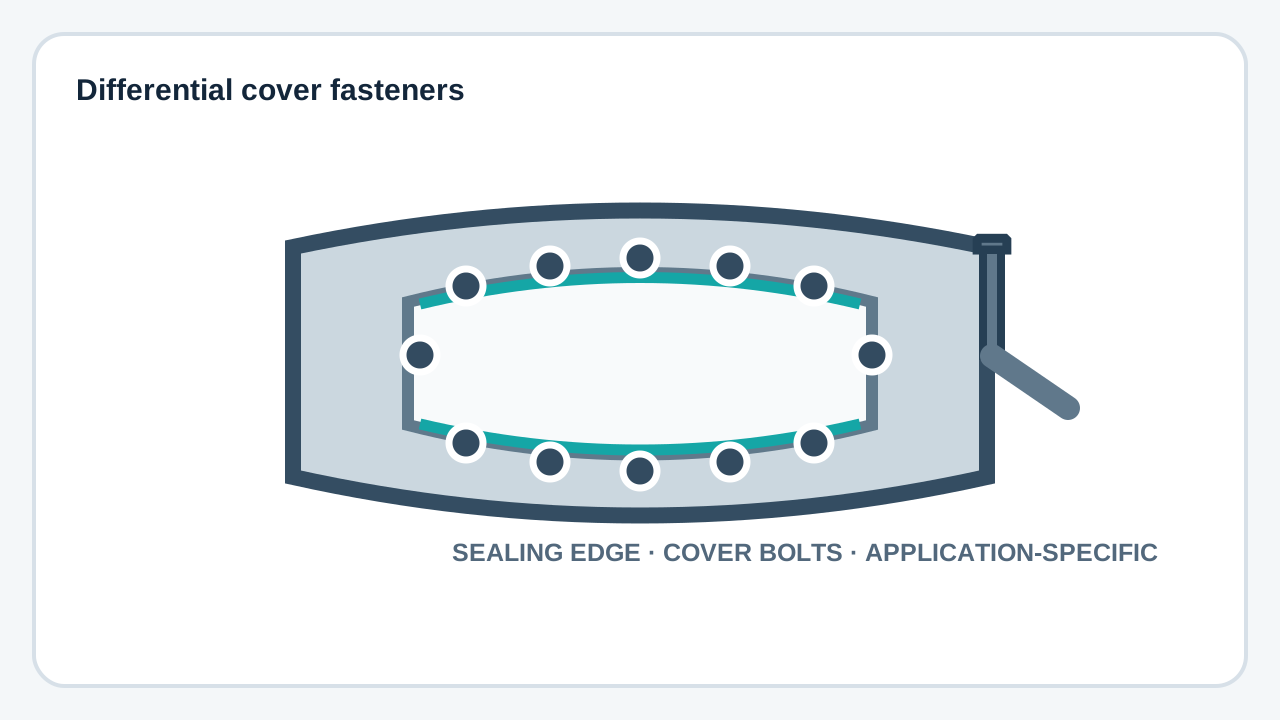
Schematic illustration, not a grade identification, dimensioned drawing or application-specific procedure. Follow the exact product and vehicle instructions.
A practical, sourced guide to the ten cover bolts on Dana 30, 35, 44 and 60 axles: what the manufacturers actually print, which hardware each number belongs to, and how to install a cover without guessing.
Search for a differential cover torque and you will find a confident single number repeated across forums. It is usually correct for somebody’s cover and wrong for somebody else’s. The trouble is that “Dana 44” names an axle family, and the cover on it might be factory stamped steel, an aluminum aftermarket cover with an O-ring, or a heavy-duty kit that ships its own screws. Each of those documents its own torque. This guide reports the figures two manufacturers publish, keeps every figure attached to the hardware it came from, and is upfront about the one number we could not source.
Quick answer: five cover figures, side by side
These are the only cover torque figures used in this article. Read the right-hand column before you trust the number in the middle.
| Cover | Torque as published | Hardware the number applies to | Reminder |
|---|---|---|---|
| Mag-Hytec Dana 44 | 12–16 ft-lb | Ten 5/16-18 stainless Allen cap screws, with washers | Aftermarket aluminum cover with an O-ring; not a factory cover |
| ARB Dana 30 | 34.5 Nm [25.4 ft-lb] | Supplied 5/16 UNC screws | Only for the screws in the ARB kit |
| ARB Dana 35 | 34.5 Nm [25.4 ft-lb] | Supplied 5/16 UNC screws | Only for the screws in the ARB kit |
| ARB Dana 44 | 34.5 Nm [25.4 ft-lb] | Supplied 5/16 UNC screws | Not the Mag-Hytec figure, even on the same axle family |
| ARB Dana 60 | 61.6 Nm [45.4 ft-lb] | Supplied 3/8 UNC screws | Larger screw than the Dana 30/35/44 kits |
The gap between 12–16 ft-lb and 25.4 ft-lb is the whole point. Two covers for the same axle family list different numbers because they are two different kits with different hardware and seals. Nothing here says one is right and the other is wrong; it says the number is a property of the kit.
Reading this on a phone? The same five figures in plain text
- Mag-Hytec Dana 44: 12–16 ft-lb, ten 5/16-18 stainless Allen cap screws.
- ARB Dana 30: 34.5 Nm (25.4 ft-lb), supplied 5/16 UNC screws.
- ARB Dana 35: 34.5 Nm (25.4 ft-lb), supplied 5/16 UNC screws.
- ARB Dana 44: 34.5 Nm (25.4 ft-lb), supplied 5/16 UNC screws.
- ARB Dana 60: 61.6 Nm (45.4 ft-lb), supplied 3/8 UNC screws.
What this article does not give you
We did not find a validated factory cover torque for any specific model year, so we do not print one. If your axle still wears the original stamped-steel cover, the correct figure comes from the service manual for your exact vehicle and year, not from the table above. We also do not publish a fluid volume: the Mag-Hytec product page lists a capacity of 4 quarts while its installation sheet mentions roughly 3 quarts, and the two disagree, so neither is a fill instruction for your vehicle. Use the fluid type and level called for by your vehicle and axle, and account for the actual pinion angle if it has been modified.
Axle family is not the differential mechanism
Two separate classifications get tangled together in searches. Dana 30, 35, 44 and 60 name the axle family, which sets the housing and the cover shape. Open, limited-slip (LSD) and locking describe the differential mechanism inside the housing. Neither label on its own selects a cover torque. An open Dana 44 and a locked Dana 44 can share the same cover and the same cover bolts; a Dana 44 with an aftermarket cover and a Dana 44 with the factory cover do not necessarily share a number. Identify the axle family to get the right cover, then read the instructions for that cover.
Worked example: 2004 Jeep Wrangler Rubicon, rear Dana 44
To keep the figures honest we anchor them to one case. The Mag-Hytec product page lists its Dana 44 cover for the rear axle of 2003–2010 Wrangler Rubicon models and for the optional Dana 44 on 1997–2006 Wrangler. Take a 2004 Wrangler Rubicon, rear axle, fitted with the aftermarket Mag-Hytec cover. For that combination, and only that combination, the Mag-Hytec sheet gives ten 5/16-18 stainless Allen cap screws at 12–16 ft-lb. This is an aftermarket cover, not the factory cover, and the figure should not be carried to the front axle, to another cover, or to another hardware kit. If you are working from the vehicle side, start from our vehicle lookup and confirm the axle before you buy a cover.
Preflight: check before you open anything
- Identify the axle and the kit. Confirm the axle family and that the cover you hold is the one the instructions describe. ARB’s guide maps part numbers to axles: 0750001 Dana 60 and Land Rover Salisbury, 0750002 Dana 30, 0750003 Dana 44, 0750004 Dana 35 and 35C.
- Check clearance. Confirm the cover clears suspension, steering and any nearby components through full travel, and that it clears the internals of the axle. ARB calls the clearance check crucial before tightening the cover bolts. The Mag-Hytec Dana 44 lists an overall projection of 3 1/4 inches, so measure your own clearances rather than assuming.
- Check for bolt bottoming. A screw that runs out of thread before the cover seats will give a misleading torque reading. ARB notes that tapping depths on factory housings are inconsistent and tells you to check that the supplied bolts clamp the cover down properly. Its kits ship two screw lengths, but we have no sourced map of which length goes in which hole, so we do not offer one; follow the kit’s own instructions and check clamping and bottoming yourself.
- Check fill plug access. Confirm you can reach the fill plug with the cover installed and the axle at its working height.
- Support the vehicle safely. Chock the wheels and use approved stands if the vehicle is lifted. Never rely on a jack alone.
Installation: what the Mag-Hytec sheet actually says
The steps below follow the Mag-Hytec installation recommendations. They are for the O-ring style Mag-Hytec cover; a different cover may specify a different sealing method.
- Remove any dried silicone from the housing flange.
- Clean the flange and check that it is flat. Inspect for dents, irregularities and gouges, and do not round over the sealing face while you clean it.
- Apply a thin film of gear lube to the O-ring.
- Fit all ten bolts with their washers and run them finger-tight.
- Fit a 1/4-inch hex bit to a torque wrench and tighten in a cross pattern to 12–16 ft-lb.
Three details are easy to get wrong. First, the Mag-Hytec procedure for a normal installation puts a thin layer of gear oil on the O-ring and does not call for sealant, so do not add RTV on top of the O-ring out of habit. The sheet does describe exceptions, covered in the next section. Second, the sheet says to tighten in a “cross tight” pattern but does not print a numbered factory sequence or a set of torque stages; we have not invented either. Start the bolts by hand, tighten gradually in a cross pattern, and make the final pass at a value within the manufacturer’s range. Third, as general practice rather than a quotation from either source, use a torque wrench rather than a powered impact tool for the final pass, and do not add lubricant, anti-seize or threadlocker to the cover bolts unless your kit’s instructions call for it.
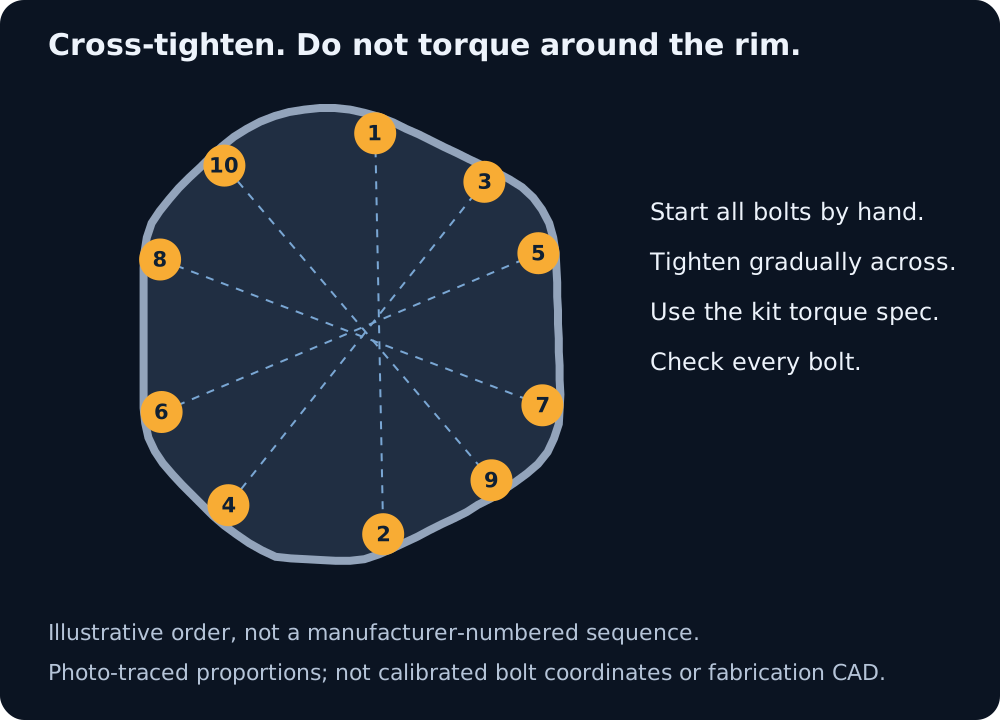
About the diagram: the numbers show the idea of working back and forth across the flange rather than around it in a circle. They are not a manufacturer-numbered sequence, and the exact position of each bolt has not been sourced from a drawing. Follow whatever tightening instructions come with your cover.
O-ring, gasket or sealant: follow the kit
The sealing method belongs to the cover. The Mag-Hytec cover seals with an O-ring. ARB’s guide allows either gasket sealant or a replacement gasket and tells you to follow the instructions for the sealing product you choose. Silicone and RTV products differ in cure time and handling, so read the label on the tube rather than copying a generic bead recipe from a forum. Unless the exact maker instructions say otherwise, do not combine methods. The Mag-Hytec sheet itself lists exceptions: if the O-ring is missing or damaged and none is available, it says you may run a bead of RTV silicone or use a gasket on the mating surface; if the O-ring passes over a deep factory stamp or other flaw, or the housing was machined off center, it describes maker-directed remedies, including a localized thin RTV coat in the off-center case. Those are exceptions to read in the original sheet, not routine steps, and we do not reproduce a repair recipe here.
Kit hardware is kit-specific
ARB’s Dana 44 kit supplies four 5/16 x 1.5-inch screws and six 5/16 x 0.75-inch screws; the Dana 30 kit uses the same lengths, and the Dana 60 kit supplies four 3/8 x 1.5-inch and six 3/8 x 0.75-inch screws. Those lengths belong to the ARB kits. They are not Mag-Hytec hardware and they are not factory hardware, so do not use them as a shopping list for a different cover. ARB also says its Land Rover Salisbury cover needs metric M10 cap screws that are not included; it says to use torque settings to suit the grade of screw purchased and gives no numeric value, so we give none either. Our bolt size chart can help you confirm what a screw actually is, but it does not replace the cover maker’s figure.
Cover bolts are not bearing caps, ring gear bolts or pinion nuts
Keep the cover fasteners separate in your head and on your bench. The cover bolts hold a sealing lid and are torqued to a modest figure. Bearing cap bolts, ring gear bolts and the pinion nut are internal fasteners with different specifications and different procedures. The drain and fill plugs and the wheel lugs are different again. A torque value found for one of these tells you nothing about the others, and applying a cover figure to an internal fastener, or the reverse, is a mistake in both directions.
If it leaks: find the source before adding torque
Extra torque is the reflex fix and usually the wrong one. Oil at the bottom of the cover is not proof that the cover is leaking. Clean the area and trace fresh oil to its actual source; do not keep driving with unknown low fluid. If it is the cover, check the sealing face for dents or gouges, check that the O-ring or gasket is seated and undamaged, and check that no screw is bottoming out before the flange closes. Mag-Hytec also notes that the factory stamped letters or numbers on the housing casting can be deeper than others, and that an O-ring crossing a deeply stamped mark could weep oil, so inspect the O-ring path against the flange. Tightening beyond the published range will not cure a damaged sealing face. These are troubleshooting steps, not proof that every leak has the same cause.
A note on dimensions
The only physical dimension we quote is the Mag-Hytec Dana 44 overall projection of 3.25 inches (82.55 mm). Cover width, flange-plane height, bolt-centre coordinates, wall thickness, O-ring groove size and screw length were not sourced. Our illustration is a schematic traced from the general layout of a ten-bolt Dana 44 cover, not a fabrication drawing, and should not be used for machining or as a claim about exact measurements. The size entry in the product page’s additional-information field is ambiguous metadata and is not used as a cover dimension here.
Frequently asked questions
What is the torque for a Dana 44 differential cover?
It depends on the cover. The Mag-Hytec Dana 44 cover lists 12–16 ft-lb for ten 5/16-18 stainless Allen cap screws, and the ARB Dana 44 kit lists 34.5 Nm (25.4 ft-lb) for its supplied 5/16 UNC screws. A factory cover figure is not sourced here.
What is the Dana 60 differential cover torque?
For the ARB Dana 60 kit, 61.6 Nm (45.4 ft-lb) on the supplied 3/8 UNC screws. That figure belongs to the ARB kit hardware.
Do Dana 30 and Dana 35 covers use the same torque?
In ARB’s guide both list 34.5 Nm (25.4 ft-lb) with supplied 5/16 UNC screws, the same as the ARB Dana 44 kit. That is ARB kit hardware only.
Does an open, limited-slip or locking differential change the cover torque?
No. That describes the mechanism inside the axle. The cover and its bolts determine the torque, so use the instructions for the cover you are installing.
Do I need RTV on a Mag-Hytec cover?
Not in the normal Mag-Hytec procedure, which uses a thin layer of gear oil on the O-ring. The sheet lists exceptions, such as an unavailable O-ring or an off-center housing casting; read them in the original document.
How many quarts of gear oil does the axle take?
This article does not give one. The manufacturer’s own documents disagree (4 quarts on the product page, about 3 quarts in the instructions). Use the fluid and level specified for your vehicle and axle.
Pre-torque checklist
- Axle family and cover confirmed against the instructions.
- Clearance and internal clearance checked; no bolt bottoming.
- Fill plug reachable with the cover fitted.
- Vehicle chocked and on approved stands.
- Flange clean, flat and free of dents and gouges; sealing face not rounded.
- Sealing method matches the kit (O-ring film of gear lube, or the gasket or sealant your kit specifies).
- All ten bolts and washers finger-tight before any torque wrench.
- Cross-pattern tightening to the value for your hardware; no impact tool for the final pass.
Primary sources
All figures above come from the documents below, retrieved 2026-09-29. Manufacturer instructions change, so check the current version for your part before you torque.
- Mag-Hytec Dana 44 product page: fitment list and the 3 1/4 inch projection. Its 4-quart capacity and ambiguous additional-information dimensions are not used.
- Mag-Hytec Dana 44 installation recommendations, dated 05/05/17: page 1 for the ten 5/16-18 screws and 12–16 ft-lb, page 2 steps 6–11 for the installation procedure; PDF page 3 (Maintenance) and PDF page 4 (“For All Dana Covers” NOTICE) for the RTV or gasket exceptions and the warning that an O-ring crossing a deeply stamped mark could weep oil.
- ARB installation guide 21020751, revision 10/09/10: PDF page 3 for part numbers, page 6 section 2.3 for torque values, page 8 for kit screw lengths. Disclosure: this copy is a mirror hosted by ExtremeTerrain, not ARB’s own site; the guide itself is authored by ARB.
Bottom line: match the number to the cover and the screws in your hands, install it clean and flat with the sealing method the kit specifies, and if you need a factory-cover figure, take it from the service manual for your exact vehicle. Browse more guides in the Knowledge Hub.
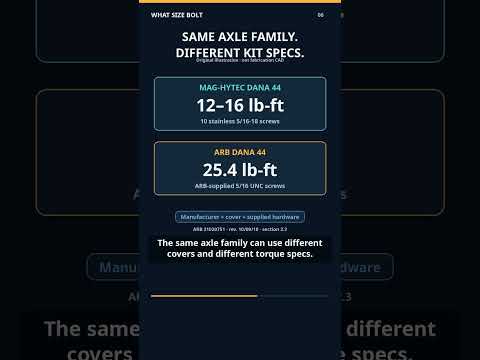
Video plays from YouTube when clicked. Always confirm torque values against your service manual.