GM 3800 V6 Head Bolt Torque & Tightening Sequence (Series II & III)
By WhatSizeBoltEdited 9 min read
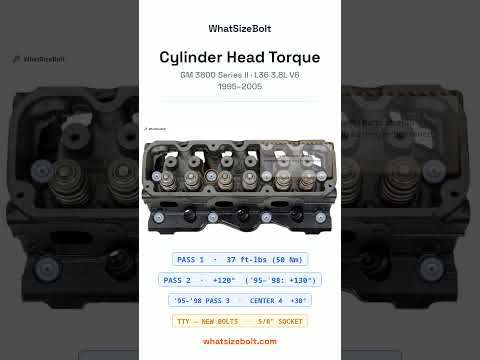
GM 3800 head bolt torque: 37 lb ft (50 Nm) first pass, then an angle pass that differs by year - +120 degrees plus 30 on the centre four, or +130. Sixteen single-use 7/16-14 TTY bolts, installed dry.

Almost everything published about the GM 3800 says the same thing: 37 lb ft, then 120 degrees. The first half of that is right. The second half depends on what year your engine is — and on a bolt that is designed to stretch past yield, guessing the angle is how a head gasket job becomes a head gasket job you do twice.
What this article covers
Series II and Series III only — the 1995-2008 engines.
The 3800 name goes back to 1988, but the engine was substantially redesigned twice. This page covers the Series II (1995–2005, VIN K naturally aspirated and VIN 1 supercharged) and the Series III (2004–2008, L26 and supercharged L32) — the 3800s in the Grand Prix, Regal, Bonneville, LeSabre, Impala, Monte Carlo, Park Avenue, Intrigue, LaCrosse and Lucerne. The Series I (1988–1994) uses a different procedure that we could not source from anything we would stand behind, so it is not listed below. Do not carry a Series II figure back onto a Series I engine.
GM 3800 head bolt torque specs
One value everyone agrees on, and one that moves.
| Source | Engines covered | Procedure |
|---|---|---|
| GM service procedure | 3800 Series II / III | 37 lb ft (50 N·m) in sequence → +120° in sequence → +30° on the four centre bolts |
| AERA Technical Committee (2003) | 1995–2002, VIN K & 1 | 35–37 lb ft (49–50 N·m) in sequence → +130° (bulletin supersedes AERA TB 1952) |
| Published spec charts | 1995–1998 | 37 lb ft → +130° → +30° centre four |
| Published spec charts | 1999–2005 | 37 lb ft → +120° |
The bolts themselves
Coarse-thread, single-use, and they go in dry.
| Spec | Value |
|---|---|
| Thread | 7/16-14 (coarse UNC) into the block |
| Count | 16 per engine — 8 per cylinder head |
| Type | Torque-to-yield — permanently stretched, replace every time |
| Lubrication | None. Install dry. |
| First pass | 37 lb ft (50 N·m), all bolts, in sequence |
GM went to non-reusable torque-to-yield (TTY) bolts on this engine family back in 1985, long before the Series II. A TTY bolt is meant to yield — that is how it holds a consistent clamp load — so it does not come back to the same length or the same stiffness a second time. Reusing them is the single most common reason a 3800 head gasket weeps again a few thousand miles after the job.
Tightening pattern
Eight bolts per head, worked from the centre outward.

Run the entire pattern at each pass. The first pass brings every bolt to 37 lb ft before any bolt sees an angle; the angle pass then goes round again in the same order. Never take one bolt all the way through and move on — you pull that corner of the head down against a gasket the rest of the head has not touched yet.
How to torque 3800 head bolts, step by step
The prep matters as much as the numbers — a dirty blind hole ruins the reading before you start.
- Chase the block threads with a 7/16-14 tap — the AERA bulletin calls this out specifically. Debris or old sealer in a blind hole absorbs torque that never reaches the clamp load.
- Blow the holes out — oil or coolant trapped at the bottom of a blind hole hydro-locks the bolt and gives a false reading long before the head is clamped.
- Fit the head gasket with the arrow pointing to the front of the engine.
- Install new bolts dry. No oil, no anti-seize. The published torque assumes a dry thread; lubricating one moves the real clamp load well past spec.
- First pass: 37 lb ft (50 N·m) on every bolt, in sequence with a calibrated torque wrench.
- Angle pass: fit a torque angle gauge and turn each bolt the angle your year calls for, in the same sequence. Counting flats on the socket is not accurate enough here.
- Final pass if your procedure calls for it — another 30° on the four centre bolts, again in sequence.
Before you pull the head: it is probably the intake gasket
The 3800’s famous coolant leak usually is not the head gasket at all.
The Series II 3800 has a well-documented failure that looks exactly like a head gasket and is not one. The OEM plastic-manifold intake gasket deteriorates after roughly 60,000 miles where it seals the cylinder head coolant passage to the manifold. Coolant seeps past, the engine overheats, and if it gets down into the lifter valley and the crankcase it can take the bearings with it. GM issued a revised gasket (P/N 89017554) under bulletin 04-06-01-017 in May 2004.
There is a second one: GM recall 03034 (July 2003) covered coolant leaks on certain 2000–2003 Chevrolet, Buick and Pontiac 3800s at the throttle body and upper-to-lower intake joints. If the car was repaired under it there should be a recall decal under the hood.
Related 3800 torque values
The other fasteners you disturb getting to the head.
| Fastener | Torque |
|---|---|
| Valve rocker arm bolt | 11 lb ft (15 N·m) → +90° |
| Lower intake manifold bolt | 11 lb ft (15 N·m) |
| Upper intake manifold bolt (VIN K) | 89 lb in (10 N·m) |
| Rocker arm cover bolt | 89 lb in (10 N·m) |
Confirm these against the manual for your year the same way — they come from published spec data, not from a factory document we could read end to end.
Tools and parts for the job
The angle gauge is not optional on a TTY bolt — order anything you are missing before you start.
Some links below are Amazon affiliate links — as an Amazon Associate we may earn a small commission at no extra cost to you.
Torque angle gauge
Every 3800 head bolt spec is torque-plus-angle. A 1/2" drive angle gauge is the only way to turn 120° and know it was 120° — counting socket flats is not close enough on a bolt being stretched past yield.
1/2" torque wrench
A calibrated click wrench for the first pass. Everything after it is angle, so the 37 lb ft starting point has to be right.
GM 3800 head bolt set
Sixteen new 7/16-14 torque-to-yield bolts. These are single-use by design — reusing the old ones is the most common cause of a repeat head gasket leak on this engine.
3800 intake manifold gasket set
The Series II coolant leak is usually here, not at the head gasket. Worth having on the bench before you commit to pulling heads.
Common mistakes
Five ways a 3800 head job comes back.
- Reusing the old head bolts — they are torque-to-yield and already stretched. New bolts, every time.
- Oiling the threads — the spec is a dry-thread spec. Lubricant sends the real clamp load well past where GM wanted it.
- Using one angle for every year — the +120° everyone quotes is not universal, and the extra +30° on the centre four is easy to miss entirely.
- Guessing the angle by socket flats — a hex flat is 60°. Two flats is 120° only if you started perfectly square and nothing slipped.
- Pulling the head for an intake gasket leak — check the far more common failure first.
Frequently asked questions
What is the head bolt torque on a GM 3800?
The first pass is 37 lb ft (50 N·m) on every bolt, in sequence — that figure is consistent across sources. The angle pass that follows is where they diverge: GM’s procedure gives +120° and then another +30° on the four centre bolts, while the AERA technical bulletin covering 1995–2002 gives +130°. Use the figure published for your model year.
Can I reuse 3800 head bolts?
No. GM went to torque-to-yield head bolts on this engine family in 1985, and they are designed to stretch permanently when tightened. A reused bolt will not reach the same clamp load. Replace all sixteen.
What size are 3800 head bolts?
7/16-14 coarse thread into the block, sixteen per engine — eight per cylinder head. The AERA procedure calls for chasing the block threads with a 7/16-14 tap before installing new bolts.
Do 3800 head bolts go in dry or oiled?
Dry. The published torque-plus-angle spec assumes a dry thread. Oiling the threads drops the friction and drives the actual bolt tension well past what the spec intends.
My 3800 is losing coolant — is it the head gasket?
Usually not. The Series II’s signature leak is the intake manifold gasket where it seals the cylinder head coolant passage, typically around 60,000 miles. GM released a revised gasket (P/N 89017554) under bulletin 04-06-01-017. Rule that out before you pull a head.
Keep going
Bottom line: give every 3800 head bolt a first pass of 37 lb ft (50 N·m) in sequence — that part is settled. The angle pass is not: +120° with a further +30° on the four centre bolts in GM’s procedure, +130° in the AERA bulletin covering 1995–2002. Sixteen new 7/16-14 torque-to-yield bolts, installed dry, an angle gauge rather than counted flats, and the figure printed for your model year rather than the one everyone repeats.
Video plays from YouTube when clicked. Always confirm torque values against your service manual.