How to Test a Car Battery with a Multimeter
By WhatSizeBolt TeamEdited 5 min read
A healthy car battery reads 12.6 volts or higher at rest. Learn exactly how to test yours with a multimeter in under 5 minutes — with a full voltage chart so you know when to replace it.
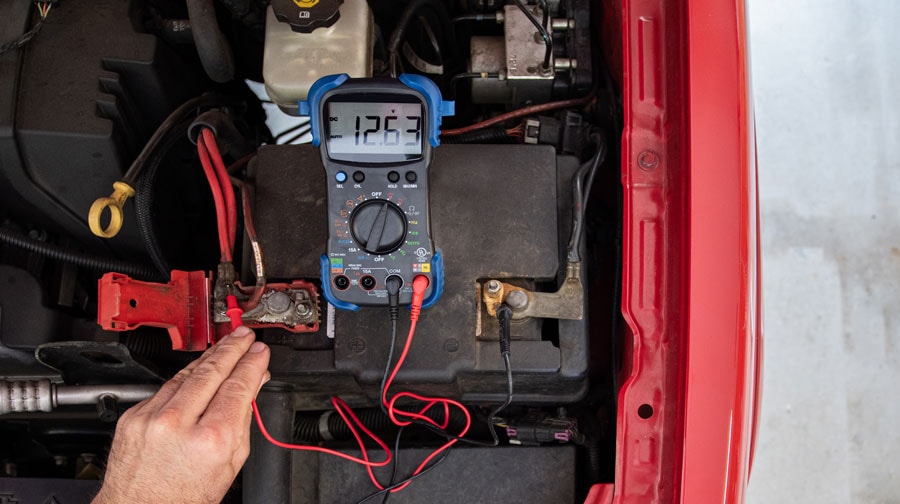
Testing your car battery with a multimeter is one of the most useful diagnostic skills a DIYer can have. A bad battery causes no-starts, dim headlights, and electrical gremlins — and it only takes about five minutes to check. This guide walks you through the exact steps and tells you what the numbers mean.
What you need
Minimal kit — the meter does all the work.
- A digital multimeter (any basic model works — Fluke, AstroAI, Cen-Tech).
- Safety glasses (optional but recommended).
- Clean battery terminals — brush off corrosion with a wire brush first.
Some links below are Amazon affiliate links — as an Amazon Associate we may earn a small commission at no extra cost to you.
Digital automotive multimeter
A basic DC-volt multimeter is all you need to read resting voltage, run the charging check and do the cranking test. Auto-ranging models make it foolproof.
Step 1: set your multimeter to DC voltage
Car batteries are 12-volt DC systems, so you need DC, not AC.
Set the dial to DC voltage and select the 20 V range (or auto-range if your meter has it).
Step 2: connect the probes
Red to positive, black to negative — and don’t panic at a minus sign.
- Red probe → positive terminal (+).
- Black probe → negative terminal (−).
Step 3: read the voltage (engine off)
This is the resting voltage test — the number that tells you the battery’s state of charge.
The battery should have been off for at least 30 minutes for an accurate reading.
| Voltage | Battery state |
|---|---|
| 12.6 V or higher | Fully charged (100%) |
| 12.4 V | ~75% charged |
| 12.2 V | ~50% charged — borderline |
| 12.0 V | ~25% charged — needs charging |
| Under 12.0 V | Dead or failing — replace or charge first |
| Under 10.5 V | Bad cell — replace the battery |
Step 4: load test — engine running
Start the engine and read the voltage again with the meter still connected.
| Voltage (running) | What it means |
|---|---|
| 14.0 V – 14.7 V | Alternator charging normally |
| 13.5 V – 13.9 V | Slightly low — watch it |
| Under 13.5 V | Alternator may be failing |
| Over 14.8 V | Overcharging — check voltage regulator |
If your voltage jumps to 14.0–14.7 V when the engine starts, your alternator is working correctly and the battery is being recharged during driving. If it doesn’t, work through our alternator multimeter test next.
Step 5: crank test (optional)
Watch what the voltage does the instant the starter turns.
Have a helper crank the engine while you watch the meter. During cranking, voltage will drop — that is normal. But if it drops below 9.6 V, the battery is probably too weak to start the car reliably. This rule assumes a warm (about 70°F) battery; in cold weather, or for a definitive answer, get a proper load test (most parts stores do it free) before replacing.
Multimeter recommendations
Any multimeter works for this test — here are three solid options at different price points.
| Model | Price | Best for |
|---|---|---|
| AstroAI AM33D | ~$13 | Best budget pick — accurate, auto-range |
| Innova 3320 | ~$25 | Purpose-built for automotive, has MIN/MAX hold |
| Fluke 117 | ~$180 | Professional grade, True RMS, worth it for frequent electrical work |
Automotive multimeter with MIN/MAX hold
A purpose-built automotive meter with MIN/MAX capture makes the cranking test easier — it grabs the lowest voltage during the crank so you don’t have to catch it by eye.
Quick reference
The numbers to remember.
- Resting voltage goal: 12.6 V+.
- Charging voltage goal: 14.0–14.7 V.
- Replace if: resting under 12.0 V after a full charge, or cranking drops below 9.6 V.
Frequently asked questions
My battery reads 12.4 V — is it bad?
Not necessarily. Charge it fully (use a trickle charger overnight), then retest. If it comes back to 12.6 V and holds it, the battery is fine.
Battery reads 12.6 V but the car won’t start?
You may have a bad cell. A battery can show good resting voltage but collapse under load. Take it to AutoZone or O’Reilly for a free load test — they’ll run 200–300 amps through it and show if a cell drops out.
How often should I check it?
Test it annually, or any time you have a slow crank, dim lights, or a dashboard warning. Batteries typically last 3–5 years.
Is it the battery or the alternator?
Test the battery at rest first — it should read 12.6 V or higher. If the battery is good but voltage doesn’t climb into the 14.0–14.7 V range once the engine is running, the fault is the alternator, not the battery.
Keep going
Bottom line: a multimeter and five minutes tell you almost everything. 12.6 V+ at rest means a fully charged, healthy battery, and 14.0–14.7 V with the engine running means the alternator is recharging it. Replace the battery if it rests under 12.0 V after a full charge or drops below 9.6 V while cranking.