Drain-Plug Washers, O-Rings and Washerless Designs: What Actually Seals?
By WhatSizeBolt TeamEdited 7 min read
Drain plugs can seal with a separate gasket, a designed O-ring, a specified thread-sealing system, or a proprietary closure. Learn what each design means and why exact application instructions—not appearance alone—should guide replacement.
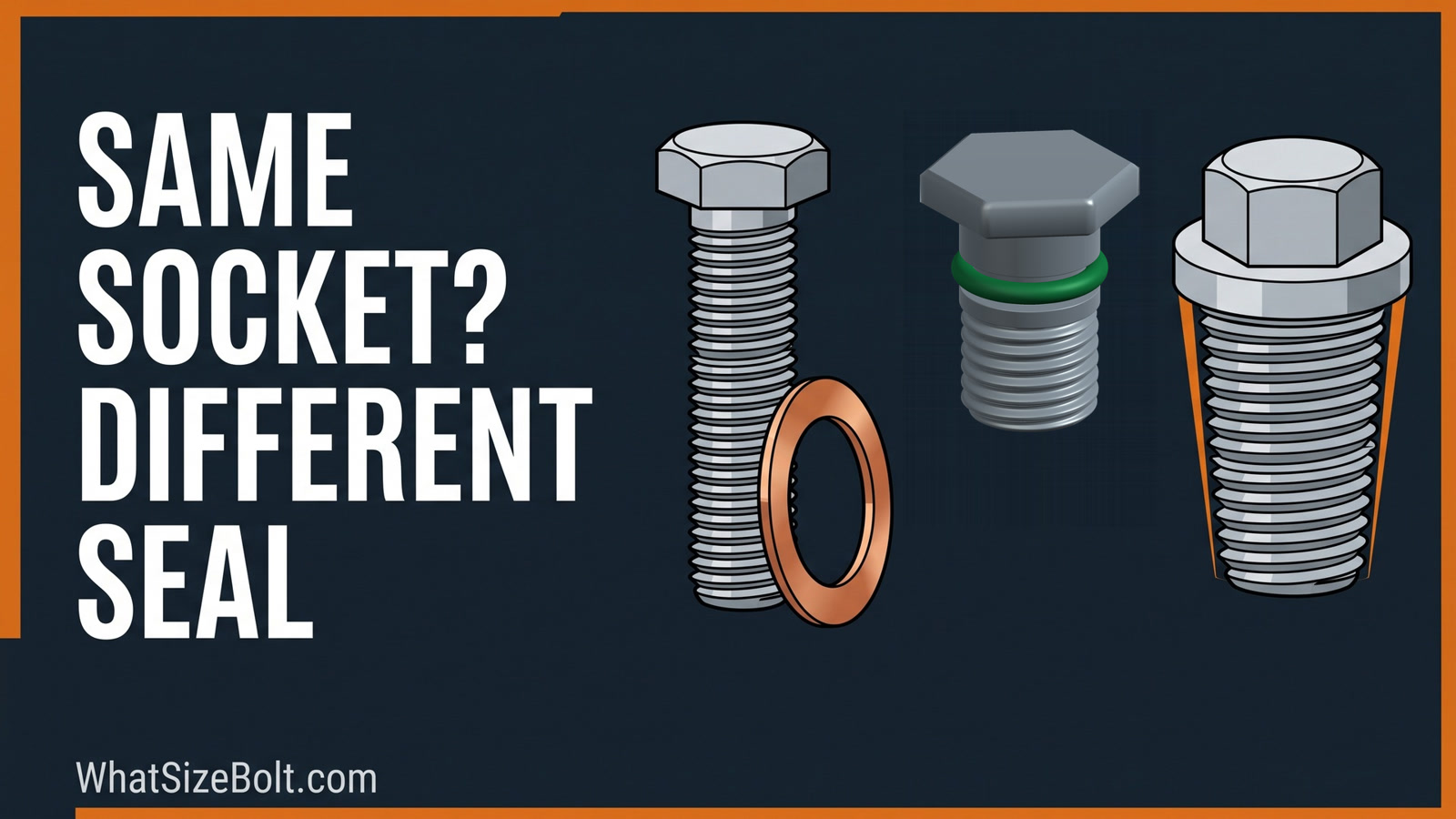
A drain plug can accept the right socket, thread into the housing, and still be the wrong replacement. The missing piece is often the sealing system: the surface, washer, O-ring, or specified thread treatment that stops fluid from escaping.
Before changing a seal
Use the service information for the exact application. Do not add a washer, thread tape, or RTV blindly; an extra or different sealing element can change how the original assembly fits.
A drain plug with no separate washer can be intentional. No visible loose washer does not mean one is missing. The featured illustration shows a generic O-ring mechanism; it is not to scale or an OEM installation drawing.
The threads hold the plug; the seal may work somewhere else
The drive recess or hex head tells you which tool turns the plug. It does not establish thread diameter, pitch, engagement length, or sealing-face compatibility.
In a typical straight-thread, face-sealed assembly, the threads provide the fastening action. The specified gasket or sealing ring closes the escape path where the plug face meets the housing. A substitute can feel tight because it bottoms out—not because the intended sealing face has made contact. “It screws in” is not a fitment test.
Other designs seal in a groove around the plug or at an axial face. Some specified thread-sealing systems use sealant. Proprietary closures may have their own sealing interface. Identify the design before selecting a replacement.
Four sealing systems to recognize
| Design | Where sealing happens | What not to assume |
|---|---|---|
| Separate metal or coated gasket | At the designed mating faces | Any washer with the same hole is equivalent |
| O-ring or elastomer seal | In a designed groove and mating bore or face | No loose metal washer means one is missing |
| Specified thread-sealing system | At the thread connection, according to its design and instructions | Every differential uses tapered threads or the same sealant |
| Proprietary plastic or bayonet closure | At its application-specific seal interface | It behaves like an ordinary threaded metal bolt |
These are design categories, not a chart for choosing a part by appearance.
Copper versus aluminum: can you swap drain-plug washers?
Not automatically. Both appear in manufacturer sealing-ring catalogs, but material is only one part of the specification. Profile, thickness, inside and outside dimensions, coating, sealing-face geometry, and the designed assembly load can all matter.
Elring lists copper rings, aluminum rings, O-rings, elastomer rings, and metal rings with elastomer sealing lips as distinct families. Dorman catalogs application-specific aluminum, rubber, and rubber-coated-metal engine drain gaskets. These references show that different constructions exist; they do not establish a universal “copper is best” rule. Elring standard parts · Dorman aluminum example · Dorman rubber example.
Do not choose copper or aluminum solely from the oil-pan material. Match the specified replacement for the actual vehicle, housing, and plug. A same-size hole is not enough evidence to substitute.
Why an O-ring plug may not need a loose washer
An O-ring works with a gland: the space and mating surfaces that locate it and control its deformation. In a radial layout, contact with a mating bore squeezes the ring around the plug. In a face-seal layout, the mating faces squeeze it axially. These placements are different and should not be confused.
Parker’s O-Ring Handbook explains that the ring and its gland act as a system. The seal changes shape within its available space; the explanation is not that the rubber simply shrinks into a smaller volume. Parker O-Ring Handbook.
There is direct OEM evidence for a specific application: Detroit’s DD-platform oil-pan installation instructions specify fitting the drain plug with a new O-ring (step 9). That supports the documented O-ring design; it is not a generic replacement rule for passenger cars. Detroit instructions, step 9.
Adding a metal washer to an unidentified O-ring assembly is not a harmless upgrade. It can change how the original parts engage. First establish whether the design is complete as intended.
Thread sealant does not prove thread shape
Parker distinguishes thread-sealing connections from peripheral face-sealing arrangements and describes tapered pipe-thread families. This is a general engineering reference, not an automotive service recipe. Parker Catalog 4260.
A scoped automotive example is RAM bulletin 03-005-21, which specifies thread sealant on the differential drain plug for a defined Anti-Spin rear-axle service application. Its model years, configurations, and conditions limit its scope. The bulletin does not by itself prove tapered geometry, nor does it apply to every RAM differential. RAM bulletin 03-005-21.
Do not infer the sealing method from the head shape, and do not improvise with tape, RTV, or an extra washer. Use the exact sealing product and assembly condition specified for the application.
A drain plug does not have to be a conventional bolt
Audi’s third-generation EA888 engine training document describes a plastic lower oil pan with a plastic bayonet-lock drain plug. Its locking arrangement is not the continuous screw thread of a conventional bolt. Audi training reference.
This is a design-training document, not a current repair manual. It establishes the described closure design, but service procedures, exact seal construction, tools, and replacement rules still require the applicable service information. A generic bayonet illustration should not be mistaken for an Audi installation drawing.
Engine oil, transmission, and differential openings have different jobs
A drain opening removes fluid. A fill opening admits fluid. A level-control or overflow arrangement serves a different purpose. Similar-looking drives do not make hardware or procedures interchangeable.
ZF’s passenger-car transmission guidance distinguishes draining, filling, running conditions, fluid temperature, and level checks. Requirements depend on the transmission and vehicle; there is no universal “fill until it spills” rule for every automatic transmission. ZF transmission guidance. Identify the opening before ordering hardware or removing anything. A general design explainer is not a substitute for the fluid-service procedure.
Reuse rules are application-specific
Honda’s 2024 CR-V manual explicitly calls for a new drain-bolt washer. Detroit’s documented DD-platform example calls for a new O-ring. These are instructions for two particular applications—not proof that every drain uses a replaceable crush washer. Honda 2024 CR-V owner’s manual.
Use current instructions to determine whether to replace the washer, ring, gasket, or complete plug. Do not assume a seal is reusable because it looks undamaged, or that all plugs share the same replacement policy.
More torque is not a seal repair
Debris, a damaged washer, a cut O-ring, or a scar across a sealing face can leave a fluid path even when the threads match. Tightening harder may damage the plug or housing instead of fixing the cause.
NASA’s Fastener Design Manual explains that torque is an indirect route to clamping load: thread friction, under-head friction, coatings, and lubricants affect the result. This is a general fastening reference—not an automotive drain-plug torque table. NASA RP-1228.
The safe identification checklist
- Identify the exact vehicle, powertrain or axle, and opening: drain, fill, or level check.
- Match the specified plug, thread engagement, sealing seat, and seal construction.
- Inspect the intended sealing surfaces and follow the specified replacement rules.
- Follow the correct assembly condition and tightening instructions. Use a torque wrench where specified and check the current service manual.
- If threads or the sealing face are damaged, have an appropriate repair assessed rather than forcing an oversized plug or adding more torque.
Match the whole assembly—not just the wrench. Use WhatSizeBolt’s free lookup as a starting point, inspect its field-level evidence, and confirm the result against the applicable service information. The measurement guide is supporting reading about measurement only; measurement alone does not establish seal compatibility.
Frequently asked questions
Does every drain plug need a washer?
No. A particular assembly may use a separate gasket, a designed O-ring, or another specified sealing system. Establish the intended design before assuming a washer is missing.
Can I replace an aluminum drain washer with copper?
Not on material name or hole size alone. Use a replacement approved for the actual plug and application, including the required construction, profile, and dimensions.
Why is a matching socket not enough?
Drive size does not determine thread geometry, engagement length, sealing-face fit, or the specified seal.
Do all differential plugs seal on tapered threads?
No universal conclusion can be drawn from the fluid system or a plug’s appearance. A documented sealant instruction does not itself prove a tapered thread.
Should I use a general bolt torque chart for a drain plug?
No. Use the applicable installation specification and assembly condition. A general chart is not a vehicle-specific drain-plug installation specification.
Sources and applicability
- Honda 2024 CR-V owner’s manual — washer instruction for that model-year application.
- Detroit DD-platform oil-pan installation document — new O-ring instruction, step 9.
- Audi third-generation EA888 training reference — describes the bayonet-lock design; not a current repair manual.
- RAM bulletin 03-005-21 — scoped Anti-Spin rear-axle thread-sealant example; does not prove tapered threads.
- Parker Catalog 4260 and Parker O-Ring Handbook ORD 5700 — general engineering references, not OEM fitment guidance.
- NASA RP-1228, Fastener Design Manual — general fastening reference, not an automotive torque table.
- ZF passenger-car transmission guidance — fluid and level procedures are model-specific.
- Elring standard-parts catalog, Dorman aluminum gasket example, and Dorman rubber gasket example — product-family examples, not OEM service instructions.
External references are cited for evidence and context; they are not sponsored recommendations. Confirm all fitment and service instructions in the current information for the exact application.

Video plays from YouTube when clicked. Always confirm torque values against your service manual.