Whitworth Threads: The Forgotten Standard That Built the World
Why a 200-year-old British engineering standard still holds together classic Land Rovers, British plumbing, and UK fire couplings — and why your modern wrenches will round the head off if you don't know what you're looking at.
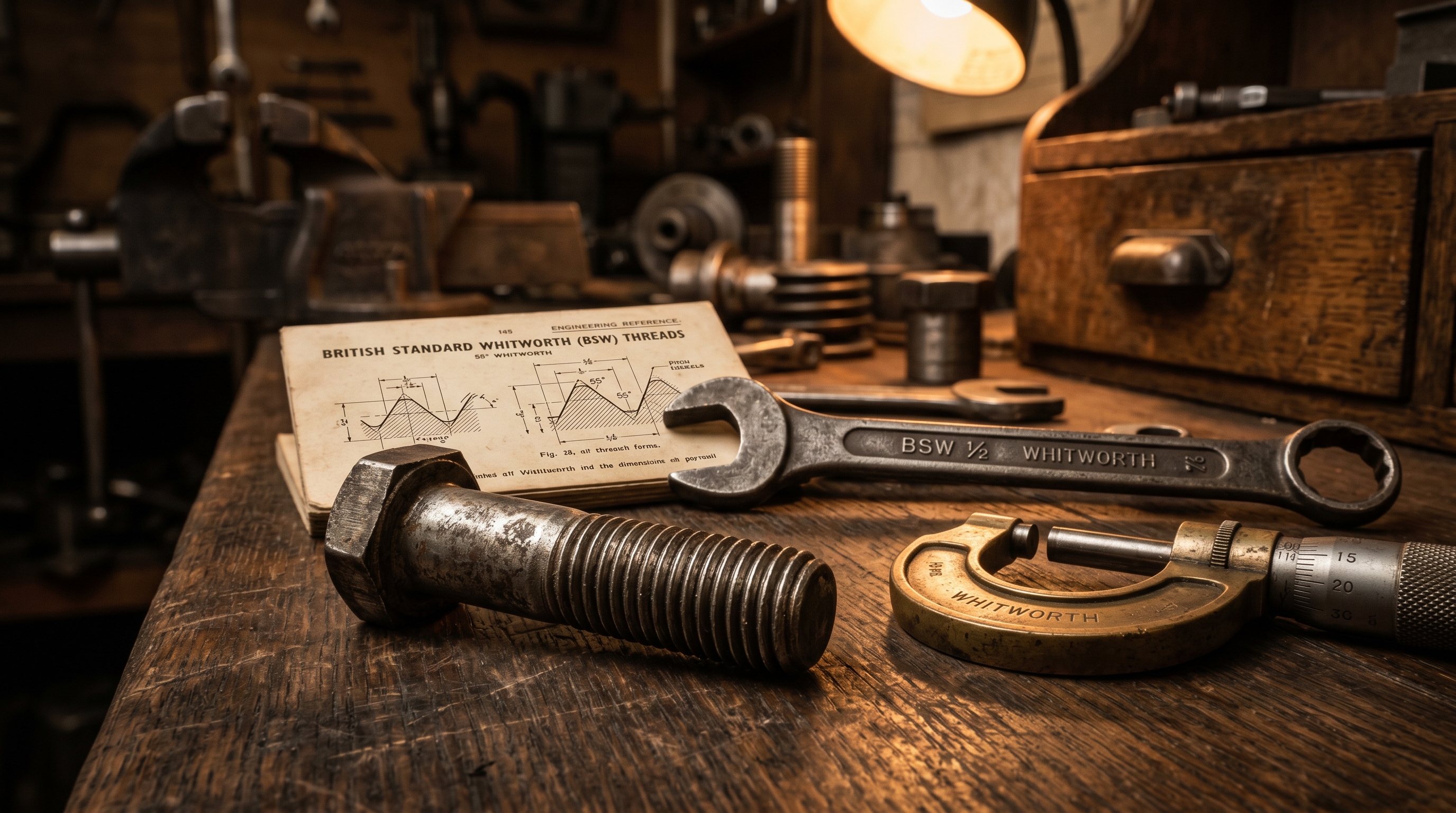
Before 1841, no two bolts in Britain were guaranteed to fit each other. Every machine shop cut threads to its own internal pattern, which meant a 1/4-inch bolt from a Manchester foundry would not necessarily thread into a 1/4-inch nut made fifty miles away in Birmingham. The Industrial Revolution was inventing the modern world one bespoke fastener at a time — and it was about to hit a wall.
Then a Manchester engineer named Joseph Whitworth proposed something radical: a single, uniform standard. Every fastener at every diameter would share the same thread angle, the same crest shape, and the same fixed pitches. Britain adopted it, the world's railways were built on it, and almost 200 years later you can still find Whitworth threads holding together the things they were designed for.


What Makes a Thread "Whitworth"
Three properties define the Whitworth profile and distinguish it from the 60-degree Unified and Metric threads that came later.
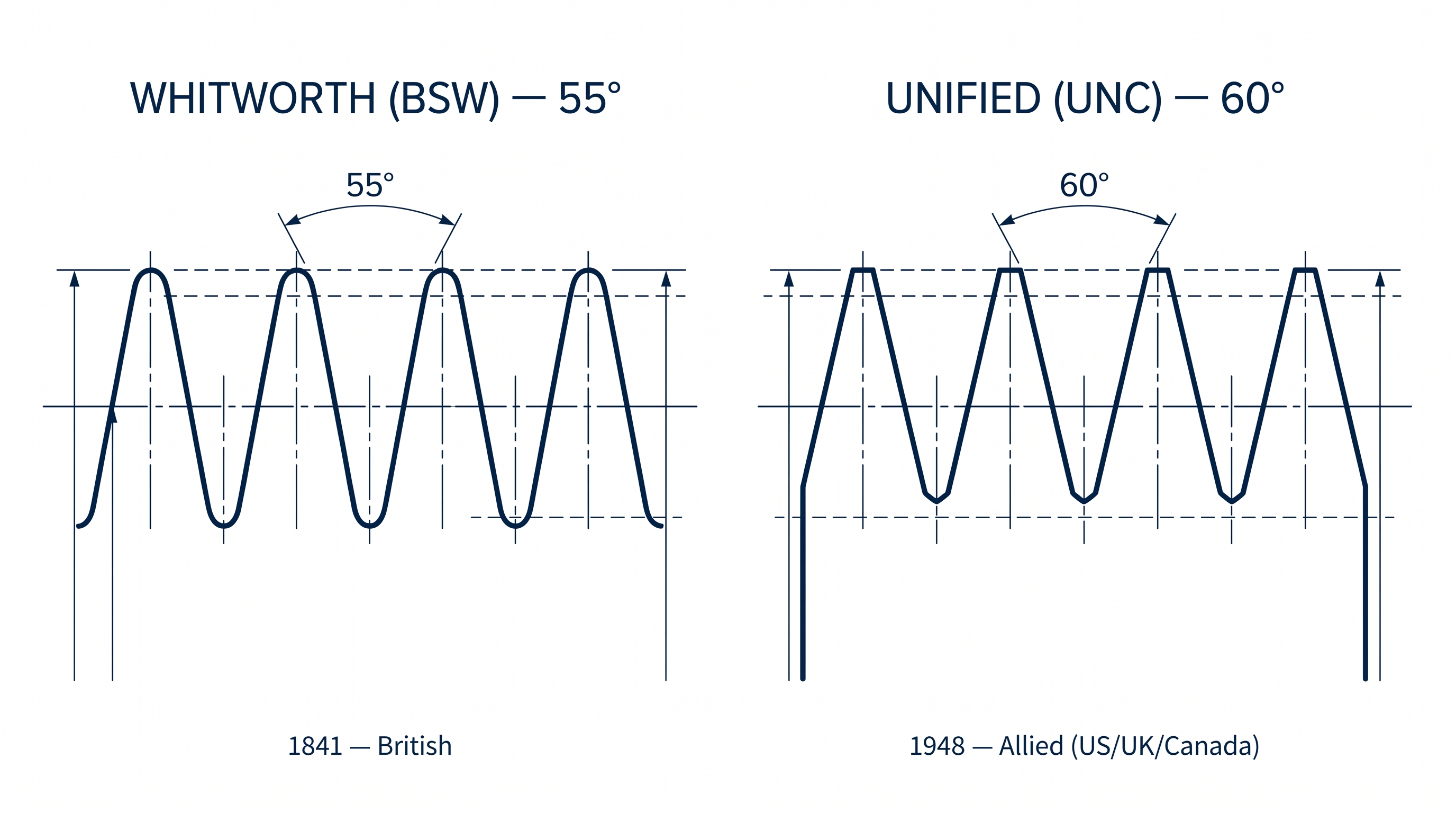
- 55-degree flank angle. The angle between adjacent thread surfaces, measured in the axial cross-section, is 55 degrees — visibly more "open" than the 60-degree Unified profile.
- Rounded crests and roots. The radius is precisely 1/6th of the thread depth. Rounded threads tolerate dirt, deform less under load, and resist fatigue cracking at the root. Unified is flat-crested.
- Fixed pitches per diameter. A 1/4-inch Whitworth bolt has exactly one official pitch (20 TPI), a 3/8-inch has one (16 TPI), and so on. You don't pick the pitch separately from the bolt size.
Adopted as British Standard Whitworth (BSW), it became the de facto national thread in Britain by the 1860s and was formally codified as British Standard BS 84 in 1903. It built the rail network, the merchant marine, the early automobile industry, and the entire factory tooling that produced all of it.
The Thread Standards Timeline
Whitworth was the first standardized thread. It was not the last. The vocabulary still trips people up because each link in the chain gets called by a different name depending on who you ask.
| Year | Standard | Angle | What happened next |
|---|---|---|---|
| 1841 | Whitworth (BSW) | 55° rounded | Still current in BSP plumbing, BS 336 fire fittings, classic UK vehicles |
| 1864 | Sellers thread (proposal) | 60° flat | Became the de facto U.S. Standard from 1868 |
| 1924 | American National (NC / NF) | 60° flat | Formal codification of Sellers; replaced by Unified in 1948 |
| 1948 | Unified (UNC / UNF / UNEF) | 60° flat | Result of the US/UK/Canada Inch Screw Thread Agreement. The current US inch standard. |
| 1947+ | ISO Metric (M-series) | 60° flat | Global default outside the US. M8×1.25, M10×1.5, etc. |
Why Your Modern Wrenches Don't Fit Whitworth Bolts
The thing that ambushes every first-time vintage British vehicle restorer.
Whitworth wrench sizes refer to the bolt shank diameter, not the across-flats hex size. A "1/4-inch Whitworth" wrench fits a Whitworth bolt with a 1/4-inch shank — but the actual hex head measures roughly 0.445 inches across the flats, which corresponds to no modern American or metric wrench size.
To complicate matters: pre-1948 BSW and BSF shared the same hex head size for the same shank diameter. After 1948, the standard was revised so that BSF heads were stepped down one Whitworth size for clearance — meaning a "1/2-inch BSW" wrench is the same as a "9/16-inch BSF" wrench in real-world hex dimensions. If you are restoring a Land Rover that straddles that transition, your wrench set needs to be dual-marked or you need to know the trick.
Where Whitworth Still Lives in 2026
Four major places, ordered by how likely a DIYer is to encounter them.

Classic Land Rovers (Series I, II, IIA, III)
The most active community keeping Whitworth alive is Land Rover restoration. The original utility Land Rover, produced from 1948 as the Series I, used predominantly BSW and BSF threads on body and chassis, UNF on the drivetrain (inherited from the Rover P3 engine), and BA threads on Lucas electrical components. The Series II, Series IIA, and Series III continued the BSF-on-chassis / UNF-on-drivetrain split until the all-metric Defender debuted in 1983.
British Plumbing — BSP (British Standard Pipe)
BSP pipe threads are a direct descendant of the Whitworth form — 55° flank angle, rounded crests — and are still the dominant pipe thread in the UK, EU, Australia, and most of the Commonwealth. American NPT pipe threads use 60° instead. The two are NOT interchangeable: thread an American fitting into a British faucet and you will either leak or strip the bore.
British Fire Hose Couplings — BS 336 vs NST
American fire departments use National Standard Thread (NST) — a 60° Acme-style thread engineered for high-pressure durability. Britain, the EU, Australia, India, and most of the Commonwealth use BS 336, derived from the Whitworth form at 55°. The two are not interchangeable; an American fire truck pulling up to a British hydrant needs an adapter.
Classic British Motorcycles and Lucas Electrical
Pre-1970s British motorcycles — Triumph, BSA, Norton, Vincent, Royal Enfield — are almost entirely BSW/BSF on the engine cases and BA on the electrical. A 1968 Triumph Bonneville and a 1968 Series IIA Land Rover share the same wrench-set requirement: Whitworth/BSF plus BA.
Whitworth-Era Land Rovers in the WhatSizeBolt Database
Catalogued Series I, II, IIA, and III generations. Each year page documents the Whitworth/UNF/BA fastener mix for that production run.
How to Identify a Whitworth Bolt on Sight
A five-step bench check that works on any unknown fastener.
- Country and era. British vehicle from before about 1980? Default suspicion: BSW or BSF for body/chassis, UNF for engine, BA for electrical.
- Thread angle. Put the bolt next to a known Unified bolt of similar diameter. If the flank angles look visibly more "open" (55° versus 60°), you're looking at Whitworth-form.
- Crest shape. Whitworth has clearly rounded crests; Unified is flat. Under a magnifier, this is unmistakable.
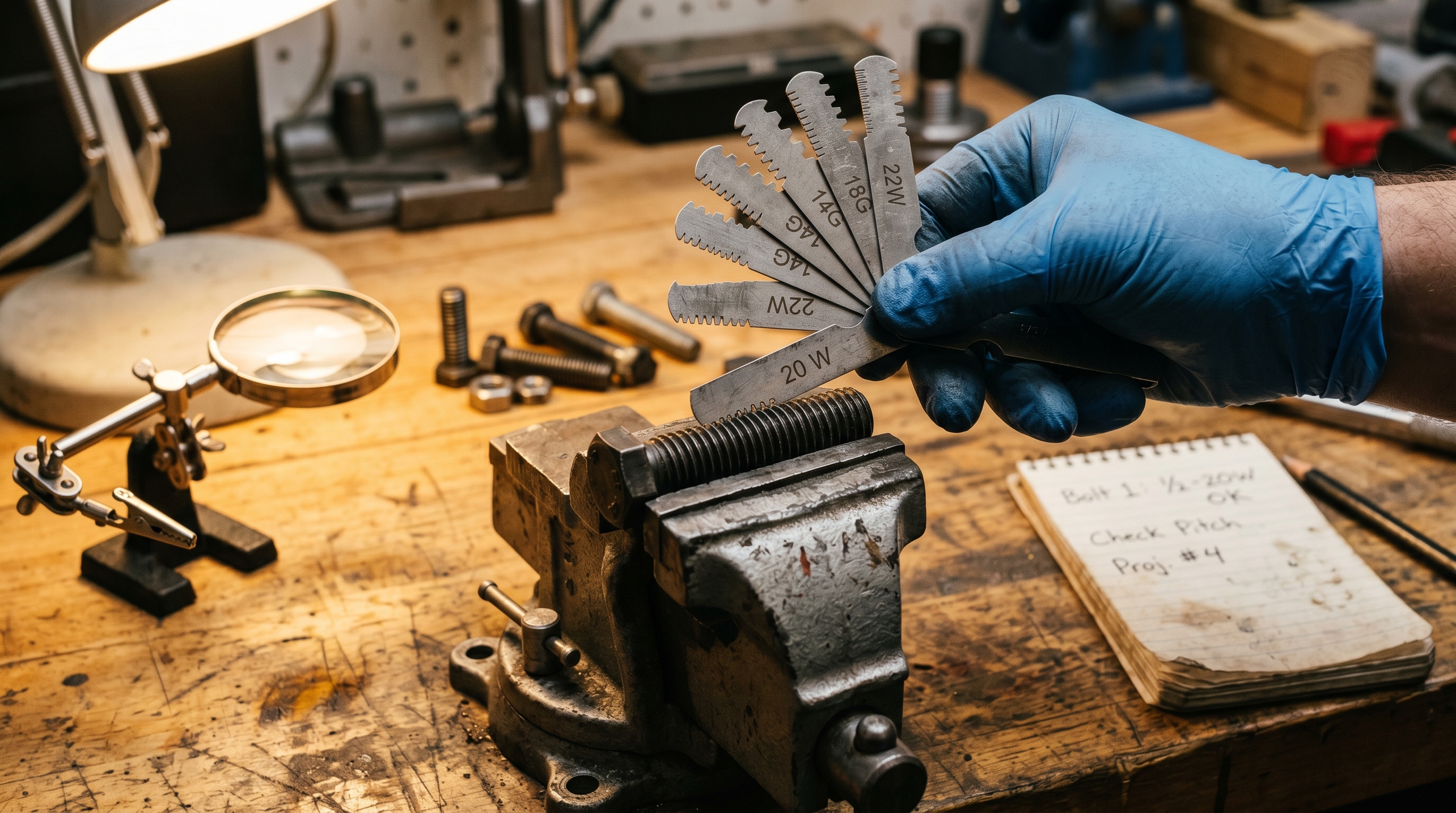
- Thread pitch. Use a thread-pitch gauge with Whitworth blades. BSW pitches are 20, 18, 16, 14, 12, 11, 10, 9, 8, 7, 6, 5, 4.5, 4 TPI for 1/4″ through 3″ diameters. BSF runs finer: 26, 22, 20, 18, 16, 14, 12, 11, 10, 9, 8 TPI for 1/4″ through 1-1/2″.
- Head dimension. If the hex head measures roughly halfway between two AF sizes, that's a strong Whitworth signal — e.g., a 1/4″ Whitworth bolt has a 0.445″ hex.
Tools for Whitworth Work
A four-tool kit covers nearly every Whitworth-era restoration job — Land Rover Series, British motorcycle, classic British saloon, or pre-war machinery.
Whitworth/BSF Combination Wrench Set
Body, chassis, and most non-engine fasteners on Series I/II/IIA Land Rovers and pre-1970s British motorcycles. Dual-marked sets cover both BSW and BSF in one tool.
Thread Pitch Gauge with Whitworth Blades
Identify unknown bolts in 30 seconds at the bench. Look for a multi-set with BSW, BSF, and Unified blades on one tool body.
BA (British Association) Wrench Set
Lucas electrical, gauges, and small-instrument fasteners on any pre-1980s British vehicle. A 0BA-through-10BA set covers everything you'll meet.
Click-Type Torque Wrench, 5–80 ft-lb
Most chassis and accessory torque specs on Series Land Rovers and classic motorcycles sit in this range. Lower-torque than modern vehicles — an 80 ft-lb-max wrench handles almost everything.
As an Amazon Associate, WhatSizeBolt earns from qualifying purchases on the links above.
Sourcing Whitworth Replacement Fasteners
Specialist suppliers maintain stock for the restoration market.
- Namrick (UK) — Comprehensive BSW, BSF, and BA inventory. Ships internationally.
- Tracy Tools (UK) — Whitworth and BA taps, dies, and pitch gauges.
- Holt's Auto Products — Classic vehicle fastener kits including Whitworth.
- Bolt Depot (US) — Limited Whitworth stock, useful for emergency replacement.
For tools, Snap-on, Britool, and Sykes-Pickavant still manufacture Whitworth/BSF combination wrench sets. Used sets on eBay and at British classic-car shows are often dramatically cheaper than new and entirely serviceable.
The Terminology Trap
Three centuries of layered standards mean the vocabulary can mislead. Here's the quick reference.
| Term | Meaning | Status |
|---|---|---|
| Whitworth (BSW) | British Standard Whitworth. 55°, rounded. Coarse pitch. | 1841–present (legacy) |
| BSF | British Standard Fine. Same 55° Whitworth form, finer pitches. | 1908–present (legacy) |
| BSP | British Standard Pipe. 55° Whitworth-form pipe thread. | Current outside the US |
| BSC | British Standard Cycle. 60° for bicycles. NOT Whitworth-form despite the "BS" prefix. | Current (niche) |
| BA | British Association. 47.5° thread for small instruments and electrical. Sized 0BA to 22BA. | Current (restoration) |
| Sellers thread (1864) | 60° flat-crest profile proposed by William Sellers. Adopted as the de facto U.S. Standard from 1868; codified as American National in 1924. "Sellers Standard" is colloquial — never a published standard name. | Obsolete name; profile lives on as Unified |
| NC / NF | National Coarse / National Fine. Pre-Unified American standard. | Obsolete (replaced by Unified) |
| UNC / UNF / UNEF | Unified Coarse / Fine / Extra Fine. The current American inch standard. | Current (US inch) |
| SAE | Society of Automotive Engineers. Adopted Unified. "SAE wrench set" = inch wrench set. | Casual American usage |
| Imperial | British colloquial umbrella for "inch threads." Includes BOTH Whitworth and Unified. | Casual British usage |
| Standard | American shop slang for "inch, not metric." Imprecise. | Casual American usage |
| ISO Metric (M-series) | 60° thread, designated by diameter × pitch in mm (M8×1.25, etc.). | Global default outside the US |
Frequently Asked Questions
Will a metric wrench fit a Whitworth bolt?
No. A metric wrench in the closest size will be loose on the hex flats, which is exactly the condition that rounds the head. A 1/4″ Whitworth bolt has a 0.445″ (11.3 mm) hex — an 11 mm metric wrench is undersized and a 12 mm wrench is oversized. You need a Whitworth or BSF wrench in the matching size.
What's the difference between BSW and BSF?
Both use the 55° Whitworth thread profile. BSW (British Standard Whitworth, 1841) is the coarse-pitch family; BSF (British Standard Fine, 1908) is the fine-pitch family. They share thread form and many wrench sizes pre-1948 — after 1948, BSF heads were stepped down one size, so a 1/2″ BSW wrench equals a 9/16″ BSF wrench in real-world hex dimensions.
Did Land Rover ever fully switch off Whitworth?
Not until the all-metric Defender debuted in 1983. The Series I, II, IIA, and III run (1948–1985) used a mix of BSF, UNF, and BA throughout. Even late Series III vehicles retain BSF and BA fasteners on Lucas electrical, gauges, and some accessory mounts.
Is BSP the same thread as Whitworth?
BSP uses the Whitworth thread form (55° flank angle, rounded crests) but with pipe-specific pitches and parallel/tapered variants (BSPP, BSPT). It's a direct descendant, still standard in UK, EU, Australian, and Commonwealth plumbing. Do not interchange with American NPT, which is 60°.
Can I retap Whitworth threads to UNF?
Sometimes, but rarely the right call. Whitworth and UNF are different pitches AND different angles, so retapping over an existing Whitworth thread leaves a chewed, oversize hole. Use the right fastener instead — suppliers like Namrick and Tracy Tools still stock BSW, BSF, and BA fasteners in original sizes.
Is "Sellers" the same as "American National"?
"Sellers thread" refers to the 1864 60° flat-crest profile proposed by William Sellers. It was never formally codified under that name — it became the de facto U.S. Standard from 1868, was formally codified as American National (NC/NF) in 1924, and was folded into Unified (UNC/UNF) in 1948 by the US/UK/Canada Inch Screw Thread Agreement. All three names describe the same underlying 60° flat-crest profile.
The Practical Bottom Line
If you own a vehicle built in Britain before about 1975, assume Whitworth-family threads are present somewhere on it until you have proven otherwise. Reach for a Whitworth/BSF wrench set before you reach for an AF set. Identify unknown bolts with a pitch gauge before forcing a wrench onto them. And do not assume that just because a thread "looks British inch" it is interchangeable with the modern American or metric equivalent in your bin — it isn't.
For specific fastener specs, use the free spec lookup tool, browse the catalogued Series IIA and Series III pages, or grab the printable torque chart for your toolbox.
And if you've never seen this story told in 50 seconds, the "Why your grandpa's wrenches don't fit anything anymore" Short on the WhatSizeBolt YouTube channel covers it visually, with the 55° vs 60° thread cross-sections that started this entire article.
Safety note: Always use a calibrated torque wrench and double-check the spec against your vehicle's service manual.