Square-Head Bolts vs Square-Drive Plugs: Sizes, Tools & Uses
By WhatSizeBoltPublished 8 min read
A square head, a square recess and a ratchet drive are different interfaces. Learn what the size labels mean, which tools engage them, where square-head bolts are used and when to stop rather than force a near-fit.
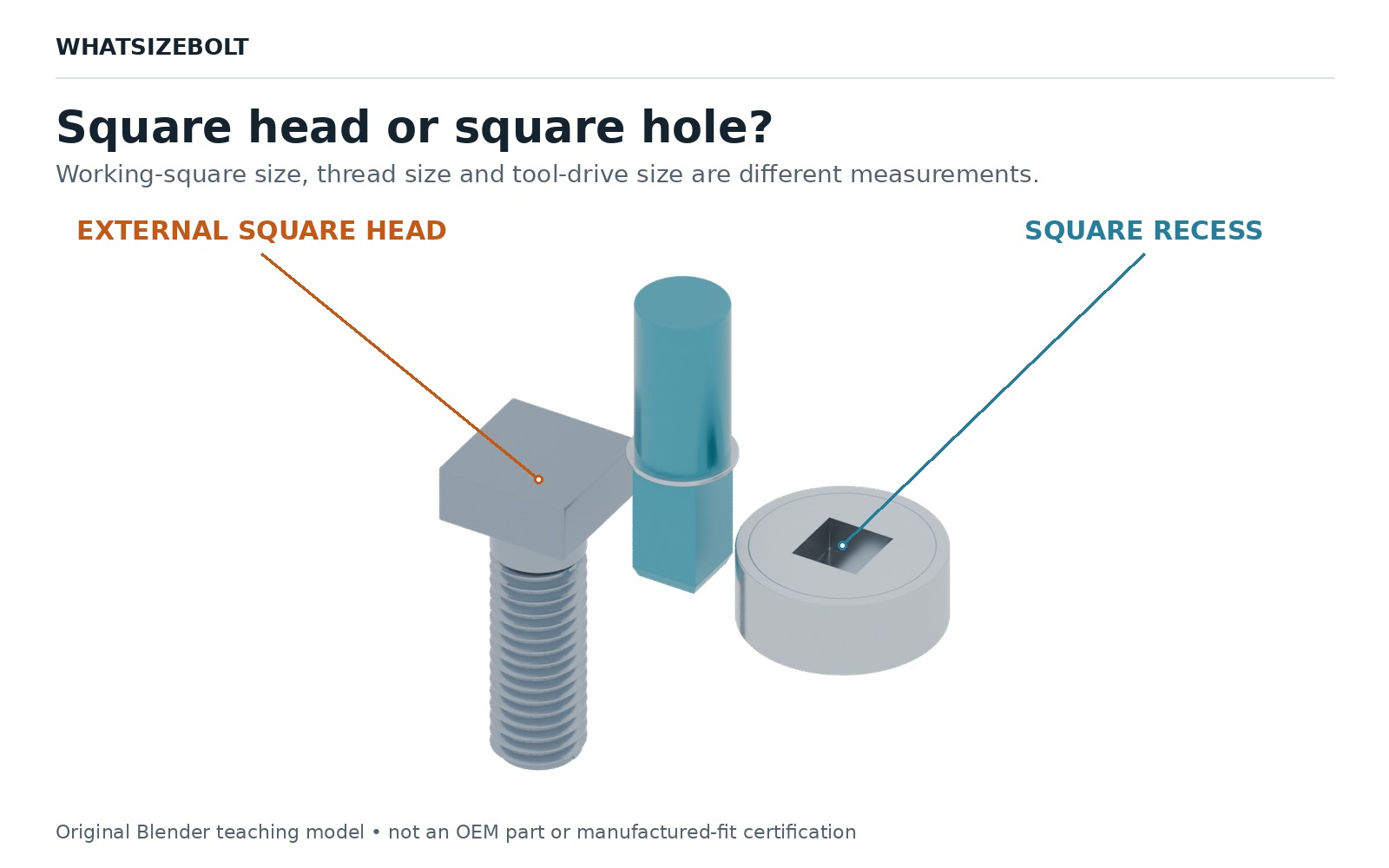
A square on a fastener can mean two very different things: a raised square head on a bolt, or a square recess down inside a plug. One takes a tool around the outside; the other takes a male tool into the opening. Identify which geometry you have before choosing a wrench or socket. Then measure the working square and read the fastener’s thread specification separately.
This is identification guidance, not vehicle-specific fitment, strength, or tightening advice.
First, identify the interface
Look at the fastener end-on. If a raised four-sided head projects outward, you have an external square head. The tool must fit around that head: for example, an appropriately sized open-end wrench, a four-point female square socket, or a purpose-designed eight-point socket that seats correctly on the square. If the fastener has a cavity with four straight sides, it has an internal square recess; the tool must have a matching male square working end, such as a plug key made for that recess.
These are not the same as a Robertson screw, which has a shaped square recess for a driver bit, or a carriage bolt, whose square neck under a rounded head engages the workpiece or a matching hole to resist rotation. A ratchet’s square drive is yet another interface: it connects sockets and extensions, not necessarily the fastener itself.
Measure the right thing: across flats
For an external square head, measure from one flat face straight across to the opposite flat face. This is the across-flats (AF) dimension. Do not measure diagonally from corner to corner: that gives a larger number and will not tell you which wrench or socket to select. For an internal square recess, measure between opposite flat walls at the opening, and also check the usable depth. A worn, burred, tapered, or shallow recess may not provide full engagement even if its opening seems close to a nominal size.
Keep that measurement separate from the thread. A “1/2-13 UNC” label means a nominal 1/2-inch thread with 13 threads per inch in the Unified National Coarse series. It does not state the head’s AF size, identify a square-drive tool connection, specify material grade, or certify the fit of a replacement. In a generic bench example, a 1/2-inch square-head bolt has a 3/4-inch head across flats; that is not a universal conversion. Portland Bolt’s square-head table identifies ASME B18.2.1-1996 as its dimensional reference, and its coarse-thread table lists 1/2-13. Those are useful reference points, not a complete audit of a current standard or an OEM drawing.
| Size label or reference | What it means | What it does not prove |
|---|---|---|
| 1/2-13 UNC | Nominal thread diameter 1/2 inch and 13 threads per inch, coarse series. | Head width, tool-drive size, grade, tolerance-class acceptance, or application fit. |
| 3/4-inch AF square head | Opposite external head flats are nominally 3/4 inch apart in the example. | Thread size, strength, or that every 1/2-inch bolt has this head. |
| 7/16-inch H regular nut | “H” is the nut-thickness dimension: 7/16 inch (11.1125 mm) in the cited 1/2-inch regular-nut reference row. | It is not the nut’s wrench size, and it does not identify a square head. |
| 3/8-inch tool drive | A nominal ratchet/socket connection family. | The fastener’s square size, the working-end shape, or plug compatibility. |
Square-head dimensions here follow the supplier table’s stated 1996 reference; the regular-nut thickness is from a supplier table identified with ASME B18.2.2. These are references, not inspection limits or current-edition certification. Nominal dimensions do not establish a Class 2A/2B fit.
Choose the tool by what it has to engage
- Raised external square head: Measure AF, then choose a wrench or female square socket that fits snugly on the flats without rocking. A purpose-made eight-point socket can be an option if its geometry is intended for square heads and it seats fully. Do not assume every eight-point socket, an approximate metric socket, or an adjustable wrench is a safe fit. Use the tool maker’s intended application and the fastener’s service procedure.
- Internal square plug: Measure the recess opening and usable depth. Choose a male square plug key or other tool specifically intended for that plug style and size. Confirm that it enters to meaningful depth and engages the sides rather than wedging on a corner or bottoming out. A square bar or extension that happens to enter is not automatically the proper plug tool.
- Still unsure: Check the part or vehicle service information, the replacement maker’s specification, and the tool manufacturer’s description. If a proper fitting tool cannot be identified, pause rather than using a near-fit.
Why a 3/8-inch extension may not be the right plug key
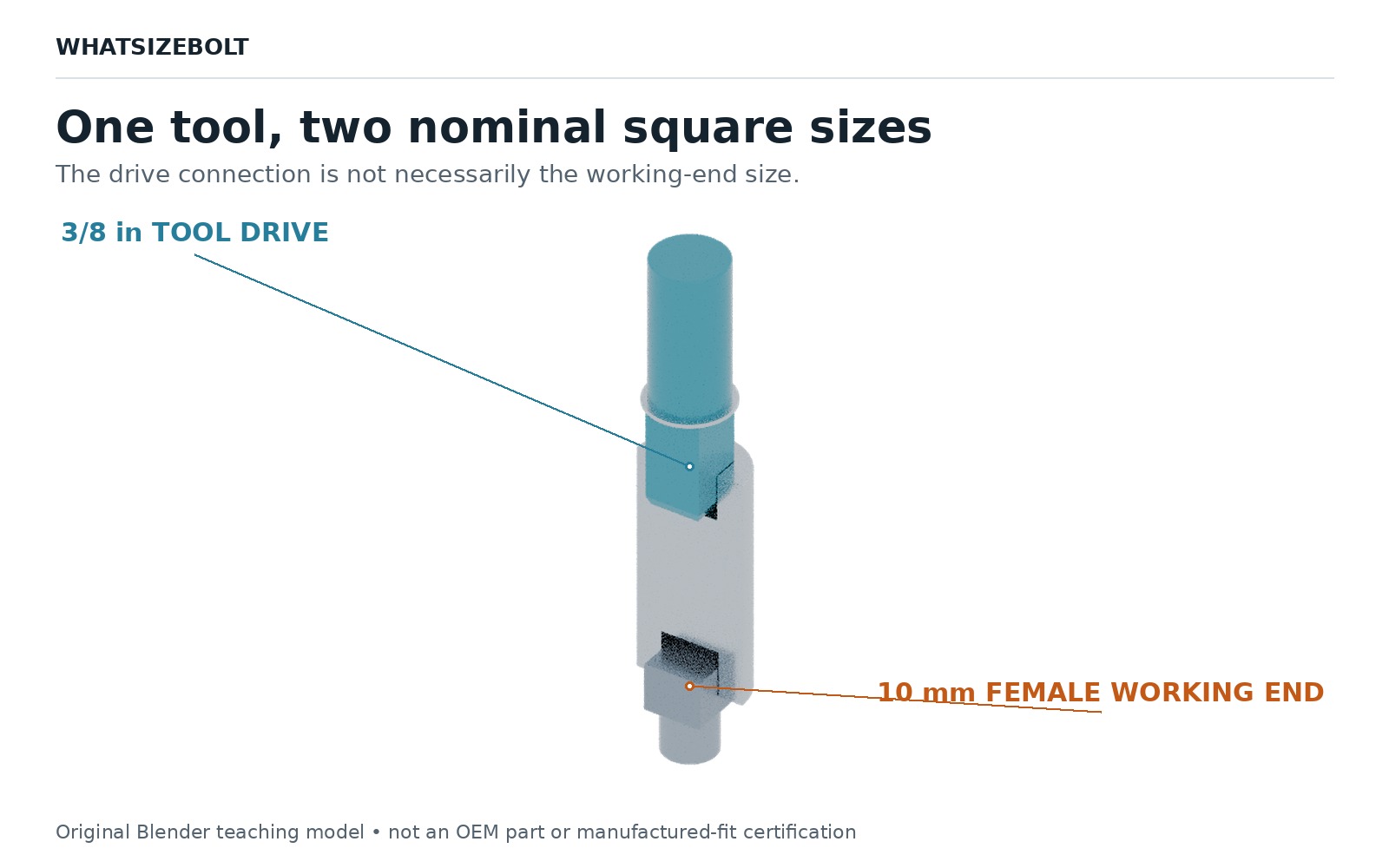
On a socket or plug key, a 3/8-inch drive label describes the tool-side connection, not necessarily its working end. A bare 3/8-inch extension does have a nominally matching male drive tang, but that does not establish a plug’s actual recess size or the tool’s usable engagement. It may slide into some square recesses, yet its leading chamfer can reduce straight-sided contact in a shallow cavity. A close-but-not-correct size can load only corners, round the recess, or slip. Use the specified plug key when the maker calls for one, and do not treat “it goes in” as proof that it is a suitable working fit.
Tool interfaces can combine different nominal sizes at their two ends. For example, Laser Tools describes its 3687 drain-plug key as having a 10 mm female working square and a 3/8-inch drive connection; its published product data also gives a 19 mm outside diameter and 40 mm length. In that description, 10 mm refers to the square it works on, while 3/8 inch refers to the tool-side connection. It is not a 3/8-inch fastener head. The maker does not publish the cavity depth and tolerances in the cited listing, so those should not be inferred from the label.
Common modern ratchet-drive families include 1/4, 3/8, 1/2, 3/4, and 1 inch. These names identify common tool interfaces; they are not a complete chart of external square-head widths or internal plug-recess sizes. A 1/3-inch ratchet drive is not a common modern drive family, though unusual, custom, or historical tooling can exist. Do not reject a tool solely because an unusual size is unfamiliar—verify its actual dimensions and intended use.
Where square-head bolts still appear
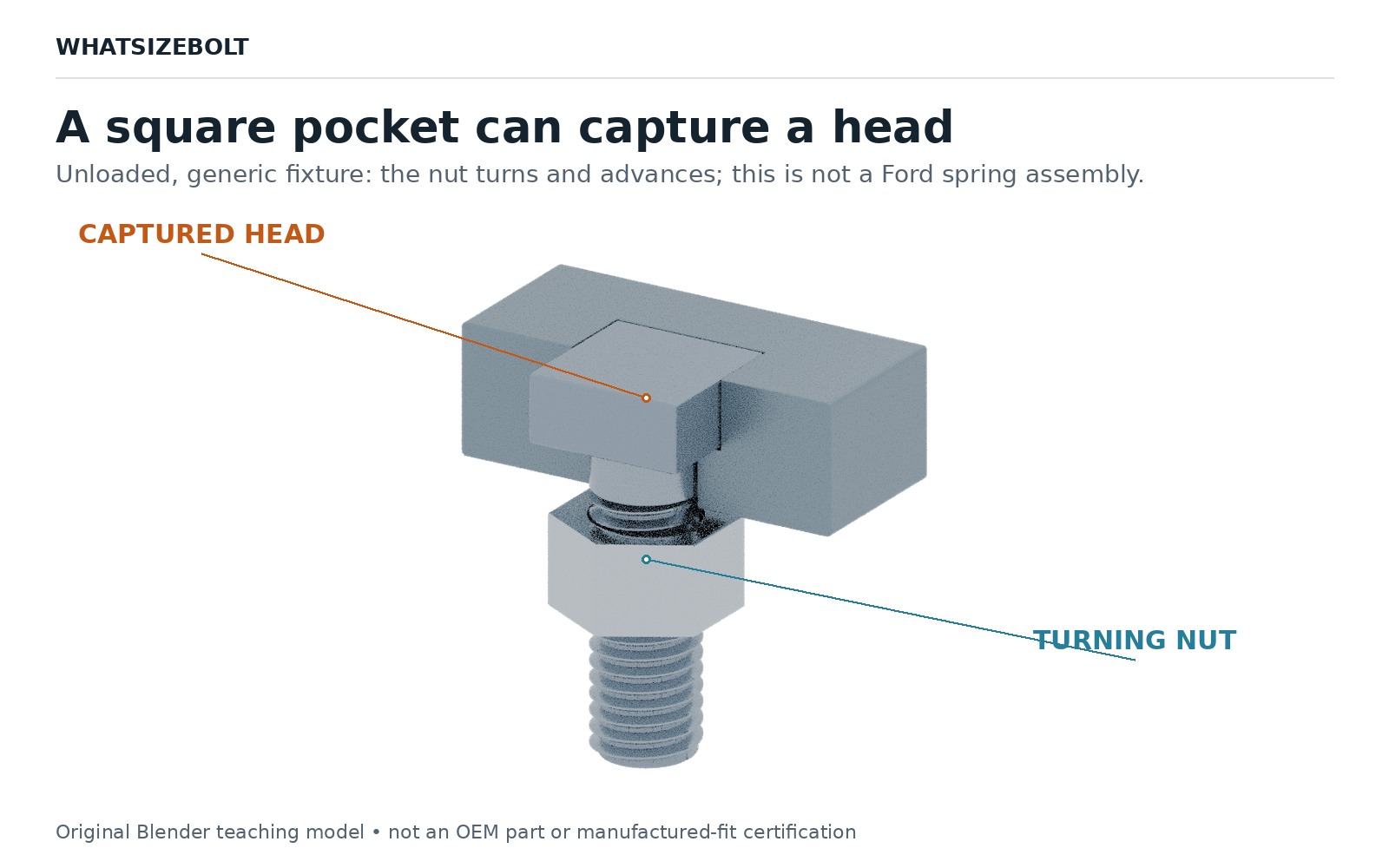
Square-head machine bolts were prominent before hex heads became dominant. Today, manufacturers still list them for timber work, covered-bridge restoration, and utility crossarms, among other applications. Their broad, flat sides give a compatible wrench surfaces to engage. A matching square pocket can also capture the head against rotation while a nut is turned; that is a general geometric feature of a correctly matched fixture, not a claim about a particular vehicle joint.
For a narrow automotive-history example, current Eckler’s and Belchers restoration catalogs list a square-head front spring-center bolt for the 1928–1931 Ford Model A; Belchers identifies the part as A-5345-F. These current replacement listings document the catalog application. They are not a contemporaneous Ford factory drawing, proof that every early Ford used square-head bolts, or authorization to substitute a part based on head shape alone.
The trade-offs are practical. A square has four equivalent orientations, versus six for a hexagon—90 degrees versus 60 degrees of ideal rotational symmetry. That does not prescribe the real swing clearance of a particular wrench or ratchet: actual clearance depends on tool geometry, access, and ratchet pitch. The square shape also does not establish strength. Material, grade, heat treatment, coating, thread fit, joint design, and the required installation procedure remain separate questions. Pick a correctly fitting tool and use application-specific service information, rather than treating the outline as a performance rating.
Before replacing a square-head bolt or plug
- Identify whether the square is an external head, a recess, or a carriage-bolt neck. Do not confuse it with a Robertson-style driver recess or ratchet drive.
- Record the external head’s AF or the recess’s opening and usable depth. Keep that measurement separate from thread diameter and pitch.
- Verify the thread series and diameter, overall underhead length, threaded length, head form, and any application-specific dimensions against reliable part information. Do not infer a whole fastener from a single matching number.
- Confirm material grade, coating, and any reuse restrictions or anti-rotation features using the application’s parts and service information. A square shape does not identify these properties.
- Choose a tool that fully engages the actual working surface, and check the manufacturer’s instructions for the fastener or plug. Use the specified torque procedure when one exists; no generic torque value follows from this article.
Stop if the tool rocks, only catches corners, bottoms out before engaging the recess, or begins to bind, deform, or slip. Do not force a near-fit. A damaged head, damaged recess, uncertain replacement, or unusual service procedure calls for the appropriate repair information or a qualified technician—not improvisation.
Quick answers
Is a square-head bolt stronger than a hex-head bolt?
Not because it is square. Shape describes the head interface; strength depends on the fastener material, grade, dimensions, condition, and joint design.
Can I use an ordinary 3/8-inch extension on a square-recess plug?
Not by size label alone. It may physically enter, but the end shape, chamfer, recess depth, and engagement matter. Use the intended plug key if specified and verify the fit without forcing it.
Does a 1/2-13 thread mean a 1/2-inch square head?
No. It names the nominal thread diameter and pitch. Head AF is a separate measurement; the generic bench example in this article has a 3/4-inch square head.
Can I use a restoration listing as proof a replacement fits my car?
No. A catalog application is a useful lead, not an OEM drawing or fitment confirmation for a specific vehicle. Verify the exact part and service information before replacing a fastener.
Start with your exact application
Use the free WhatSizeBolt vehicle and fastener lookup to start identifying a component, then inspect its source and the applicable service information. The wrench and socket finder can help name a tool interface, but it does not certify a replacement, an extension-to-plug fit, or a tightening procedure. If a field lacks source evidence, do not turn it into a guessed specification.
References
- Portland Bolt: Square Head Bolts — dimension table cites ASME B18.2.1-1996; also notes current uses.
- Portland Bolt: Rolled Thread Bolt Diameter — 1/2-13 coarse-thread reference.
- AFT Fasteners: Finished Hex Nuts Dimensions — regular-nut table identified with ASME B18.2.2.
- Osborn Products: Basic Screw Thread Designations — Unified thread profile reference.
- ASME B18.2.1 — standard scope.
- Eckler’s: Model A Ford Center Spring Tie Bolt & Nut and Belchers: Front Spring Centre Bolt A-5345-F — current catalogs for the stated application.
- Laser Tools: 3687 Drain Plug Key, Female Square 10 mm — maker’s interface and envelope data.
- GEDORE: Socket-Wrench Extensions — common tool-drive families.
- Laser Tools 1579 — 3/8-inch and 11 mm working-square plug-key examples.
- Dorman Shop Press: Square Drive — a professional account of metric recesses and chamfer-related engagement limits; not an OEM procedure or universal fitment rule.
Use the relevant maker or service documentation for a specific part. Reference dimensions and examples here are not a manufactured-fit certificate, vehicle-specific replacement approval, strength test, or torque instruction.

Video plays from YouTube when clicked. Always confirm torque values against your service manual.