Predator (Harbor Freight) Engine Torque Specs
⚠ Largely unconfirmed by the manufacturer — verify against your engine before torquing.
Cylinder head bolt torque at a glance
- 212 Non-Hemi17 ft-lbMedium
- 212 Hemi18 ft-lbMedium ⚠ sources disagree
- 212 Ghost19–22 ft-lbHigh
- 224220 in-lb≈ 18.3 ft-lbLow
- 301cc (8 HP)Not published
- 420cc (13 HP)25 ft-lbLow ⚠ sources disagree
- 670cc V-Twin (22 HP)Not published
- DuroMax XP18HPE15 ft-lbLow
HighMediumLow= how many independent sources agree
Harbor Freight's Predator engines are clones of the Honda GX family, but here's the honest truth most sites won't tell you: for almost every Predator, Harbor Freight does not publish a torque table. Their owner's manuals cover setup and maintenance only. Read the rest ›
The one exception is the 212 GHOST kart racing engine (item 57531), whose manual does carry a specification table -- so the Ghost figures below are manufacturer-published, and the rest are parts-house or forum-sourced, several openly conflicting, with a few common specs simply undocumented. We show you exactly what we found, how confident it is, and where the numbers disagree — which is more useful than a single made-up figure.
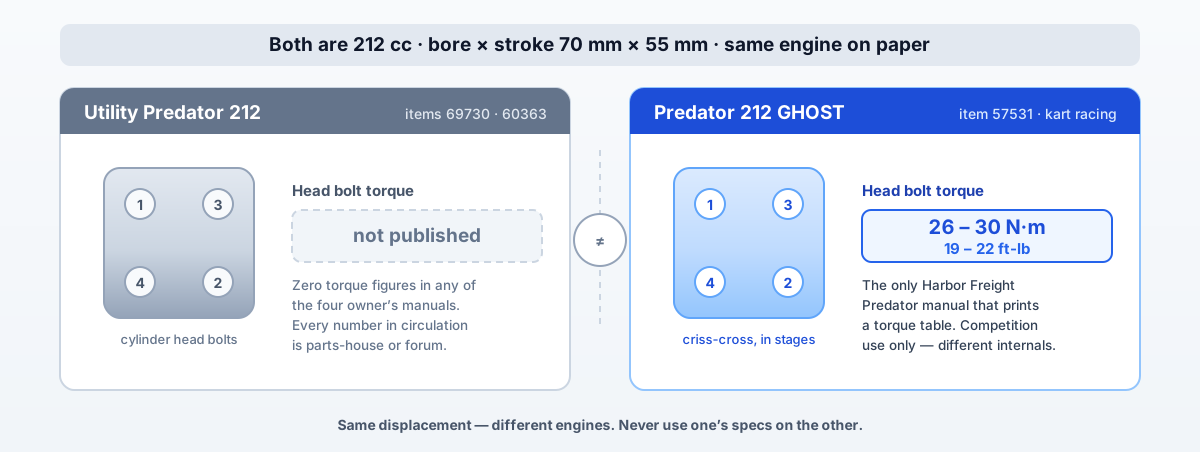 Open the comparison diagram full-size ↗
Where these numbers come from. 25 published figures, 18 confirmed gaps, every source named. How we checked ›
We inspected the Harbor Freight 212cc, 301cc and 670cc owner's manuals page by page. Re-checked 2026-09-09 against Harbor Freight's own PDF server, per item number: the UTILITY 212s publish no torque figure of any kind -- items 69730 (all three UPC revisions) and 60363 contain zero numeric torque mentions, confirmed by text extraction. But the 212 GHOST kart racing engine, item 57531, DOES publish one, and that single exception is why the blanket claim this page used to make has been narrowed. All five manuals describe the same 212 cc / 70 mm x 55 mm engine, but the Ghost is a competition-only product ("THIS ENGINE IS FOR COMPETITION USE ONLY" on its own cover) with different internals, so its published figures are NOT transferred to the utility 212 rows below -- that cross-attribution is the exact error this page exists to avoid. That was re-confirmed in 2026-08 for the 301cc (item 62554) and the 670cc V-Twin (item 61614): both manuals publish bore/stroke, compression ratio, plug type and gap, valve clearance, idle speed and PTO shaft dimensions, and the word "torque" appears in neither document. So the gaps on this page are confirmed absences in the manufacturer's own documentation, not gaps in the search. Two item numbers worth not confusing, because both circulate against the wrong engine: 60340 is Harbor Freight's 420cc engine, not the 301cc, and 68530 is an 8750-watt generator, not the 670cc V-Twin. Nothing here is manufacturer-confirmed. Because the Predator 212/224 are ~196cc clones of the Honda GX200, the GX200 spec is a reasonable cross-reference when a Predator number is missing or disputed. The Predator 301cc and 670cc V-twin fastener torques are essentially undocumented; we flag those as gaps rather than invent values.
Predator 212 Non-Hemi212cc
Badged 212cc; actual displacement ~196cc, same class as Honda GX200. More about this engine ›
Harbor Freight owner's manuals for this engine do not publish a torque-spec table (confirmed by direct inspection of the 69730 manual on ManualsLib/Harbor Freight's own PDF server) -- all values below come from parts-house tech articles that reverse-engineered/compiled the specs, cross-checked against forum consensus.
| Fastener | Torque | Where it comes from |
|---|---|---|
| cylinder head bolts | 17 ft-lbMedium | Also reported as 204 in-lb (same value). Why ›Torque in criss-cross pattern. Same spec as above expressed in in-lb by the same source (OMB Warehouse); rocker studs share this torque value. |
| connecting rod bolts (stock rod) | 108 in-lb= 9 ft-lbMedium | 9 ft-lb equivalent. Apply light oil to threads. Why ›Same value expressed in ft-lb by clone-engine community references; applied 1 ft-lb increments alternating sides. |
| rocker arm pivot lock nut | 94 in-lb≈ 7.8 ft-lbMedium | Also reported as 7 ft-lb (84 in-lb) by ARC Racing -- close but not identical; minor source variance. |
| flywheel nutM14x1.5 | 55 ft-lbMedium | Reconciled to the Honda GX200 clone spec: Honda's shop manual specs this M14x1.5 flywheel nut at 55 ft-lb (75 N-m), and parts-house sources… Why ›cite 54-65 ft-lb. A previously-circulated 36-44 ft-lb figure is unsupported and dangerously low - an under-torqued flywheel nut lets the flywheel walk on the taper and shear the key. Use a flywheel holding tool, never an impact gun. |
| oil drain plugM12x1.5 | 12 ft-lbLow | ~11-14 ft-lb with a 17mm socket. Aluminum crankcase - snug only, do not overtighten or the threads strip. |
Valve clearance — feeler gauge, not a wrenchValve clearance — set with a feeler gauge, not a wrench
- clearance (cold), intake: Not a torque spec -- clearance value. Community-reported range .004-.006 in for intake; a competing source reports .003-.004. No manufacturer-published figure found. Set on a cold engine.
- clearance (cold), exhaust: Not a torque spec -- clearance value. Community-reported range .006-.008 in; competing report .004-.005. No manufacturer-published figure found.
1 spec not published — spark plug What we found ›
- spark plugGAP: No confirmed Predator-specific torque figure located; Predator manuals specify a finger-tighten-plus-partial-turn method rather than a numeric torque, consistent with other engines in this family. General 14mm gasket spark-plug torque for aluminum heads runs 18-22 ft-lb (NGK/Champion guidance) -- provided as general reference only, NOT confirmed for this engine. Plug: NGK BP6ES / Champion RJ19LM (212-class), NGK BPR6ES / Champion RN4C (420-class); gap 0.028-0.031 in; 14mm x 1.25 thread with a short ~9.5mm reach that differs from the Honda GX long-reach plug - do not substitute the GX plug blind.
Predator 212 Hemi212cc
actual ~196ccHemi head has a different chamber/valve geometry than non-hemi but shares the same bore/stroke class; the two use DIFFERENT flywheels/tapers… More about this engine ›
(not interchangeable) per OMB Warehouse and DIYGoKarts community consensus, though reported torque values for head/flywheel are the same as non-hemi in most compiled sources.
| Fastener | Torque | Where it comes from |
|---|---|---|
| cylinder head bolts | 18 ft-lbMediumalso cited220 in-lb ≈ 18.3 ft-lbLow⚠ sources disagree | 216 in-lb equivalent, per ARC Racing's Gen 2 hemi head spec. A second source gives 17 ft-lb (204 in-lb), i.e. the same as non-hemi -- treat… Why ›17-18 ft-lb as the practical range. Forum-reported alternative (~18.3 ft-lb), consistent with the ARC Racing figure above. |
| flywheel nutM14x1.5 | 54 ft-lbLow | Same nominal spec commonly cited for non-hemi; NOT confirmed by a manufacturer manual. Why ›Hemi and non-hemi flywheels are not physically interchangeable (different crank taper) but the torque figure quoted in the community is the same number. |
| oil drain plugM12x1.5 | 12 ft-lbLow | ~11-14 ft-lb with a 17mm socket. Aluminum crankcase - snug only, do not overtighten or the threads strip. |
2 specs not published — spark plug, valve cover / rocker arm What we found ›
- spark plugGAP: no Hemi-specific torque value located. See non-hemi entry for general spark-plug torque reference caveat. Plug: NGK BP6ES / Champion RJ19LM (212-class), NGK BPR6ES / Champion RN4C (420-class); gap 0.028-0.031 in; 14mm x 1.25 thread with a short ~9.5mm reach that differs from the Honda GX long-reach plug - do not substitute the GX plug blind.
- valve cover / rocker armGAP: GoPowerSports' Hemi head product page (a natural place to look) explicitly does not list torque specs. No other Hemi-specific source found for valve cover or rocker arm/lash torque distinct from the non-hemi figures.
Predator 212 Ghost (item 57531)212cc Manufacturer-published
The kart racing variant, and the ONLY Predator whose Harbor Freight manual publishes a specification table -- so unlike every other engine… More about this engine ›
on this page, these are manufacturer figures rather than parts-house or forum ones. Competition use only; its manual states so on the cover and notes the engine is exempt from emission standards. Same 212 cc and 70 mm x 55 mm bore/stroke as the utility 69730 and 60363, but a different product with different internals, so do NOT apply these numbers to a standard 212 -- and do not apply the standard 212 numbers to a Ghost. Manual also gives 8.5:1 compression, 10W-30 synthetic 0.63 qt, 1600 RPM idle, 6000 RPM maximum, counterclockwise PTO rotation and a 0.75 in x 2.43 in output shaft.
| Fastener | Torque | Where it comes from |
|---|---|---|
| cylinder head bolts | 19–22 ft-lbHigh | MANUFACTURER-PUBLISHED, and the only such figure on this page. Why ›The manual's spec table reads verbatim "Torque Specification for Cylinder Head Bolts / 26 - 30 Nm (19 - 22 ft-lb)". Torque in a criss-cross pattern. This sits materially above the 17 ft-lb the parts-house sources give for the utility 212 -- that is a difference between two different engines, NOT a correction to either. |
Valve clearance — feeler gauge, not a wrenchValve clearance — set with a feeler gauge, not a wrench
- clearance (cold), intake: Not a torque spec -- clearance value: 0.003 - 0.005 in, manufacturer-published. Worth contrasting with the utility 212, where no manufacturer figure exists and the community reports two conflicting ranges.
- clearance (cold), exhaust: Not a torque spec -- clearance value: 0.005 - 0.007 in, manufacturer-published.
3 specs not published — spark plug, connecting rod bolts, flywheel nut What we found ›
- spark plugGAP for torque -- the manual specifies the plug and its gap but no tightening figure. Plug: Torch F7TC, gap 0.023 - 0.031 in. Both are manufacturer-published and differ from the NGK BP6ES / 0.028 - 0.031 in commonly quoted for the utility 212, so check which engine you actually have before buying plugs.
- connecting rod boltsGAP: the Ghost manual publishes a head-bolt figure but no rod-bolt figure. Do not assume the utility 212 rod spec carries over -- the Ghost ships with a different rod.
- flywheel nutGAP: no figure in the Ghost manual. The 212 non-hemi/GX200 55 ft-lb cross-reference is a reasonable starting point but is NOT confirmed for this engine.
Predator 224224cc
Also sold/branded as "Ducar 224" / Predator 224 Max Performance non-hemi. Shares the same M14x1.5 flywheel taper family as the 212 non-hemi/GX200.
| Fastener | Torque | Where it comes from |
|---|---|---|
| cylinder head bolts / studded side cover bolts | 220 in-lb≈ 18.3 ft-lbLow | ~18.3 ft-lb. Torque in criss-cross pattern. |
| connecting rod bolts (stock rod) | 108 in-lb= 9 ft-lbLow | Same spec as Predator 212/224 shared stock rod, per parts-house community reference (not confirmed independently for 224 specifically). |
| flywheel nutM14x1.5 | 54 ft-lbLow | Stock spec commonly cited for the 224 non-hemi/Ducar platform; aftermarket ARC billet flywheels for this engine spec 55-70 ft-lb depending on model. |
| oil drain plugM12x1.5 | 12 ft-lbLow | ~11-14 ft-lb with a 17mm socket. Aluminum crankcase - snug only, do not overtighten or the threads strip. |
Valve clearance — feeler gauge, not a wrenchValve clearance — set with a feeler gauge, not a wrench
- clearance (cold), intake: Not a torque spec -- clearance value: 0.0039-0.0059 in.
- clearance (cold), exhaust: Not a torque spec -- clearance value: 0.0059-0.0078 in.
1 spec not published — spark plug What we found ›
- spark plugGAP: no torque figure located; Predator manual method is finger-tighten + partial turn, not a numeric spec. Plug: F7TC, gap 0.027-0.031 in. Plug: NGK BP6ES / Champion RJ19LM (212-class), NGK BPR6ES / Champion RN4C (420-class); gap 0.028-0.031 in; 14mm x 1.25 thread with a short ~9.5mm reach that differs from the Honda GX long-reach plug - do not substitute the GX plug blind.
Predator 301cc (8 HP)301cc
Bore x stroke 80 x 60mm -- same bore as Honda GX270 (77x58 is actually GX270's own bore; Predator 301's 80x60 is closer to a stroked/bored… More about this engine ›
clone of that displacement class, not identical to any single Honda GX). GAP: could not locate a Predator-301-specific manufacturer or parts-house torque table for head bolts, connecting rod, or flywheel nut -- despite dedicated searching of OMB Warehouse, ARC Racing, and Harbor Freight/Everest spec pages, none publish fastener torque for this specific model. Do not assume GX270/GX340 numbers apply without independent verification; they are provided only as an unconfirmed reference point.
Valve clearance — feeler gauge, not a wrenchValve clearance — set with a feeler gauge, not a wrench
- clearance (cold), intake: Not a torque spec -- clearance value: 0.0039-0.0059 in.
- clearance (cold), exhaust: Not a torque spec -- clearance value: 0.0039-0.0059 in.
4 specs not published — cylinder head bolts, connecting rod bolts, flywheel nut, spark plug What we found ›
- cylinder head boltsGAP -- no source found specific to the Predator 301. For reference only (NOT confirmed for this engine): Honda GX270/GX340 family head bolts torque to 25 ft-lb (35 N-m) per official Honda assembly documentation. Circulating (unsourced) figure: ~140-160 in-lb. Honda GX270 clone parent = 25 ft-lb.
- connecting rod boltsGAP, and now a confirmed one rather than an unsearched one: Harbor Freight's own owner's manual for this engine (item 62554) was read cover to specifications page in 2026-08 and contains no torque table at all -- the word "torque" does not appear in it. The manual publishes bore/stroke, compression ratio, plug type and gap, valve clearance and idle speed, and no fastener torques. Note also that item number 60340, sometimes cited for the 301cc, is Harbor Freight's 420cc engine.
- flywheel nutGAP -- no source found specific to the Predator 301 flywheel nut. Community discussion (DIYGoKarts) explicitly notes this model's torque figure isn't well documented; do not extrapolate from the 212cc's M14 spec since the 301's crank/flywheel is a different, larger part. Circulating (unsourced) figure: ~40-50 ft-lb. Honda GX270 M16 nut = 125 ft-lb - confirm your nut size.
- spark plugGAP: no torque figure located. Plug: F7RTC, gap 0.0275-0.0315 in. Plug: NGK BP6ES / Champion RJ19LM (212-class), NGK BPR6ES / Champion RN4C (420-class); gap 0.028-0.031 in; 14mm x 1.25 thread with a short ~9.5mm reach that differs from the Honda GX long-reach plug - do not substitute the GX plug blind.
Predator 420cc (13 HP)420cc
Same platform class as Honda GX390 (M16x1.5 flywheel taper). More about this engine ›
This is the engine with the well-known flywheel-nut conflict flagged by the task brief: parts-house sources disagree between 54 ft-lb and 83 ft-lb -- both are recorded below with sources, not resolved.
| Fastener | Torque | Where it comes from |
|---|---|---|
| cylinder head bolts | 25 ft-lbLowalso cited18 ft-lbLow⚠ sources disagree | Stock bolt spec per forum consensus ("clone 420cc"); an ARP aftermarket CrMo bolt kit lists a generic 54 ft-lb spec but the poster/ARP… Why ›ultimately recommended 40 ft-lb for M10 grade-12.9 fasteners into an aluminum block -- illustrating why stock-bolt torque should not be exceeded with aftermarket hardware without consulting the kit's own instructions. Reference: Honda GX390 head bolt = 25 ft-lb (M10x80). Alternate range reported (10-12 ft-lb initial pass, 18-20 ft-lb final crisscross pass) -- meaningfully lower than the 25 ft-lb figure above; genuine spread in what's publicly documented for this fastener. |
| flywheel nutM16x1.5 | 83 ft-lbMediumalso cited54 ft-lbLow⚠ sources disagree | Matches Honda GX390's official flywheel nut spec (170 N-m / 125 ft-lb is GX390's V-twin-adjacent big-bolt figure -- note GX390… Why ›single-cylinder's own flywheel M16 nut is separately documented at 83 ft-lb in community compilations). Reported as the standard/stock spec by multiple parts-house sources. Reference: the Honda GX390 (M16 flywheel nut) specs 125 ft-lb; the Predator 420's much lower quoted figures suggest a smaller flywheel fastener - confirm your nut size before torquing. CONFLICTING value: some community threads report 54 ft-lb for the 420's flywheel nut (the same number as the 212's smaller M14 nut), which multiple other sources say is actually the 212cc spec being mis-applied to the 420. Flagged explicitly per the task's known-conflict list. Do not silently pick one -- verify against the specific engine/flywheel in hand before torquing. |
| flywheel nut (billet aftermarket flywheel)M16x1.5 | 65 ft-lbMedium | Aftermarket billet flywheel spec, distinct from either stock figure above -- included to avoid readers conflating aftermarket and stock… Why ›torque. Reference: the Honda GX390 (M16 flywheel nut) specs 125 ft-lb; the Predator 420's much lower quoted figures suggest a smaller flywheel fastener - confirm your nut size before torquing. |
| oil drain plugM14x1.5 | 12 ft-lbLow | ~11-14 ft-lb with a 17mm socket. Aluminum crankcase - snug only, do not overtighten or the threads strip. |
Valve clearance — feeler gauge, not a wrenchValve clearance — set with a feeler gauge, not a wrench
- clearance (cold), intake: Not a torque spec -- clearance value. Community-reported factory spec .005 in intake, but other threads suggest .003 in as a safer conservative setting. No manufacturer figure confirmed.
- clearance (cold), exhaust: Not a torque spec -- clearance value. Community-reported factory spec .007 in exhaust.
2 specs not published — connecting rod bolts, spark plug What we found ›
- connecting rod boltsGAP -- no dedicated 420cc-specific source found in this research pass despite searching; do not infer from the 212/224's 108 in-lb figure, as the 420 rod/bolt is a substantially larger part.
- spark plugGAP: no torque figure located. Plug: NGK BP6ES / Champion RJ19LM (212-class), NGK BPR6ES / Champion RN4C (420-class); gap 0.028-0.031 in; 14mm x 1.25 thread with a short ~9.5mm reach that differs from the Honda GX long-reach plug - do not substitute the GX plug blind.
Predator 670cc V-Twin (22 HP)670cc
GAP -- this is the weakest-documented engine in the Predator lineup for this research pass. More about this engine ›
The official Harbor Freight owner's manual (item 61614, confirmed via ManualsLib page-by-page inspection) does not include a torque-spec table -- it covers setup/maintenance/parts-list only, consistent with Harbor Freight's general practice of NOT publishing detailed torque charts for Predator engines. No OMB Warehouse, ARC Racing, or GoPowerSports tech article specific to the 670 V-Twin's fastener torques was found. Case Colt Ingersoll Tractors forum has a thread titled exactly on this topic ("HF670 Predator series and Torque data") but it sits behind a paywall/bot-block (HTTP 402) that could not be bypassed in this research pass -- worth a manual follow-up if a subscription or alternate access is available.
5 specs not published — cylinder head bolts, connecting rod bolts, flywheel nut, spark plug, valve cover / rocker arm lash What we found ›
- cylinder head boltsGAP -- no source found.
- connecting rod boltsGAP -- no source found.
- flywheel nutGAP -- no source found.
- spark plugGAP -- no source found. Plug: NGK BP6ES / Champion RJ19LM (212-class), NGK BPR6ES / Champion RN4C (420-class); gap 0.028-0.031 in; 14mm x 1.25 thread with a short ~9.5mm reach that differs from the Honda GX long-reach plug - do not substitute the GX plug blind.
- valve cover / rocker arm lashGAP -- no source found. This engine's rated output is sometimes cited as "45 Nm at 2500 rpm" but that is the engine's own crankshaft output torque rating (a performance spec), not a fastener torque -- do not confuse the two.
DuroMax XP18HPE440cc
Separate brand (not a Predator) but a GX390-class clone commonly cross-shopped with the Predator 420. More about this engine ›
No manufacturer torque table is published; the figures below are parts-house ranges at low confidence - cross-reference the Honda GX390 and confirm against your engine.
| Fastener | Torque | Where it comes from |
|---|---|---|
| cylinder head boltsM8x1.25 | 15 ft-lbLow | Parts-house range ~155-185 in-lb (~13-15 ft-lb). Honda GX390 (same class) = 25 ft-lb. |
| flywheel nut | 50 ft-lbLow | Parts-house range ~47-54 ft-lb. Confirm nut size - the GX390 M16 nut specs 125 ft-lb. |
| spark plug14mm x 1.25 | 13 ft-lbLow | General 14mm-plug guidance ~11-14 ft-lb; no engine-specific figure published. |
What is the real head bolt torque on a Predator 212?
Parts-house sources put it around 17 ft-lb (≈204 in-lb) on the 212 non-hemi — close to the Honda GX200 clone spec of 18 ft-lb, which is the sanity check we'd use. No manufacturer figure exists. The 420cc head-bolt torque is disputed between ~18 and 25 ft-lb; the table shows both.
What is the flywheel nut torque on a Predator 212 / 420?
This is the most conflicted spec in the whole Predator range. The 212 flywheel nut reconciles to 55 ft-lb (Honda's GX200 shop-manual figure for the same M14x1.5 nut), with parts-house sources quoting 54–65 ft-lb; the 420 is quoted as 54, 65 (billet flywheel), and 83 ft-lb (matching the Honda GX390 M16 family). We show every value with its source rather than pick one — err toward the manufacturer-clone figure and a flywheel holding tool, never an impact gun.
Does Harbor Freight publish Predator torque specs?
No. We checked the official 212cc (item 69730) and 670cc (item 61614) owner's manuals directly — they contain setup, maintenance, and parts lists but no fastener torque table. That is why reputable numbers for these engines are hard to find and why so many circulating figures conflict.
What's the torque spec for a Predator 301 or 670 V-twin?
Genuinely undocumented. Neither Harbor Freight nor the usual parts-house tech articles publish fastener torques for the 301cc or the 670cc V-twin. Rather than invent a number, treat these as gaps: cross-reference the Honda GX-family equivalent, or pull the value from a service manual for the specific clone platform.
What size oil drain plug does the Predator 212 use?
The Predator 212cc uses an M12 x 1.5 oil drain plug (the 420cc steps up to M14 x 1.5). Use a 17mm socket and snug it to roughly 11-14 ft-lb — do not overtighten, the crankcase is aluminum and the threads strip easily.
Is the Predator 420 just a Honda GX390?
It shares the GX390's general architecture and is a useful cross-reference, but it is NOT identical. The flywheel-nut size and spark-plug thread reach in particular can differ, so don't apply GX390 service specs blind — confirm the actual fastener on your engine first. Where a Predator number is missing or disputed, we cite the GX clone-parent value as a reference point, clearly labeled.
Related lookups
- Honda GX Series Engine Torque Specs
- Briggs & Stratton Engine Torque Specs
- Kohler Engine Torque Specs
- Kohler K-Series & Magnum Engine Torque Specs
- Kawasaki Engine Torque Specs
- Honda GCV Series Engine Torque Specs
- Stihl Engine Torque Specs
- Husqvarna Chainsaw Torque Specs
- Echo Engine Torque Specs
- Tecumseh Engine Torque Specs
- Onan Engine Torque Specs
- Carburetor, Muffler & Blower Housing Specs
- Snow Blower Shear Pin Sizes
- All Small Engine Specs
- Wrench & Socket Size Finder
Loading interactive lookup…